

v 1 r; ω
ð
Þ ¼
ð
d
3 r
0
ε r, r
0 , ω
ð
Þ v 1 r
0 , ω
ð
Þþ
ð
d
3 r
00 n 1 ðr
00 , ωÞ
r 0 À r 00
j
j
!
:
ð20Þ
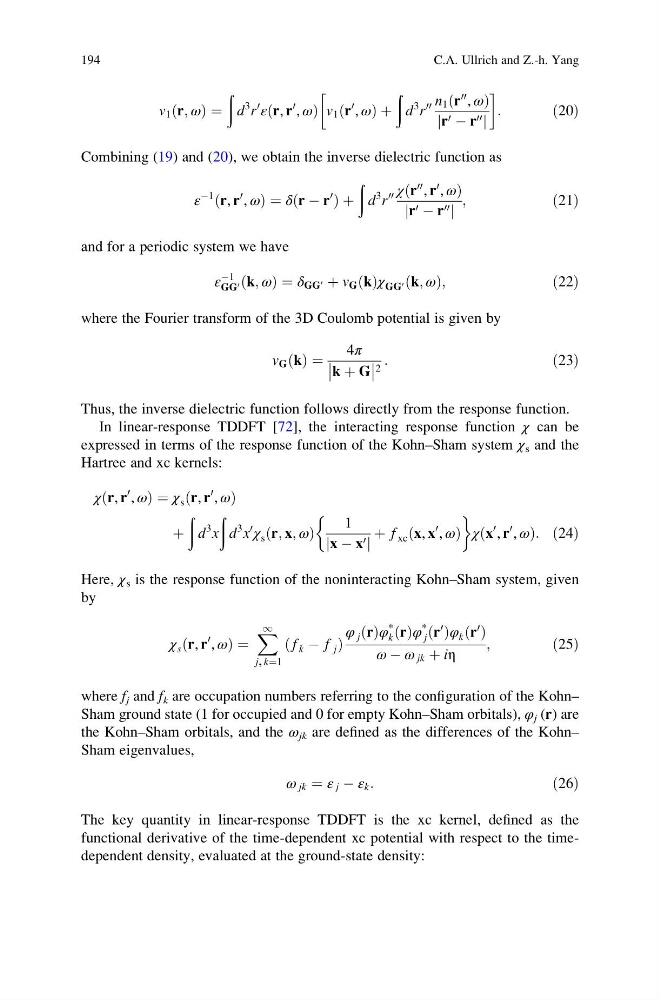
Combining (19) and (20), we obtain the inverse dielectric function as
ε
À1 r, r
0 , ω
ð
Þ¼δ r À r
0
ð
Þþ
ð
d
3 r
00 χðr
00 , r
0 , ωÞ
r 0 À r 00
j
j
;
ð21Þ
and for a periodic system we have
ε
À1
GG 0 k; ω
ð
Þ ¼ δ GG 0 þ v G k
ð Þχ GG 0 k; ω
ð
Þ;
ð22Þ
where the Fourier transform of the 3D Coulomb potential is given by
v G k
ð Þ ¼
4π
k þ G
2 :
ð23Þ
Thus, the inverse dielectric function follows directly from the response function.
In linear-response TDDFT [72], the interacting response function χ can be
expressed in terms of the response function of the Kohn–Sham system χ s and the
Hartree and xc kernels:
χ r, r
0 , ω
ð
Þ¼χ s r, r
0 , ω
ð
Þ
þ
ð
d
3 x
ð
d
3 x
0
χ s r; x; ω
ð
Þ
1
x À x 0
j
j
þ f xc x, x
0 , ω
ð
Þ
&
'
χ x
0 , r
0 , ω
ð
Þ: ð24Þ
Here, χ s is the response function of the noninteracting Kohn–Sham system, given
by
χ s r, r
0 , ω
ð
Þ¼
X 1
j, k¼1
ð f k À f j Þ
φ j r
ð Þφ
*
k r
ð Þφ
*
j r
0
ð Þφ k r
0
ð Þ
ω À ω jk þ iη
;
ð25Þ
where f j and f k are occupation numbers referring to the configuration of the Kohn–
Sham ground state (1 for occupied and 0 for empty Kohn–Sham orbitals), φ j (r) are
the Kohn–Sham orbitals, and the ω jk are defined as the differences of the Kohn–
Sham eigenvalues,
ω jk ¼ ε j À ε k :
ð26Þ
The key quantity in linear-response TDDFT is the xc kernel, defined as the
functional derivative of the time-dependent xc potential with respect to the timedependent density, evaluated at the ground-state density:
194
C.A. Ullrich and Z.-h. Yang
ð
Þ ¼
ð
d
3 r
0
ε r, r
0 , ω
ð
Þ v 1 r
0 , ω
ð
Þþ
ð
d
3 r
00 n 1 ðr
00 , ωÞ
r 0 À r 00
j
j
!
:
ð20Þ
Combining (19) and (20), we obtain the inverse dielectric function as
ε
À1 r, r
0 , ω
ð
Þ¼δ r À r
0
ð
Þþ
ð
d
3 r
00 χðr
00 , r
0 , ωÞ
r 0 À r 00
j
j
;
ð21Þ
and for a periodic system we have
ε
À1
GG 0 k; ω
ð
Þ ¼ δ GG 0 þ v G k
ð Þχ GG 0 k; ω
ð
Þ;
ð22Þ
where the Fourier transform of the 3D Coulomb potential is given by
v G k
ð Þ ¼
4π
k þ G
2 :
ð23Þ
Thus, the inverse dielectric function follows directly from the response function.
In linear-response TDDFT [72], the interacting response function χ can be
expressed in terms of the response function of the Kohn–Sham system χ s and the
Hartree and xc kernels:
χ r, r
0 , ω
ð
Þ¼χ s r, r
0 , ω
ð
Þ
þ
ð
d
3 x
ð
d
3 x
0
χ s r; x; ω
ð
Þ
1
x À x 0
j
j
þ f xc x, x
0 , ω
ð
Þ
&
'
χ x
0 , r
0 , ω
ð
Þ: ð24Þ
Here, χ s is the response function of the noninteracting Kohn–Sham system, given
by
χ s r, r
0 , ω
ð
Þ¼
X 1
j, k¼1
ð f k À f j Þ
φ j r
ð Þφ
*
k r
ð Þφ
*
j r
0
ð Þφ k r
0
ð Þ
ω À ω jk þ iη
;
ð25Þ
where f j and f k are occupation numbers referring to the configuration of the Kohn–
Sham ground state (1 for occupied and 0 for empty Kohn–Sham orbitals), φ j (r) are
the Kohn–Sham orbitals, and the ω jk are defined as the differences of the Kohn–
Sham eigenvalues,
ω jk ¼ ε j À ε k :
ð26Þ
The key quantity in linear-response TDDFT is the xc kernel, defined as the
functional derivative of the time-dependent xc potential with respect to the timedependent density, evaluated at the ground-state density:
194
C.A. Ullrich and Z.-h. Yang