

In the following we restrict the discussion to crystals with cubic symmetry
because this leads to the considerable simplification that the dielectric tensor
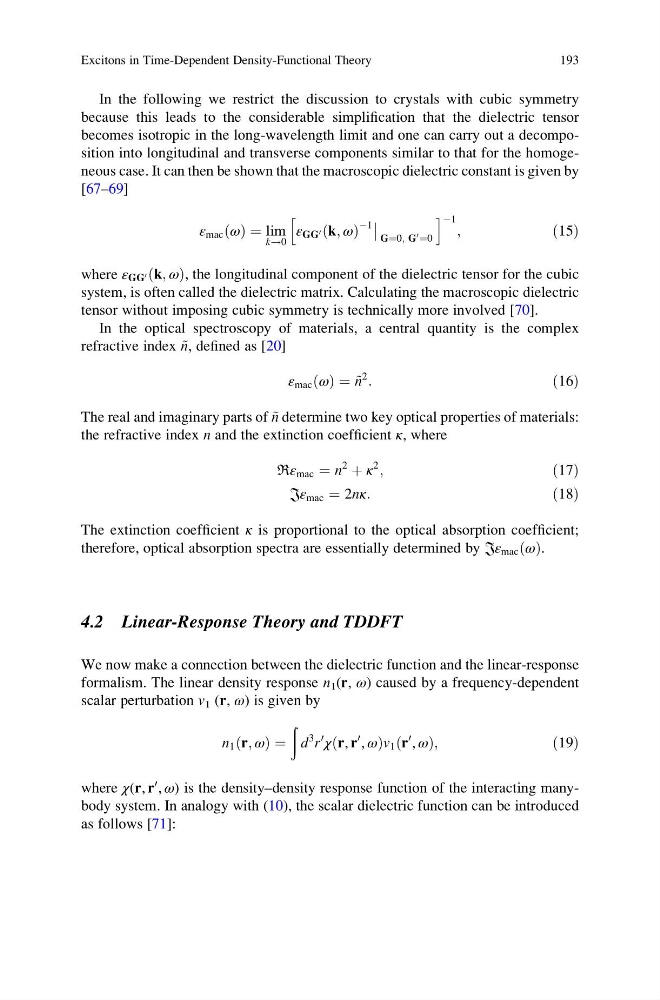
becomes isotropic in the long-wavelength limit and one can carry out a decomposition into longitudinal and transverse components similar to that for the homogeneous case. It can then be shown that the macroscopic dielectric constant is given by
[67–69]
ε mac ω
ð Þ ¼ lim
k!0
ε GG 0 k; ω
ð
Þ
À1
G¼0; G
0 ¼0
h
i À1 ;
ð15Þ
where ε GG 0 k; ω
ð
Þ, the longitudinal component of the dielectric tensor for the cubic
system, is often called the dielectric matrix. Calculating the macroscopic dielectric
tensor without imposing cubic symmetry is technically more involved [70].
In the optical spectroscopy of materials, a central quantity is the complex
refractive index ~
n, defined as [20]
ε mac ω
ð Þ ¼ ~
n
2
:
ð16Þ
The real and imaginary parts of ~
n determine two key optical properties of materials:
the refractive index n and the extinction coefficient κ, where
ℜε mac ¼ n
2
þ κ
2
;
ð17Þ
Jε mac ¼ 2nκ:
ð18Þ
The extinction coefficient κ is proportional to the optical absorption coefficient;
therefore, optical absorption spectra are essentially determined by Jε mac ω
ð Þ.
4.2 Linear-Response Theory and TDDFT
We now make a connection between the dielectric function and the linear-response
formalism. The linear density response n 1 (r, ω) caused by a frequency-dependent
scalar perturbation v 1 (r, ω) is given by
n 1 r; ω
ð
Þ ¼
ð
d
3 r
0
χðr, r
0 , ωÞv 1 ðr
0 , ωÞ;
ð19Þ
where χ(r, r
0 , ω) is the density–density response function of the interacting manybody system. In analogy with (10), the scalar dielectric function can be introduced
as follows [71]:
Excitons in Time-Dependent Density-Functional Theory
193
because this leads to the considerable simplification that the dielectric tensor
becomes isotropic in the long-wavelength limit and one can carry out a decomposition into longitudinal and transverse components similar to that for the homogeneous case. It can then be shown that the macroscopic dielectric constant is given by
[67–69]
ε mac ω
ð Þ ¼ lim
k!0
ε GG 0 k; ω
ð
Þ
À1
G¼0; G
0 ¼0
h
i À1 ;
ð15Þ
where ε GG 0 k; ω
ð
Þ, the longitudinal component of the dielectric tensor for the cubic
system, is often called the dielectric matrix. Calculating the macroscopic dielectric
tensor without imposing cubic symmetry is technically more involved [70].
In the optical spectroscopy of materials, a central quantity is the complex
refractive index ~
n, defined as [20]
ε mac ω
ð Þ ¼ ~
n
2
:
ð16Þ
The real and imaginary parts of ~
n determine two key optical properties of materials:
the refractive index n and the extinction coefficient κ, where
ℜε mac ¼ n
2
þ κ
2
;
ð17Þ
Jε mac ¼ 2nκ:
ð18Þ
The extinction coefficient κ is proportional to the optical absorption coefficient;
therefore, optical absorption spectra are essentially determined by Jε mac ω
ð Þ.
4.2 Linear-Response Theory and TDDFT
We now make a connection between the dielectric function and the linear-response
formalism. The linear density response n 1 (r, ω) caused by a frequency-dependent
scalar perturbation v 1 (r, ω) is given by
n 1 r; ω
ð
Þ ¼
ð
d
3 r
0
χðr, r
0 , ωÞv 1 ðr
0 , ωÞ;
ð19Þ
where χ(r, r
0 , ω) is the density–density response function of the interacting manybody system. In analogy with (10), the scalar dielectric function can be introduced
as follows [71]:
Excitons in Time-Dependent Density-Functional Theory
193