

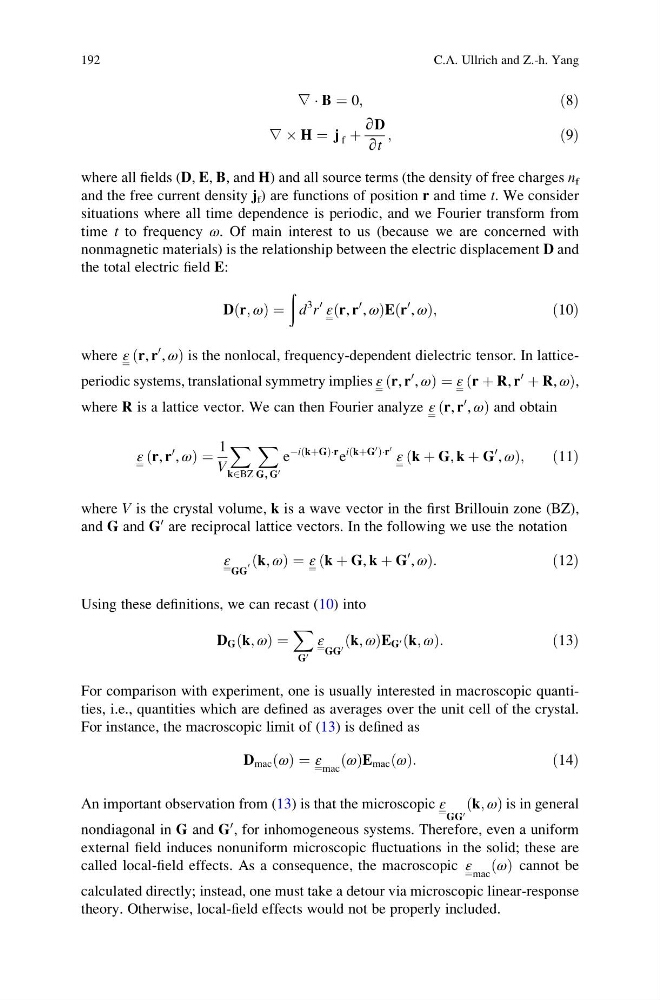
∇ Á B ¼ 0;
ð8Þ
∇ Â H ¼ j f þ
∂D
∂t
;
ð9Þ
where all fields (D, E, B, and H) and all source terms (the density of free charges n f
and the free current density j f ) are functions of position r and time t. We consider
situations where all time dependence is periodic, and we Fourier transform from
time t to frequency ω. Of main interest to us (because we are concerned with
nonmagnetic materials) is the relationship between the electric displacement D and
the total electric field E:
D r; ω
ð
Þ ¼
ð
d
3 r
0
ε
¼
ðr, r
0 , ωÞEðr
0 , ωÞ;
ð10Þ
where ε
¼
ðr, r
0 , ωÞ is the nonlocal, frequency-dependent dielectric tensor. In latticeperiodic systems, translational symmetry implies ε
¼
ðr, r
0 , ωÞ ¼ ε
¼
ðr þ R, r
0
þ R, ωÞ,
where R is a lattice vector. We can then Fourier analyze ε
¼
ðr, r
0 , ωÞ and obtain
ε
¼
r, r
0 , ω
ð
Þ¼
1
V
X
k2BZ
X
G, G 0
e
Ài kþG
ð
Þ Á r e
i kþG
0
ð
Þ Á r
0 ε
¼
k þ G, k þ G
0 , ω
ð
Þ ;
ð11Þ
where V is the crystal volume, k is a wave vector in the first Brillouin zone (BZ),
and G and G
0 are reciprocal lattice vectors. In the following we use the notation
ε
¼ GG
0 k; ω
ð
Þ ¼ ε
¼
k þ G, k þ G
0 , ω
ð
Þ :
ð12Þ
Using these definitions, we can recast (10) into
D G k; ω
ð
Þ ¼
X
G 0
ε
¼ GG 0
k; ω
ð
ÞE G 0 k; ω
ð
Þ:
ð13Þ
For comparison with experiment, one is usually interested in macroscopic quantities, i.e., quantities which are defined as averages over the unit cell of the crystal.
For instance, the macroscopic limit of (13) is defined as
D mac ω
ð Þ ¼ ε
¼mac
ω
ð ÞE mac ω
ð Þ:
ð14Þ
An important observation from (13) is that the microscopic ε
¼ GG 0
k; ω
ð
Þis in general
nondiagonal in G and G
0 , for inhomogeneous systems. Therefore, even a uniform
external field induces nonuniform microscopic fluctuations in the solid; these are
called local-field effects. As a consequence, the macroscopic ε
¼mac
ω
ð Þ cannot be
calculated directly; instead, one must take a detour via microscopic linear-response
theory. Otherwise, local-field effects would not be properly included.
192
C.A. Ullrich and Z.-h. Yang
ð8Þ
∇ Â H ¼ j f þ
∂D
∂t
;
ð9Þ
where all fields (D, E, B, and H) and all source terms (the density of free charges n f
and the free current density j f ) are functions of position r and time t. We consider
situations where all time dependence is periodic, and we Fourier transform from
time t to frequency ω. Of main interest to us (because we are concerned with
nonmagnetic materials) is the relationship between the electric displacement D and
the total electric field E:
D r; ω
ð
Þ ¼
ð
d
3 r
0
ε
¼
ðr, r
0 , ωÞEðr
0 , ωÞ;
ð10Þ
where ε
¼
ðr, r
0 , ωÞ is the nonlocal, frequency-dependent dielectric tensor. In latticeperiodic systems, translational symmetry implies ε
¼
ðr, r
0 , ωÞ ¼ ε
¼
ðr þ R, r
0
þ R, ωÞ,
where R is a lattice vector. We can then Fourier analyze ε
¼
ðr, r
0 , ωÞ and obtain
ε
¼
r, r
0 , ω
ð
Þ¼
1
V
X
k2BZ
X
G, G 0
e
Ài kþG
ð
Þ Á r e
i kþG
0
ð
Þ Á r
0 ε
¼
k þ G, k þ G
0 , ω
ð
Þ ;
ð11Þ
where V is the crystal volume, k is a wave vector in the first Brillouin zone (BZ),
and G and G
0 are reciprocal lattice vectors. In the following we use the notation
ε
¼ GG
0 k; ω
ð
Þ ¼ ε
¼
k þ G, k þ G
0 , ω
ð
Þ :
ð12Þ
Using these definitions, we can recast (10) into
D G k; ω
ð
Þ ¼
X
G 0
ε
¼ GG 0
k; ω
ð
ÞE G 0 k; ω
ð
Þ:
ð13Þ
For comparison with experiment, one is usually interested in macroscopic quantities, i.e., quantities which are defined as averages over the unit cell of the crystal.
For instance, the macroscopic limit of (13) is defined as
D mac ω
ð Þ ¼ ε
¼mac
ω
ð ÞE mac ω
ð Þ:
ð14Þ
An important observation from (13) is that the microscopic ε
¼ GG 0
k; ω
ð
Þis in general
nondiagonal in G and G
0 , for inhomogeneous systems. Therefore, even a uniform
external field induces nonuniform microscopic fluctuations in the solid; these are
called local-field effects. As a consequence, the macroscopic ε
¼mac
ω
ð Þ cannot be
calculated directly; instead, one must take a detour via microscopic linear-response
theory. Otherwise, local-field effects would not be properly included.
192
C.A. Ullrich and Z.-h. Yang