

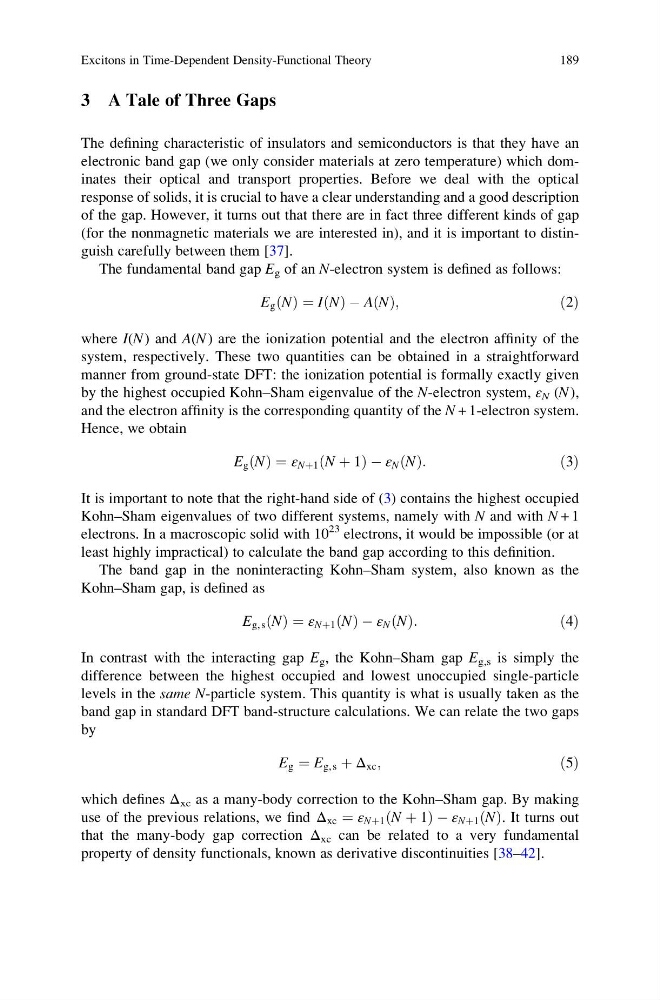
3 A Tale of Three Gaps
The defining characteristic of insulators and semiconductors is that they have an
electronic band gap (we only consider materials at zero temperature) which dominates their optical and transport properties. Before we deal with the optical
response of solids, it is crucial to have a clear understanding and a good description
of the gap. However, it turns out that there are in fact three different kinds of gap
(for the nonmagnetic materials we are interested in), and it is important to distinguish carefully between them [37].
The fundamental band gap E g of an N-electron system is defined as follows:
E g N
ð Þ ¼ I N
ð Þ À A N
ð Þ;
ð2Þ
where I(N ) and A(N ) are the ionization potential and the electron affinity of the
system, respectively. These two quantities can be obtained in a straightforward
manner from ground-state DFT: the ionization potential is formally exactly given
by the highest occupied Kohn–Sham eigenvalue of the N-electron system, ε N (N ),
and the electron affinity is the corresponding quantity of the N + 1-electron system.
Hence, we obtain
E g N
ð Þ ¼ ε Nþ1 N þ 1
ð
ÞÀε N N
ð Þ:
ð3Þ
It is important to note that the right-hand side of (3) contains the highest occupied
Kohn–Sham eigenvalues of two different systems, namely with N and with N + 1
electrons. In a macroscopic solid with 10
23 electrons, it would be impossible (or at
least highly impractical) to calculate the band gap according to this definition.
The band gap in the noninteracting Kohn–Sham system, also known as the
Kohn–Sham gap, is defined as
E g, s N
ð Þ ¼ ε Nþ1 N
ð Þ À ε N N
ð Þ:
ð4Þ
In contrast with the interacting gap E g , the Kohn–Sham gap E g,s is simply the
difference between the highest occupied and lowest unoccupied single-particle
levels in the same N-particle system. This quantity is what is usually taken as the
band gap in standard DFT band-structure calculations. We can relate the two gaps
by
E g ¼ E g, s þ Δ xc ;
ð5Þ
which defines Δ xc as a many-body correction to the Kohn–Sham gap. By making
use of the previous relations, we find Δ xc ¼ ε Nþ1 N þ 1
ð
ÞÀε Nþ1 N
ð Þ. It turns out
that the many-body gap correction Δ xc can be related to a very fundamental
property of density functionals, known as derivative discontinuities [38–42].
Excitons in Time-Dependent Density-Functional Theory
189
The defining characteristic of insulators and semiconductors is that they have an
electronic band gap (we only consider materials at zero temperature) which dominates their optical and transport properties. Before we deal with the optical
response of solids, it is crucial to have a clear understanding and a good description
of the gap. However, it turns out that there are in fact three different kinds of gap
(for the nonmagnetic materials we are interested in), and it is important to distinguish carefully between them [37].
The fundamental band gap E g of an N-electron system is defined as follows:
E g N
ð Þ ¼ I N
ð Þ À A N
ð Þ;
ð2Þ
where I(N ) and A(N ) are the ionization potential and the electron affinity of the
system, respectively. These two quantities can be obtained in a straightforward
manner from ground-state DFT: the ionization potential is formally exactly given
by the highest occupied Kohn–Sham eigenvalue of the N-electron system, ε N (N ),
and the electron affinity is the corresponding quantity of the N + 1-electron system.
Hence, we obtain
E g N
ð Þ ¼ ε Nþ1 N þ 1
ð
ÞÀε N N
ð Þ:
ð3Þ
It is important to note that the right-hand side of (3) contains the highest occupied
Kohn–Sham eigenvalues of two different systems, namely with N and with N + 1
electrons. In a macroscopic solid with 10
23 electrons, it would be impossible (or at
least highly impractical) to calculate the band gap according to this definition.
The band gap in the noninteracting Kohn–Sham system, also known as the
Kohn–Sham gap, is defined as
E g, s N
ð Þ ¼ ε Nþ1 N
ð Þ À ε N N
ð Þ:
ð4Þ
In contrast with the interacting gap E g , the Kohn–Sham gap E g,s is simply the
difference between the highest occupied and lowest unoccupied single-particle
levels in the same N-particle system. This quantity is what is usually taken as the
band gap in standard DFT band-structure calculations. We can relate the two gaps
by
E g ¼ E g, s þ Δ xc ;
ð5Þ
which defines Δ xc as a many-body correction to the Kohn–Sham gap. By making
use of the previous relations, we find Δ xc ¼ ε Nþ1 N þ 1
ð
ÞÀε Nþ1 N
ð Þ. It turns out
that the many-body gap correction Δ xc can be related to a very fundamental
property of density functionals, known as derivative discontinuities [38–42].
Excitons in Time-Dependent Density-Functional Theory
189