

The so-called band-gap problem of DFT reflects the fact that in practice E g,s is
often a poor approximation to E g , typically underestimating the exact band gap by
as much as 50%. The reason for this is twofold: commonly used approximate xc
functionals (such as LDA and GGA) tend to underestimate the exact Kohn–Sham
gap E g,s , and they do not yield any discontinuity correction Δ xc . An extreme
example for the second failure is Mott insulators, which are typically predicted to
be metallic by DFT. This is no accident: in Mott insulators, the exact Kohn–Sham
system is metallic (i.e., E g,s ¼ 0) so that E g ¼ Δ xc . Clearly, standard xc functionals
(where Δ xc vanishes) are unfit to describe Mott insulators.
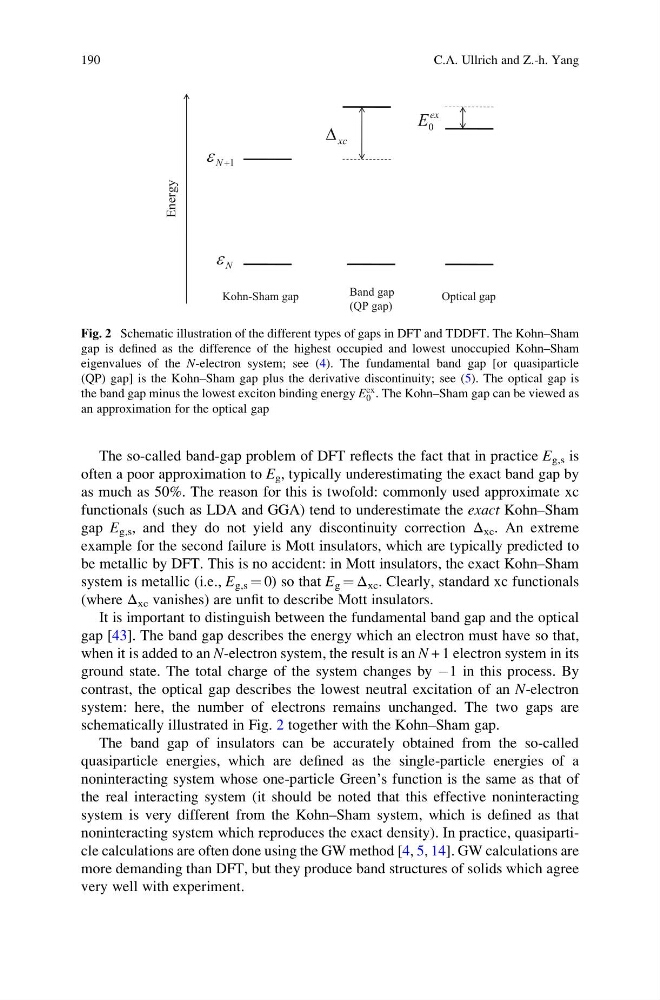
It is important to distinguish between the fundamental band gap and the optical
gap [43]. The band gap describes the energy which an electron must have so that,
when it is added to an N-electron system, the result is an N + 1 electron system in its
ground state. The total charge of the system changes by À1 in this process. By
contrast, the optical gap describes the lowest neutral excitation of an N-electron
system: here, the number of electrons remains unchanged. The two gaps are
schematically illustrated in Fig. 2 together with the Kohn–Sham gap.
The band gap of insulators can be accurately obtained from the so-called
quasiparticle energies, which are defined as the single-particle energies of a
noninteracting system whose one-particle Green’s function is the same as that of
the real interacting system (it should be noted that this effective noninteracting
system is very different from the Kohn–Sham system, which is defined as that
noninteracting system which reproduces the exact density). In practice, quasiparticle calculations are often done using the GW method [4, 5, 14]. GW calculations are
more demanding than DFT, but they produce band structures of solids which agree
very well with experiment.
Energy
N
1
N
Kohn-Sham gap
xc
Band gap
(QP gap)
Optical gap
ex
E 0
Fig. 2 Schematic illustration of the different types of gaps in DFT and TDDFT. The Kohn–Sham
gap is defined as the difference of the highest occupied and lowest unoccupied Kohn–Sham
eigenvalues of the N-electron system; see (4). The fundamental band gap [or quasiparticle
(QP) gap] is the Kohn–Sham gap plus the derivative discontinuity; see (5). The optical gap is
the band gap minus the lowest exciton binding energy E
ex
0 . The Kohn–Sham gap can be viewed as
an approximation for the optical gap
190
C.A. Ullrich and Z.-h. Yang
often a poor approximation to E g , typically underestimating the exact band gap by
as much as 50%. The reason for this is twofold: commonly used approximate xc
functionals (such as LDA and GGA) tend to underestimate the exact Kohn–Sham
gap E g,s , and they do not yield any discontinuity correction Δ xc . An extreme
example for the second failure is Mott insulators, which are typically predicted to
be metallic by DFT. This is no accident: in Mott insulators, the exact Kohn–Sham
system is metallic (i.e., E g,s ¼ 0) so that E g ¼ Δ xc . Clearly, standard xc functionals
(where Δ xc vanishes) are unfit to describe Mott insulators.
It is important to distinguish between the fundamental band gap and the optical
gap [43]. The band gap describes the energy which an electron must have so that,
when it is added to an N-electron system, the result is an N + 1 electron system in its
ground state. The total charge of the system changes by À1 in this process. By
contrast, the optical gap describes the lowest neutral excitation of an N-electron
system: here, the number of electrons remains unchanged. The two gaps are
schematically illustrated in Fig. 2 together with the Kohn–Sham gap.
The band gap of insulators can be accurately obtained from the so-called
quasiparticle energies, which are defined as the single-particle energies of a
noninteracting system whose one-particle Green’s function is the same as that of
the real interacting system (it should be noted that this effective noninteracting
system is very different from the Kohn–Sham system, which is defined as that
noninteracting system which reproduces the exact density). In practice, quasiparticle calculations are often done using the GW method [4, 5, 14]. GW calculations are
more demanding than DFT, but they produce band structures of solids which agree
very well with experiment.
Energy
N
1
N
Kohn-Sham gap
xc
Band gap
(QP gap)
Optical gap
ex
E 0
Fig. 2 Schematic illustration of the different types of gaps in DFT and TDDFT. The Kohn–Sham
gap is defined as the difference of the highest occupied and lowest unoccupied Kohn–Sham
eigenvalues of the N-electron system; see (4). The fundamental band gap [or quasiparticle
(QP) gap] is the Kohn–Sham gap plus the derivative discontinuity; see (5). The optical gap is
the band gap minus the lowest exciton binding energy E
ex
0 . The Kohn–Sham gap can be viewed as
an approximation for the optical gap
190
C.A. Ullrich and Z.-h. Yang