

Here, ε 0 is the vacuum permittivity, e is the free electron charge, and ε is the
dielectric constant of the material (we talk about the dielectric constant in greater
detail in the following section). Equation (1) is also known as the Wannier equation.
It yields a Rydberg series of bound states as well as a continuum of unbound states
[36]. The lowest (1s) excitonic state determines the exciton binding energy E
ex
0 and
the exciton Bohr radius a
Ã
0 . In GaAs, a material in which the Wannier equation
works particularly well, one obtains E
ex
0 ¼ 4:6 meV and a
*
0 ¼ 118 Å, which clearly
shows that Wannier excitons are weakly bound and extend over many lattice
constants which, a posteriori, justifies the simplified treatment via (1).
The Wannier picture of excitons as bound electron–hole pairs, described by (1),
is generally not quantitatively accurate, and breaks down completely if the exciton
radius becomes comparable to a lattice constant. In this chapter we present an ab
initio approach, based on TDDFT and/or other many-body techniques, which is
universally valid and in principle exact. This approach reveals an alternative point
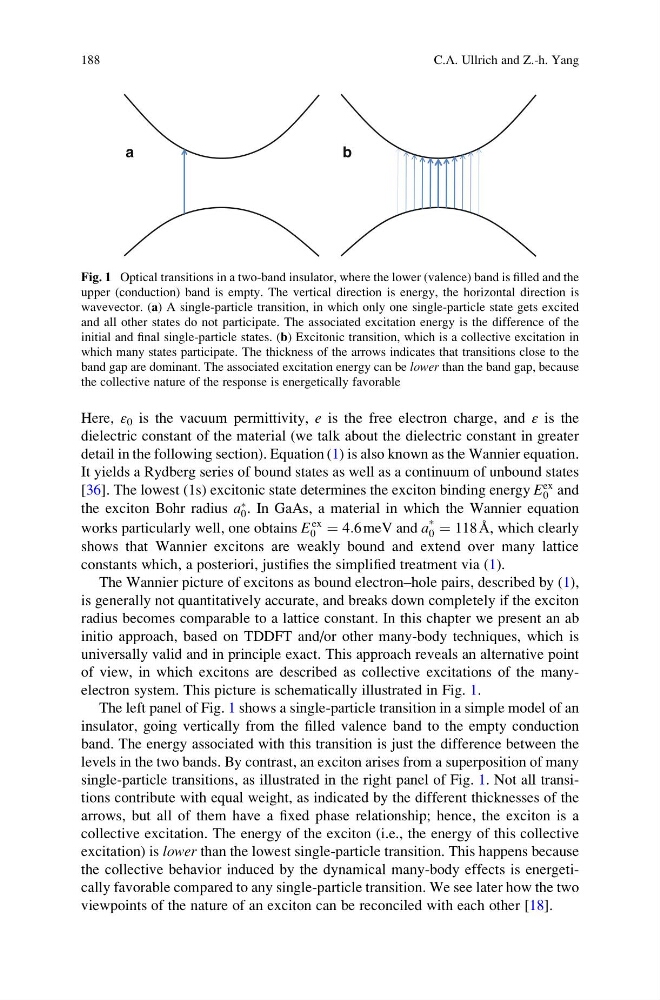
of view, in which excitons are described as collective excitations of the manyelectron system. This picture is schematically illustrated in Fig. 1.
The left panel of Fig. 1 shows a single-particle transition in a simple model of an
insulator, going vertically from the filled valence band to the empty conduction
band. The energy associated with this transition is just the difference between the
levels in the two bands. By contrast, an exciton arises from a superposition of many
single-particle transitions, as illustrated in the right panel of Fig. 1. Not all transitions contribute with equal weight, as indicated by the different thicknesses of the
arrows, but all of them have a fixed phase relationship; hence, the exciton is a
collective excitation. The energy of the exciton (i.e., the energy of this collective
excitation) is lower than the lowest single-particle transition. This happens because
the collective behavior induced by the dynamical many-body effects is energetically favorable compared to any single-particle transition. We see later how the two
viewpoints of the nature of an exciton can be reconciled with each other [18].
a
b
Fig. 1 Optical transitions in a two-band insulator, where the lower (valence) band is filled and the
upper (conduction) band is empty. The vertical direction is energy, the horizontal direction is
wavevector. (a) A single-particle transition, in which only one single-particle state gets excited
and all other states do not participate. The associated excitation energy is the difference of the
initial and final single-particle states. (b) Excitonic transition, which is a collective excitation in
which many states participate. The thickness of the arrows indicates that transitions close to the
band gap are dominant. The associated excitation energy can be lower than the band gap, because
the collective nature of the response is energetically favorable
188
C.A. Ullrich and Z.-h. Yang
dielectric constant of the material (we talk about the dielectric constant in greater
detail in the following section). Equation (1) is also known as the Wannier equation.
It yields a Rydberg series of bound states as well as a continuum of unbound states
[36]. The lowest (1s) excitonic state determines the exciton binding energy E
ex
0 and
the exciton Bohr radius a
Ã
0 . In GaAs, a material in which the Wannier equation
works particularly well, one obtains E
ex
0 ¼ 4:6 meV and a
*
0 ¼ 118 Å, which clearly
shows that Wannier excitons are weakly bound and extend over many lattice
constants which, a posteriori, justifies the simplified treatment via (1).
The Wannier picture of excitons as bound electron–hole pairs, described by (1),
is generally not quantitatively accurate, and breaks down completely if the exciton
radius becomes comparable to a lattice constant. In this chapter we present an ab
initio approach, based on TDDFT and/or other many-body techniques, which is
universally valid and in principle exact. This approach reveals an alternative point
of view, in which excitons are described as collective excitations of the manyelectron system. This picture is schematically illustrated in Fig. 1.
The left panel of Fig. 1 shows a single-particle transition in a simple model of an
insulator, going vertically from the filled valence band to the empty conduction
band. The energy associated with this transition is just the difference between the
levels in the two bands. By contrast, an exciton arises from a superposition of many
single-particle transitions, as illustrated in the right panel of Fig. 1. Not all transitions contribute with equal weight, as indicated by the different thicknesses of the
arrows, but all of them have a fixed phase relationship; hence, the exciton is a
collective excitation. The energy of the exciton (i.e., the energy of this collective
excitation) is lower than the lowest single-particle transition. This happens because
the collective behavior induced by the dynamical many-body effects is energetically favorable compared to any single-particle transition. We see later how the two
viewpoints of the nature of an exciton can be reconciled with each other [18].
a
b
Fig. 1 Optical transitions in a two-band insulator, where the lower (valence) band is filled and the
upper (conduction) band is empty. The vertical direction is energy, the horizontal direction is
wavevector. (a) A single-particle transition, in which only one single-particle state gets excited
and all other states do not participate. The associated excitation energy is the difference of the
initial and final single-particle states. (b) Excitonic transition, which is a collective excitation in
which many states participate. The thickness of the arrows indicates that transitions close to the
band gap are dominant. The associated excitation energy can be lower than the band gap, because
the collective nature of the response is energetically favorable
188
C.A. Ullrich and Z.-h. Yang