

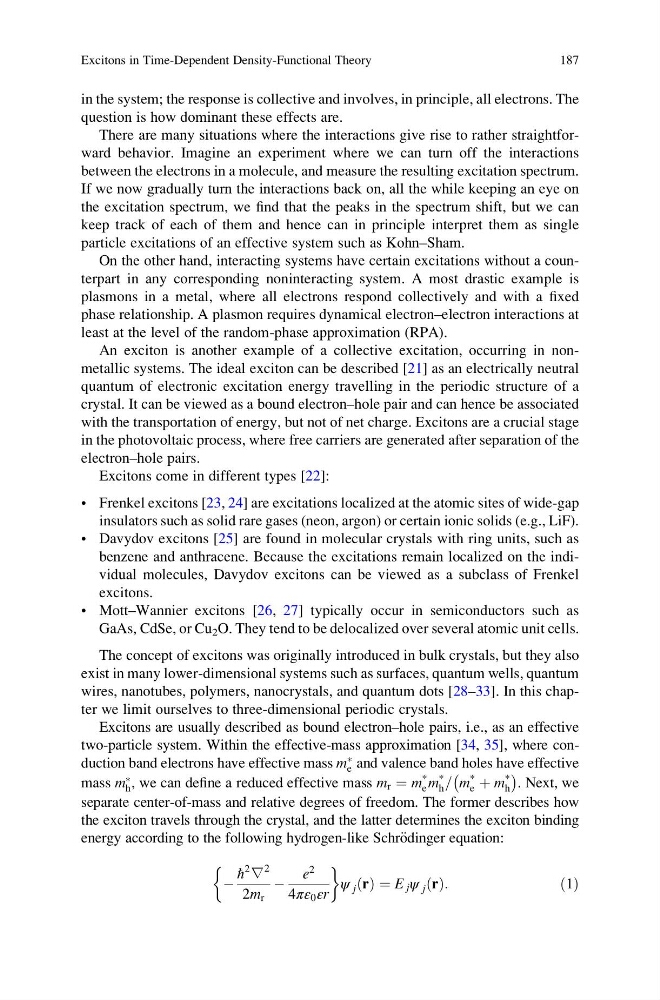
in the system; the response is collective and involves, in principle, all electrons. The
question is how dominant these effects are.
There are many situations where the interactions give rise to rather straightforward behavior. Imagine an experiment where we can turn off the interactions
between the electrons in a molecule, and measure the resulting excitation spectrum.
If we now gradually turn the interactions back on, all the while keeping an eye on
the excitation spectrum, we find that the peaks in the spectrum shift, but we can
keep track of each of them and hence can in principle interpret them as single
particle excitations of an effective system such as Kohn–Sham.
On the other hand, interacting systems have certain excitations without a counterpart in any corresponding noninteracting system. A most drastic example is
plasmons in a metal, where all electrons respond collectively and with a fixed
phase relationship. A plasmon requires dynamical electron–electron interactions at
least at the level of the random-phase approximation (RPA).
An exciton is another example of a collective excitation, occurring in nonmetallic systems. The ideal exciton can be described [21] as an electrically neutral
quantum of electronic excitation energy travelling in the periodic structure of a
crystal. It can be viewed as a bound electron–hole pair and can hence be associated
with the transportation of energy, but not of net charge. Excitons are a crucial stage
in the photovoltaic process, where free carriers are generated after separation of the
electron–hole pairs.
Excitons come in different types [22]:
• Frenkel excitons [23, 24] are excitations localized at the atomic sites of wide-gap
insulators such as solid rare gases (neon, argon) or certain ionic solids (e.g., LiF).
• Davydov excitons [25] are found in molecular crystals with ring units, such as
benzene and anthracene. Because the excitations remain localized on the individual molecules, Davydov excitons can be viewed as a subclass of Frenkel
excitons.
• Mott–Wannier excitons [26, 27] typically occur in semiconductors such as
GaAs, CdSe, or Cu 2 O. They tend to be delocalized over several atomic unit cells.
The concept of excitons was originally introduced in bulk crystals, but they also
exist in many lower-dimensional systems such as surfaces, quantum wells, quantum
wires, nanotubes, polymers, nanocrystals, and quantum dots [28–33]. In this chapter we limit ourselves to three-dimensional periodic crystals.
Excitons are usually described as bound electron–hole pairs, i.e., as an effective
two-particle system. Within the effective-mass approximation [34, 35], where conduction band electrons have effective mass m
Ã
e and valence band holes have effective
mass m
Ã
h , we can define a reduced effective mass m r ¼ m
*
e m
*
h = m
*
e þ m
*
h
À
Á
. Next, we
separate center-of-mass and relative degrees of freedom. The former describes how
the exciton travels through the crystal, and the latter determines the exciton binding
energy according to the following hydrogen-like Schr€ odinger equation:
À
ℏ
2
∇
2
2m r
À
e
2
4πε 0 εr
&
'
ψ j r
ð Þ ¼ E j ψ j r
ð Þ:
ð1Þ
Excitons in Time-Dependent Density-Functional Theory
187
question is how dominant these effects are.
There are many situations where the interactions give rise to rather straightforward behavior. Imagine an experiment where we can turn off the interactions
between the electrons in a molecule, and measure the resulting excitation spectrum.
If we now gradually turn the interactions back on, all the while keeping an eye on
the excitation spectrum, we find that the peaks in the spectrum shift, but we can
keep track of each of them and hence can in principle interpret them as single
particle excitations of an effective system such as Kohn–Sham.
On the other hand, interacting systems have certain excitations without a counterpart in any corresponding noninteracting system. A most drastic example is
plasmons in a metal, where all electrons respond collectively and with a fixed
phase relationship. A plasmon requires dynamical electron–electron interactions at
least at the level of the random-phase approximation (RPA).
An exciton is another example of a collective excitation, occurring in nonmetallic systems. The ideal exciton can be described [21] as an electrically neutral
quantum of electronic excitation energy travelling in the periodic structure of a
crystal. It can be viewed as a bound electron–hole pair and can hence be associated
with the transportation of energy, but not of net charge. Excitons are a crucial stage
in the photovoltaic process, where free carriers are generated after separation of the
electron–hole pairs.
Excitons come in different types [22]:
• Frenkel excitons [23, 24] are excitations localized at the atomic sites of wide-gap
insulators such as solid rare gases (neon, argon) or certain ionic solids (e.g., LiF).
• Davydov excitons [25] are found in molecular crystals with ring units, such as
benzene and anthracene. Because the excitations remain localized on the individual molecules, Davydov excitons can be viewed as a subclass of Frenkel
excitons.
• Mott–Wannier excitons [26, 27] typically occur in semiconductors such as
GaAs, CdSe, or Cu 2 O. They tend to be delocalized over several atomic unit cells.
The concept of excitons was originally introduced in bulk crystals, but they also
exist in many lower-dimensional systems such as surfaces, quantum wells, quantum
wires, nanotubes, polymers, nanocrystals, and quantum dots [28–33]. In this chapter we limit ourselves to three-dimensional periodic crystals.
Excitons are usually described as bound electron–hole pairs, i.e., as an effective
two-particle system. Within the effective-mass approximation [34, 35], where conduction band electrons have effective mass m
Ã
e and valence band holes have effective
mass m
Ã
h , we can define a reduced effective mass m r ¼ m
*
e m
*
h = m
*
e þ m
*
h
À
Á
. Next, we
separate center-of-mass and relative degrees of freedom. The former describes how
the exciton travels through the crystal, and the latter determines the exciton binding
energy according to the following hydrogen-like Schr€ odinger equation:
À
ℏ
2
∇
2
2m r
À
e
2
4πε 0 εr
&
'
ψ j r
ð Þ ¼ E j ψ j r
ð Þ:
ð1Þ
Excitons in Time-Dependent Density-Functional Theory
187