

theorem then states that only the last occupied degenerate orbitals may be fractionally occupied (see, e.g., [12] pp. 55–56). Suitable algorithms are rare, as
maintaining this condition can lead to degenerate orbitals having different occupation numbers which, in turn, may require minimizing the energy with respect to
unitary transformations within the space spanned by the degenerate occupied
orbitals with different occupation numbers. These points have been previously
discussed in somewhat greater detail in [8]. Most programs show at least an
effective failure of NVR when using approximate functionals, in particular around
regions of strong electron correlation, such as where bonds are being made or
broken (e.g., avoided crossing of the S 0 surfaces in Fig. 1) which often shows up as
self-consistent field (SCF) convergence failures.
As no practical exact form of E xc is known, it must be approximated in practice.
In the original papers, E xc should depend only upon the charge density. However
our notation already reflects the modern tendency to allow a spin-dependence in E xc
(spin-DFT). This additional degree of freedom makes it easier to develop improved
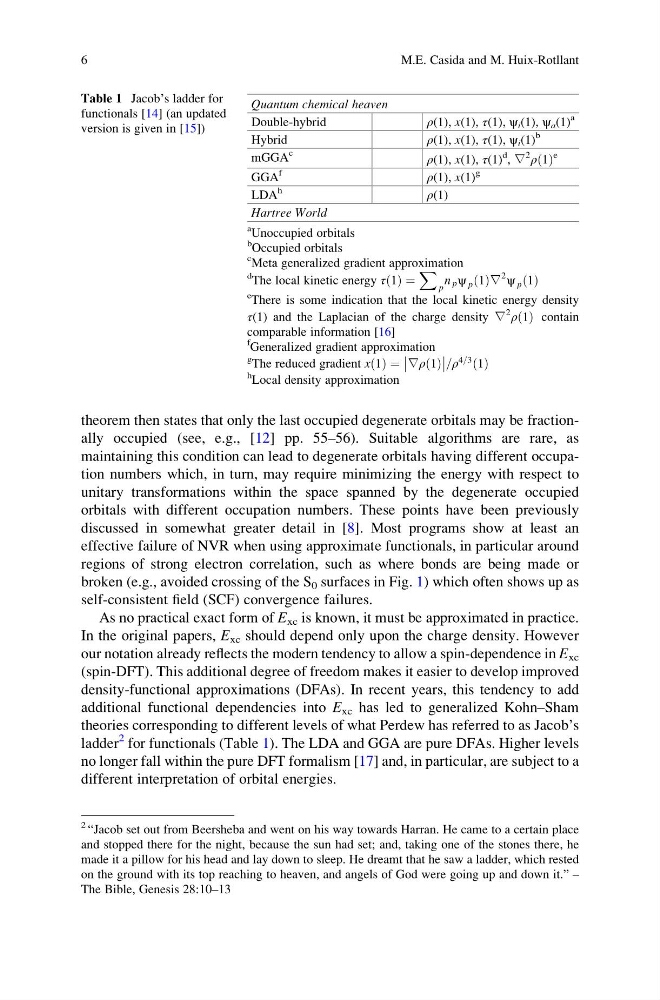
density-functional approximations (DFAs). In recent years, this tendency to add
additional functional dependencies into E xc has led to generalized Kohn–Sham
theories corresponding to different levels of what Perdew has referred to as Jacob’s
ladder
2 for functionals (Table 1). The LDA and GGA are pure DFAs. Higher levels
no longer fall within the pure DFT formalism [17] and, in particular, are subject to a
different interpretation of orbital energies.
Table 1 Jacob’s ladder for
functionals [14] (an updated
version is given in [15])
Quantum chemical heaven
Double-hybrid
ρ(1), x(1), τ(1), ψ i (1), ψ a (1)
a
Hybrid
ρ(1), x(1), τ(1), ψ i (1)
b
mGGA
c
ρ(1), x(1), τ(1)
d
, ∇
2 ρ 1
ð Þ
e
GGA
f
ρ(1), x(1)
g
LDA
h
ρ(1)
Hartree World
a
Unoccupied orbitals
b
Occupied orbitals
c
Meta generalized gradient approximation
d
The local kinetic energy τ 1
ð Þ ¼
X
p
n p ψ p 1
ð Þ∇
2 ψ p 1
ð Þ
e
There is some indication that the local kinetic energy density
τ(1) and the Laplacian of the charge density ∇
2 ρ 1
ð Þ contain
comparable information [16]
f
Generalized gradient approximation
g
The reduced gradient x 1
ð Þ ¼
∇ρ 1
ð Þ
=ρ
4=3 1
ð Þ
h
Local density approximation
2 “Jacob set out from Beersheba and went on his way towards Harran. He came to a certain place
and stopped there for the night, because the sun had set; and, taking one of the stones there, he
made it a pillow for his head and lay down to sleep. He dreamt that he saw a ladder, which rested
on the ground with its top reaching to heaven, and angels of God were going up and down it.” –
The Bible, Genesis 28:10–13
6
M.E. Casida and M. Huix-Rotllant
maintaining this condition can lead to degenerate orbitals having different occupation numbers which, in turn, may require minimizing the energy with respect to
unitary transformations within the space spanned by the degenerate occupied
orbitals with different occupation numbers. These points have been previously
discussed in somewhat greater detail in [8]. Most programs show at least an
effective failure of NVR when using approximate functionals, in particular around
regions of strong electron correlation, such as where bonds are being made or
broken (e.g., avoided crossing of the S 0 surfaces in Fig. 1) which often shows up as
self-consistent field (SCF) convergence failures.
As no practical exact form of E xc is known, it must be approximated in practice.
In the original papers, E xc should depend only upon the charge density. However
our notation already reflects the modern tendency to allow a spin-dependence in E xc
(spin-DFT). This additional degree of freedom makes it easier to develop improved
density-functional approximations (DFAs). In recent years, this tendency to add
additional functional dependencies into E xc has led to generalized Kohn–Sham
theories corresponding to different levels of what Perdew has referred to as Jacob’s
ladder
2 for functionals (Table 1). The LDA and GGA are pure DFAs. Higher levels
no longer fall within the pure DFT formalism [17] and, in particular, are subject to a
different interpretation of orbital energies.
Table 1 Jacob’s ladder for
functionals [14] (an updated
version is given in [15])
Quantum chemical heaven
Double-hybrid
ρ(1), x(1), τ(1), ψ i (1), ψ a (1)
a
Hybrid
ρ(1), x(1), τ(1), ψ i (1)
b
mGGA
c
ρ(1), x(1), τ(1)
d
, ∇
2 ρ 1
ð Þ
e
GGA
f
ρ(1), x(1)
g
LDA
h
ρ(1)
Hartree World
a
Unoccupied orbitals
b
Occupied orbitals
c
Meta generalized gradient approximation
d
The local kinetic energy τ 1
ð Þ ¼
X
p
n p ψ p 1
ð Þ∇
2 ψ p 1
ð Þ
e
There is some indication that the local kinetic energy density
τ(1) and the Laplacian of the charge density ∇
2 ρ 1
ð Þ contain
comparable information [16]
f
Generalized gradient approximation
g
The reduced gradient x 1
ð Þ ¼
∇ρ 1
ð Þ
=ρ
4=3 1
ð Þ
h
Local density approximation
2 “Jacob set out from Beersheba and went on his way towards Harran. He came to a certain place
and stopped there for the night, because the sun had set; and, taking one of the stones there, he
made it a pillow for his head and lay down to sleep. He dreamt that he saw a ladder, which rested
on the ground with its top reaching to heaven, and angels of God were going up and down it.” –
The Bible, Genesis 28:10–13
6
M.E. Casida and M. Huix-Rotllant