

Of particular importance to us is the hybrid level which incorporates some
Hartree–Fock exchange. Inspired by the adiabatic connection formalism in DFT
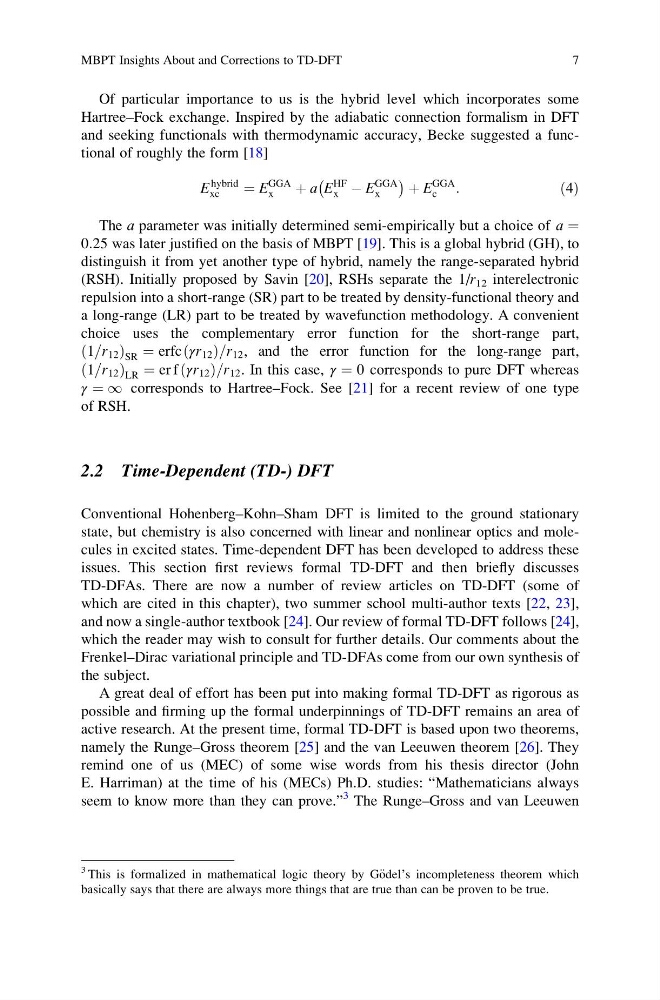
and seeking functionals with thermodynamic accuracy, Becke suggested a functional of roughly the form [18]
E
hybrid
xc
¼ E
GGA
x
þ a E
HF
x À E
GGA
x
À
Á þ E
GGA
c
:
ð4Þ
The a parameter was initially determined semi-empirically but a choice of a ¼
0:25 was later justified on the basis of MBPT [19]. This is a global hybrid (GH), to
distinguish it from yet another type of hybrid, namely the range-separated hybrid
(RSH). Initially proposed by Savin [20], RSHs separate the 1/r 12 interelectronic
repulsion into a short-range (SR) part to be treated by density-functional theory and
a long-range (LR) part to be treated by wavefunction methodology. A convenient
choice uses the complementary error function for the short-range part,
1=r 12
ð
Þ SR ¼ erfc γr 12
ð
Þ=r 12 , and the error function for the long-range part,
1=r 12
ð
Þ LR ¼ er f γr 12
ð
Þ=r 12 . In this case, γ ¼ 0 corresponds to pure DFT whereas
γ ¼ 1 corresponds to Hartree–Fock. See [21] for a recent review of one type
of RSH.
2.2 Time-Dependent (TD-) DFT
Conventional Hohenberg–Kohn–Sham DFT is limited to the ground stationary
state, but chemistry is also concerned with linear and nonlinear optics and molecules in excited states. Time-dependent DFT has been developed to address these
issues. This section first reviews formal TD-DFT and then briefly discusses
TD-DFAs. There are now a number of review articles on TD-DFT (some of
which are cited in this chapter), two summer school multi-author texts [22, 23],
and now a single-author textbook [24]. Our review of formal TD-DFT follows [24],
which the reader may wish to consult for further details. Our comments about the
Frenkel–Dirac variational principle and TD-DFAs come from our own synthesis of
the subject.
A great deal of effort has been put into making formal TD-DFT as rigorous as
possible and firming up the formal underpinnings of TD-DFT remains an area of
active research. At the present time, formal TD-DFT is based upon two theorems,
namely the Runge–Gross theorem [25] and the van Leeuwen theorem [26]. They
remind one of us (MEC) of some wise words from his thesis director (John
E. Harriman) at the time of his (MECs) Ph.D. studies: “Mathematicians always
seem to know more than they can prove.”
3 The Runge–Gross and van Leeuwen
3 This is formalized in mathematical logic theory by G€ odel’s incompleteness theorem which
basically says that there are always more things that are true than can be proven to be true.
MBPT Insights About and Corrections to TD-DFT
7
Hartree–Fock exchange. Inspired by the adiabatic connection formalism in DFT
and seeking functionals with thermodynamic accuracy, Becke suggested a functional of roughly the form [18]
E
hybrid
xc
¼ E
GGA
x
þ a E
HF
x À E
GGA
x
À
Á þ E
GGA
c
:
ð4Þ
The a parameter was initially determined semi-empirically but a choice of a ¼
0:25 was later justified on the basis of MBPT [19]. This is a global hybrid (GH), to
distinguish it from yet another type of hybrid, namely the range-separated hybrid
(RSH). Initially proposed by Savin [20], RSHs separate the 1/r 12 interelectronic
repulsion into a short-range (SR) part to be treated by density-functional theory and
a long-range (LR) part to be treated by wavefunction methodology. A convenient
choice uses the complementary error function for the short-range part,
1=r 12
ð
Þ SR ¼ erfc γr 12
ð
Þ=r 12 , and the error function for the long-range part,
1=r 12
ð
Þ LR ¼ er f γr 12
ð
Þ=r 12 . In this case, γ ¼ 0 corresponds to pure DFT whereas
γ ¼ 1 corresponds to Hartree–Fock. See [21] for a recent review of one type
of RSH.
2.2 Time-Dependent (TD-) DFT
Conventional Hohenberg–Kohn–Sham DFT is limited to the ground stationary
state, but chemistry is also concerned with linear and nonlinear optics and molecules in excited states. Time-dependent DFT has been developed to address these
issues. This section first reviews formal TD-DFT and then briefly discusses
TD-DFAs. There are now a number of review articles on TD-DFT (some of
which are cited in this chapter), two summer school multi-author texts [22, 23],
and now a single-author textbook [24]. Our review of formal TD-DFT follows [24],
which the reader may wish to consult for further details. Our comments about the
Frenkel–Dirac variational principle and TD-DFAs come from our own synthesis of
the subject.
A great deal of effort has been put into making formal TD-DFT as rigorous as
possible and firming up the formal underpinnings of TD-DFT remains an area of
active research. At the present time, formal TD-DFT is based upon two theorems,
namely the Runge–Gross theorem [25] and the van Leeuwen theorem [26]. They
remind one of us (MEC) of some wise words from his thesis director (John
E. Harriman) at the time of his (MECs) Ph.D. studies: “Mathematicians always
seem to know more than they can prove.”
3 The Runge–Gross and van Leeuwen
3 This is formalized in mathematical logic theory by G€ odel’s incompleteness theorem which
basically says that there are always more things that are true than can be proven to be true.
MBPT Insights About and Corrections to TD-DFT
7