

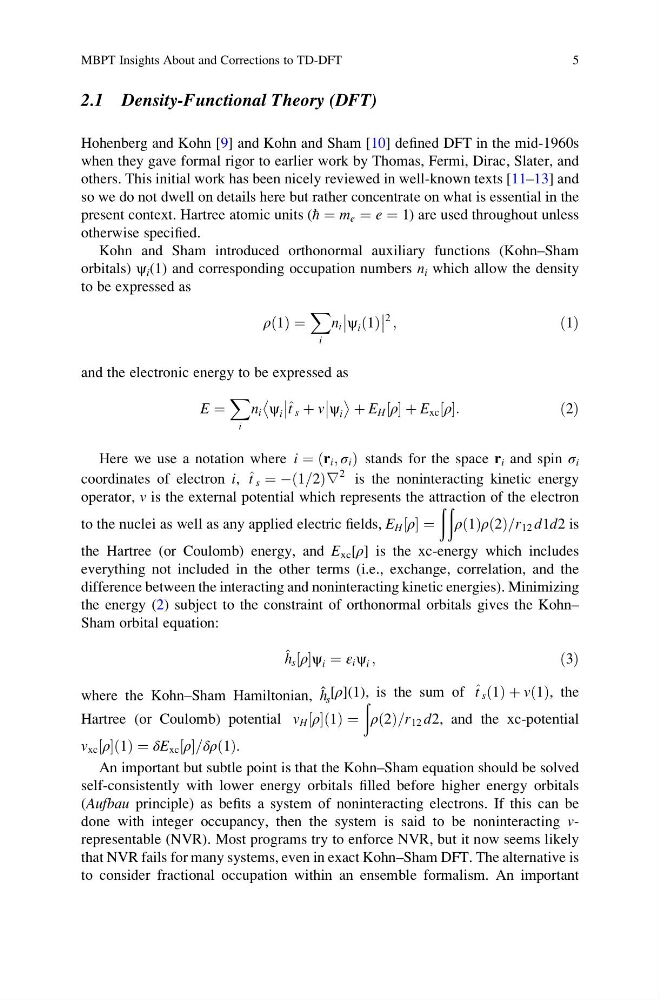
2.1 Density-Functional Theory (DFT)
Hohenberg and Kohn [9] and Kohn and Sham [10] defined DFT in the mid-1960s
when they gave formal rigor to earlier work by Thomas, Fermi, Dirac, Slater, and
others. This initial work has been nicely reviewed in well-known texts [11–13] and
so we do not dwell on details here but rather concentrate on what is essential in the
present context. Hartree atomic units (h ¼ m e ¼ e ¼ 1) are used throughout unless
otherwise specified.
Kohn and Sham introduced orthonormal auxiliary functions (Kohn–Sham
orbitals) ψ i (1) and corresponding occupation numbers n i which allow the density
to be expressed as
ρ 1
ð Þ ¼
X
i
n i
ψ i 1
ð Þ
2 ;
ð1Þ
and the electronic energy to be expressed as
E ¼
X
i
n i ψ i
^ t s þ v
ψ i
þ E H ρ
½ þ E xc ρ
½ :
ð2Þ
Here we use a notation where i ¼ r i ; σ i
ð
Þ stands for the space r i and spin σ i
coordinates of electron i, ^ t s ¼ À 1=2
ð
Þ∇
2 is the noninteracting kinetic energy
operator, v is the external potential which represents the attraction of the electron
to the nuclei as well as any applied electric fields, E H ρ
½ ¼
ðð
ρ 1
ð Þρ 2
ð Þ=r 12 d1d2 is
the Hartree (or Coulomb) energy, and E xc [ρ] is the xc-energy which includes
everything not included in the other terms (i.e., exchange, correlation, and the
difference between the interacting and noninteracting kinetic energies). Minimizing
the energy (2) subject to the constraint of orthonormal orbitals gives the Kohn–
Sham orbital equation:
^ h s ρ
½ ψ i ¼ ε i ψ i ;
ð3Þ
where the Kohn–Sham Hamiltonian, h ˆ s [ρ](1), is the sum of ^ t s 1
ð Þ þ v 1
ð Þ, the
Hartree (or Coulomb) potential v H ρ
½ 1
ð Þ ¼
ð
ρ 2
ð Þ=r 12 d2, and the xc-potential
v xc ρ
½ 1
ð Þ ¼ δE xc ρ
½ =δρ 1
ð Þ.
An important but subtle point is that the Kohn–Sham equation should be solved
self-consistently with lower energy orbitals filled before higher energy orbitals
(Aufbau principle) as befits a system of noninteracting electrons. If this can be
done with integer occupancy, then the system is said to be noninteracting vrepresentable (NVR). Most programs try to enforce NVR, but it now seems likely
that NVR fails for many systems, even in exact Kohn–Sham DFT. The alternative is
to consider fractional occupation within an ensemble formalism. An important
MBPT Insights About and Corrections to TD-DFT
5
Hohenberg and Kohn [9] and Kohn and Sham [10] defined DFT in the mid-1960s
when they gave formal rigor to earlier work by Thomas, Fermi, Dirac, Slater, and
others. This initial work has been nicely reviewed in well-known texts [11–13] and
so we do not dwell on details here but rather concentrate on what is essential in the
present context. Hartree atomic units (h ¼ m e ¼ e ¼ 1) are used throughout unless
otherwise specified.
Kohn and Sham introduced orthonormal auxiliary functions (Kohn–Sham
orbitals) ψ i (1) and corresponding occupation numbers n i which allow the density
to be expressed as
ρ 1
ð Þ ¼
X
i
n i
ψ i 1
ð Þ
2 ;
ð1Þ
and the electronic energy to be expressed as
E ¼
X
i
n i ψ i
^ t s þ v
ψ i
þ E H ρ
½ þ E xc ρ
½ :
ð2Þ
Here we use a notation where i ¼ r i ; σ i
ð
Þ stands for the space r i and spin σ i
coordinates of electron i, ^ t s ¼ À 1=2
ð
Þ∇
2 is the noninteracting kinetic energy
operator, v is the external potential which represents the attraction of the electron
to the nuclei as well as any applied electric fields, E H ρ
½ ¼
ðð
ρ 1
ð Þρ 2
ð Þ=r 12 d1d2 is
the Hartree (or Coulomb) energy, and E xc [ρ] is the xc-energy which includes
everything not included in the other terms (i.e., exchange, correlation, and the
difference between the interacting and noninteracting kinetic energies). Minimizing
the energy (2) subject to the constraint of orthonormal orbitals gives the Kohn–
Sham orbital equation:
^ h s ρ
½ ψ i ¼ ε i ψ i ;
ð3Þ
where the Kohn–Sham Hamiltonian, h ˆ s [ρ](1), is the sum of ^ t s 1
ð Þ þ v 1
ð Þ, the
Hartree (or Coulomb) potential v H ρ
½ 1
ð Þ ¼
ð
ρ 2
ð Þ=r 12 d2, and the xc-potential
v xc ρ
½ 1
ð Þ ¼ δE xc ρ
½ =δρ 1
ð Þ.
An important but subtle point is that the Kohn–Sham equation should be solved
self-consistently with lower energy orbitals filled before higher energy orbitals
(Aufbau principle) as befits a system of noninteracting electrons. If this can be
done with integer occupancy, then the system is said to be noninteracting vrepresentable (NVR). Most programs try to enforce NVR, but it now seems likely
that NVR fails for many systems, even in exact Kohn–Sham DFT. The alternative is
to consider fractional occupation within an ensemble formalism. An important
MBPT Insights About and Corrections to TD-DFT
5