

complete sense, especially for the two-electron system, because the phase factors of
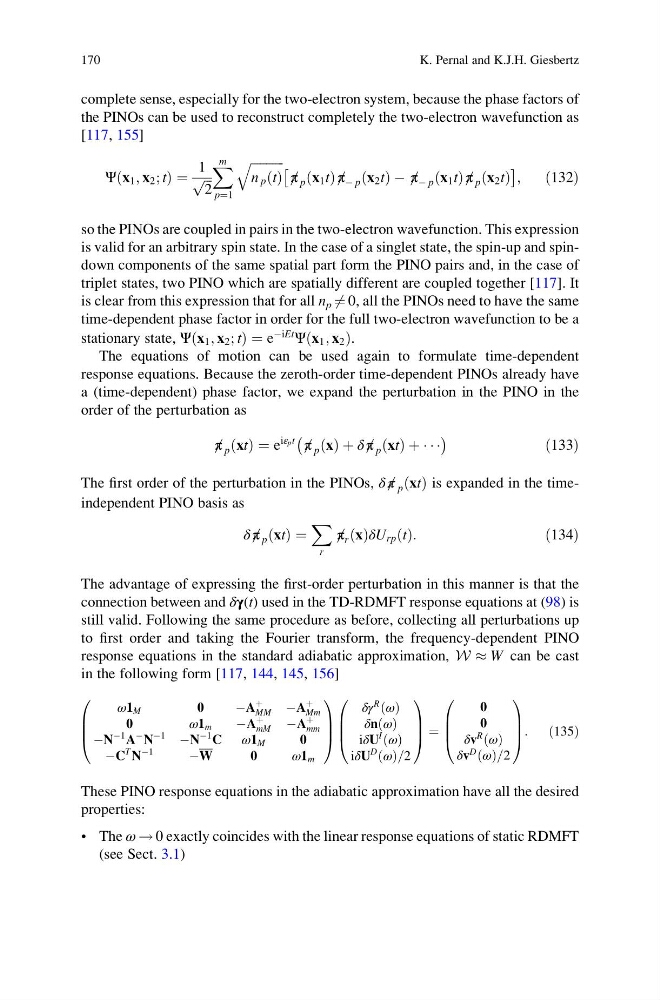
the PINOs can be used to reconstruct completely the two-electron wavefunction as
[117, 155]
Ψ x 1 ; x 2 ; t
ð
Þ¼
1
ffiffi ffi
2
p
X m
p¼1
ffiffiffiffiffiffiffiffiffiffi ffi
n p t
ð Þ
q
6 π p x 1 t
ð Þ6 π À p x 2 t
ð Þ À 6 π À p x 1 t
ð Þ6 π p x 2 t
ð Þ
Â
à ;
ð132Þ
so the PINOs are coupled in pairs in the two-electron wavefunction. This expression
is valid for an arbitrary spin state. In the case of a singlet state, the spin-up and spindown components of the same spatial part form the PINO pairs and, in the case of
triplet states, two PINO which are spatially different are coupled together [117]. It
is clear from this expression that for all n p 6 ¼ 0, all the PINOs need to have the same
time-dependent phase factor in order for the full two-electron wavefunction to be a
stationary state, Ψ x 1 ; x 2 ; t
ð
Þ¼e
ÀiEt
Ψ x 1 ; x 2
ð
Þ.
The equations of motion can be used again to formulate time-dependent
response equations. Because the zeroth-order time-dependent PINOs already have
a (time-dependent) phase factor, we expand the perturbation in the PINO in the
order of the perturbation as
6 π p xt
ð Þ ¼ e
iε p t
6 π p x
ð Þ þ δ6 π p xt
ð Þ þ Á Á Á
À
Á
ð133Þ
The first order of the perturbation in the PINOs, δ6 π p xt
ð Þ is expanded in the timeindependent PINO basis as
δ6 π p xt
ð Þ ¼
X
r
6 π r x
ð ÞδU rp t
ð Þ:
ð134Þ
The advantage of expressing the first-order perturbation in this manner is that the
connection between and δγ(t) used in the TD-RDMFT response equations at (98) is
still valid. Following the same procedure as before, collecting all perturbations up
to first order and taking the Fourier transform, the frequency-dependent PINO
response equations in the standard adiabatic approximation, W % W can be cast
in the following form [117, 144, 145, 156]
ω1 M
0
ÀA
þ
MM
ÀA
þ
Mm
0
ω1 m
ÀA
þ
mM
ÀA
þ
mm
ÀN
À1 A
À N
À1
ÀN
À1 C ω1 M
0
ÀC
T N
À1
ÀW
0
ω1 m
0
B
B
@
1
C
C
A
δγ
R
ω
ð Þ
δn ω
ð Þ
iδU
I ω
ð Þ
iδU
D ω
ð Þ=2
0
B
B
@
1
C
C
A ¼
0
0
δv
R
ω
ð Þ
δv
D
ω
ð Þ=2
0
B
B
@
1
C
C
A :
ð135Þ
These PINO response equations in the adiabatic approximation have all the desired
properties:
• The ω ! 0 exactly coincides with the linear response equations of static RDMFT
(see Sect. 3.1)
170
K. Pernal and K.J.H. Giesbertz
the PINOs can be used to reconstruct completely the two-electron wavefunction as
[117, 155]
Ψ x 1 ; x 2 ; t
ð
Þ¼
1
ffiffi ffi
2
p
X m
p¼1
ffiffiffiffiffiffiffiffiffiffi ffi
n p t
ð Þ
q
6 π p x 1 t
ð Þ6 π À p x 2 t
ð Þ À 6 π À p x 1 t
ð Þ6 π p x 2 t
ð Þ
Â
à ;
ð132Þ
so the PINOs are coupled in pairs in the two-electron wavefunction. This expression
is valid for an arbitrary spin state. In the case of a singlet state, the spin-up and spindown components of the same spatial part form the PINO pairs and, in the case of
triplet states, two PINO which are spatially different are coupled together [117]. It
is clear from this expression that for all n p 6 ¼ 0, all the PINOs need to have the same
time-dependent phase factor in order for the full two-electron wavefunction to be a
stationary state, Ψ x 1 ; x 2 ; t
ð
Þ¼e
ÀiEt
Ψ x 1 ; x 2
ð
Þ.
The equations of motion can be used again to formulate time-dependent
response equations. Because the zeroth-order time-dependent PINOs already have
a (time-dependent) phase factor, we expand the perturbation in the PINO in the
order of the perturbation as
6 π p xt
ð Þ ¼ e
iε p t
6 π p x
ð Þ þ δ6 π p xt
ð Þ þ Á Á Á
À
Á
ð133Þ
The first order of the perturbation in the PINOs, δ6 π p xt
ð Þ is expanded in the timeindependent PINO basis as
δ6 π p xt
ð Þ ¼
X
r
6 π r x
ð ÞδU rp t
ð Þ:
ð134Þ
The advantage of expressing the first-order perturbation in this manner is that the
connection between and δγ(t) used in the TD-RDMFT response equations at (98) is
still valid. Following the same procedure as before, collecting all perturbations up
to first order and taking the Fourier transform, the frequency-dependent PINO
response equations in the standard adiabatic approximation, W % W can be cast
in the following form [117, 144, 145, 156]
ω1 M
0
ÀA
þ
MM
ÀA
þ
Mm
0
ω1 m
ÀA
þ
mM
ÀA
þ
mm
ÀN
À1 A
À N
À1
ÀN
À1 C ω1 M
0
ÀC
T N
À1
ÀW
0
ω1 m
0
B
B
@
1
C
C
A
δγ
R
ω
ð Þ
δn ω
ð Þ
iδU
I ω
ð Þ
iδU
D ω
ð Þ=2
0
B
B
@
1
C
C
A ¼
0
0
δv
R
ω
ð Þ
δv
D
ω
ð Þ=2
0
B
B
@
1
C
C
A :
ð135Þ
These PINO response equations in the adiabatic approximation have all the desired
properties:
• The ω ! 0 exactly coincides with the linear response equations of static RDMFT
(see Sect. 3.1)
170
K. Pernal and K.J.H. Giesbertz