

i _
n p t
ð Þ þ n q t
ð Þ À n p t
ð Þ
À
Á 6 π p t
ð Þj _
6 π q t
ð Þ
D
E
h
i
¼ n q t
ð Þ À n p t
ð Þ
À
Á
h pq t
ð Þ þ W
6 π
{
pq t
ð Þ À W
6 π
pq t
ð Þ
;
ð126Þ
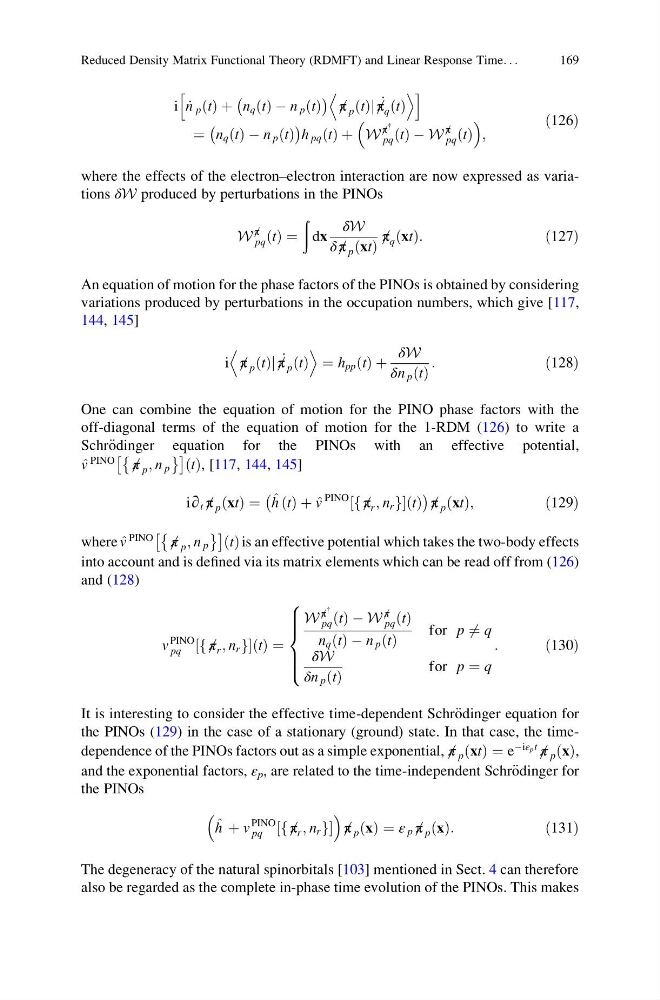
where the effects of the electron–electron interaction are now expressed as variations δW produced by perturbations in the PINOs
W
6 π
pq t
ð Þ ¼
ð
dx
δW
δ6 π p xt
ð Þ
6 π q xt
ð Þ:
ð127Þ
An equation of motion for the phase factors of the PINOs is obtained by considering
variations produced by perturbations in the occupation numbers, which give [117,
144, 145]
i 6 π p t
ð Þj _
6 π p t
ð Þ
D
E
¼ h pp t
ð Þ þ
δW
δn p t
ð Þ
:
ð128Þ
One can combine the equation of motion for the PINO phase factors with the
off-diagonal terms of the equation of motion for the 1-RDM (126) to write a
Schr€ odinger equation for the PINOs with an effective potential,
^
v
PINO
6 π p ; n p
È
É
Â
Ã
t
ð Þ, [117, 144, 145]
i∂ t 6 π p xt
ð Þ ¼ ^
h t
ð Þ þ ^
v
PINO
6 π r ; n r
f
g
½
t ð Þ
À
Á 6 π p xt
ð Þ;
ð129Þ
where ^
v
PINO
6 π p ; n p
È
É
Â
Ã
t
ð Þis an effective potential which takes the two-body effects
into account and is defined via its matrix elements which can be read off from (126)
and (128)
v
PINO
pq
6 π r ; n r
f
g
½
t ð Þ ¼
W
6 π
{
pq t
ð Þ À W
6 π
pq t
ð Þ
n q t
ð Þ À n p t
ð Þ
for p 6 ¼ q
δW
δn p t
ð Þ
for p ¼ q
8
> > > <
> > > :
:
ð130Þ
It is interesting to consider the effective time-dependent Schr€ odinger equation for
the PINOs (129) in the case of a stationary (ground) state. In that case, the timedependence of the PINOs factors out as a simple exponential, 6 π p xt
ð Þ ¼ e
Àiε p t
6 π p x
ð Þ,
and the exponential factors, ε p , are related to the time-independent Schr€ odinger for
the PINOs
^
h þ v
PINO
pq
6 π r ; n r
f
g
½
6 π p x
ð Þ ¼ ε p 6 π p x
ð Þ:
ð131Þ
The degeneracy of the natural spinorbitals [103] mentioned in Sect. 4 can therefore
also be regarded as the complete in-phase time evolution of the PINOs. This makes
Reduced Density Matrix Functional Theory (RDMFT) and Linear Response Time. . .
169
n p t
ð Þ þ n q t
ð Þ À n p t
ð Þ
À
Á 6 π p t
ð Þj _
6 π q t
ð Þ
D
E
h
i
¼ n q t
ð Þ À n p t
ð Þ
À
Á
h pq t
ð Þ þ W
6 π
{
pq t
ð Þ À W
6 π
pq t
ð Þ
;
ð126Þ
where the effects of the electron–electron interaction are now expressed as variations δW produced by perturbations in the PINOs
W
6 π
pq t
ð Þ ¼
ð
dx
δW
δ6 π p xt
ð Þ
6 π q xt
ð Þ:
ð127Þ
An equation of motion for the phase factors of the PINOs is obtained by considering
variations produced by perturbations in the occupation numbers, which give [117,
144, 145]
i 6 π p t
ð Þj _
6 π p t
ð Þ
D
E
¼ h pp t
ð Þ þ
δW
δn p t
ð Þ
:
ð128Þ
One can combine the equation of motion for the PINO phase factors with the
off-diagonal terms of the equation of motion for the 1-RDM (126) to write a
Schr€ odinger equation for the PINOs with an effective potential,
^
v
PINO
6 π p ; n p
È
É
Â
Ã
t
ð Þ, [117, 144, 145]
i∂ t 6 π p xt
ð Þ ¼ ^
h t
ð Þ þ ^
v
PINO
6 π r ; n r
f
g
½
t ð Þ
À
Á 6 π p xt
ð Þ;
ð129Þ
where ^
v
PINO
6 π p ; n p
È
É
Â
Ã
t
ð Þis an effective potential which takes the two-body effects
into account and is defined via its matrix elements which can be read off from (126)
and (128)
v
PINO
pq
6 π r ; n r
f
g
½
t ð Þ ¼
W
6 π
{
pq t
ð Þ À W
6 π
pq t
ð Þ
n q t
ð Þ À n p t
ð Þ
for p 6 ¼ q
δW
δn p t
ð Þ
for p ¼ q
8
> > > <
> > > :
:
ð130Þ
It is interesting to consider the effective time-dependent Schr€ odinger equation for
the PINOs (129) in the case of a stationary (ground) state. In that case, the timedependence of the PINOs factors out as a simple exponential, 6 π p xt
ð Þ ¼ e
Àiε p t
6 π p x
ð Þ,
and the exponential factors, ε p , are related to the time-independent Schr€ odinger for
the PINOs
^
h þ v
PINO
pq
6 π r ; n r
f
g
½
6 π p x
ð Þ ¼ ε p 6 π p x
ð Þ:
ð131Þ
The degeneracy of the natural spinorbitals [103] mentioned in Sect. 4 can therefore
also be regarded as the complete in-phase time evolution of the PINOs. This makes
Reduced Density Matrix Functional Theory (RDMFT) and Linear Response Time. . .
169