

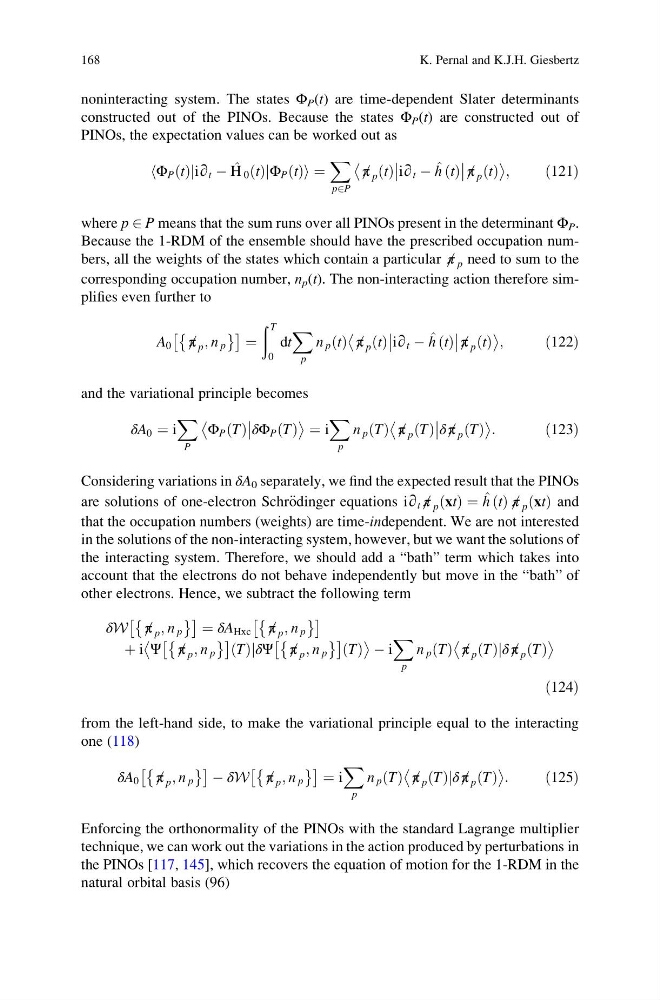
noninteracting system. The states Φ P (t) are time-dependent Slater determinants
constructed out of the PINOs. Because the states Φ P (t) are constructed out of
PINOs, the expectation values can be worked out as
Φ P t
ð Þ
h
ji∂ t À ^
H 0 t
ð Þ Φ P t
ð Þ
j
i¼
X
p2P
6 π p t
ð Þ
i∂ t À ^
h t
ð Þ 6 π p t
ð Þ
;
ð121Þ
where p 2 P means that the sum runs over all PINOs present in the determinant Φ P .
Because the 1-RDM of the ensemble should have the prescribed occupation numbers, all the weights of the states which contain a particular 6 π p need to sum to the
corresponding occupation number, n p (t). The non-interacting action therefore simplifies even further to
A 0 6 π p ; n p
È
É
Â
à ¼
ð T
0
dt
X
p
n p t
ð Þ 6 π p t
ð Þ
i∂ t À ^
h t
ð Þ 6 π p t
ð Þ
;
ð122Þ
and the variational principle becomes
δA 0 ¼ i
X
P
Φ P T
ð Þ
δΦ P T
ð Þ
¼ i
X
p
n p T
ð Þ 6 π p T
ð Þ
δ6 π p T
ð Þ
:
ð123Þ
Considering variations in δA 0 separately, we find the expected result that the PINOs
are solutions of one-electron Schr€ odinger equations i∂ t 6 π p xt
ð Þ ¼ ^
h t
ð Þ6 π p xt
ð Þ and
that the occupation numbers (weights) are time-independent. We are not interested
in the solutions of the non-interacting system, however, but we want the solutions of
the interacting system. Therefore, we should add a “bath” term which takes into
account that the electrons do not behave independently but move in the “bath” of
other electrons. Hence, we subtract the following term
δW 6 π p ; n p
È
É
Â
à ¼ δA Hxc 6 π p ; n p
È
É
Â
Ã
þ i Ψ 6 π p ; n p
È
É
Â
Ã
T
ð ÞjδΨ 6 π p ; n p
È
É
Â
Ã
T
ð Þ
À i
X
p
n p T
ð Þ 6 π p T
ð Þjδ6 π p T
ð Þ
ð124Þ
from the left-hand side, to make the variational principle equal to the interacting
one (118)
δA 0 6 π p ; n p
È
É
Â
à À δW 6 π p ; n p
È
É
Â
à ¼ i
X
p
n p T
ð Þ 6 π p T
ð Þjδ6 π p T
ð Þ
:
ð125Þ
Enforcing the orthonormality of the PINOs with the standard Lagrange multiplier
technique, we can work out the variations in the action produced by perturbations in
the PINOs [117, 145], which recovers the equation of motion for the 1-RDM in the
natural orbital basis (96)
168
K. Pernal and K.J.H. Giesbertz
constructed out of the PINOs. Because the states Φ P (t) are constructed out of
PINOs, the expectation values can be worked out as
Φ P t
ð Þ
h
ji∂ t À ^
H 0 t
ð Þ Φ P t
ð Þ
j
i¼
X
p2P
6 π p t
ð Þ
i∂ t À ^
h t
ð Þ 6 π p t
ð Þ
;
ð121Þ
where p 2 P means that the sum runs over all PINOs present in the determinant Φ P .
Because the 1-RDM of the ensemble should have the prescribed occupation numbers, all the weights of the states which contain a particular 6 π p need to sum to the
corresponding occupation number, n p (t). The non-interacting action therefore simplifies even further to
A 0 6 π p ; n p
È
É
Â
à ¼
ð T
0
dt
X
p
n p t
ð Þ 6 π p t
ð Þ
i∂ t À ^
h t
ð Þ 6 π p t
ð Þ
;
ð122Þ
and the variational principle becomes
δA 0 ¼ i
X
P
Φ P T
ð Þ
δΦ P T
ð Þ
¼ i
X
p
n p T
ð Þ 6 π p T
ð Þ
δ6 π p T
ð Þ
:
ð123Þ
Considering variations in δA 0 separately, we find the expected result that the PINOs
are solutions of one-electron Schr€ odinger equations i∂ t 6 π p xt
ð Þ ¼ ^
h t
ð Þ6 π p xt
ð Þ and
that the occupation numbers (weights) are time-independent. We are not interested
in the solutions of the non-interacting system, however, but we want the solutions of
the interacting system. Therefore, we should add a “bath” term which takes into
account that the electrons do not behave independently but move in the “bath” of
other electrons. Hence, we subtract the following term
δW 6 π p ; n p
È
É
Â
à ¼ δA Hxc 6 π p ; n p
È
É
Â
Ã
þ i Ψ 6 π p ; n p
È
É
Â
Ã
T
ð ÞjδΨ 6 π p ; n p
È
É
Â
Ã
T
ð Þ
À i
X
p
n p T
ð Þ 6 π p T
ð Þjδ6 π p T
ð Þ
ð124Þ
from the left-hand side, to make the variational principle equal to the interacting
one (118)
δA 0 6 π p ; n p
È
É
Â
à À δW 6 π p ; n p
È
É
Â
à ¼ i
X
p
n p T
ð Þ 6 π p T
ð Þjδ6 π p T
ð Þ
:
ð125Þ
Enforcing the orthonormality of the PINOs with the standard Lagrange multiplier
technique, we can work out the variations in the action produced by perturbations in
the PINOs [117, 145], which recovers the equation of motion for the 1-RDM in the
natural orbital basis (96)
168
K. Pernal and K.J.H. Giesbertz