

occupation numbers to facilitate a true quantum evolution. It is obvious that the
ideal candidate would be the phase factors of the natural orbitals, which is corroborated by the reconstruction of the exact frequency-dependent coupling matrices of
the K(ω) for singlet two-electron systems [117, 142]. To distinguish these special
natural orbitals with a specific phase from those defined as eigenfunctions of the
1-RDM, we call them phase-including natural orbitals (PINOs) and give them their
own symbols, 6 π p xt
ð Þ. Using PINOs, the functionals are also allowed to depend
explicitly on the phase of the orbitals, so the PILS functional becomes a legal
functional.
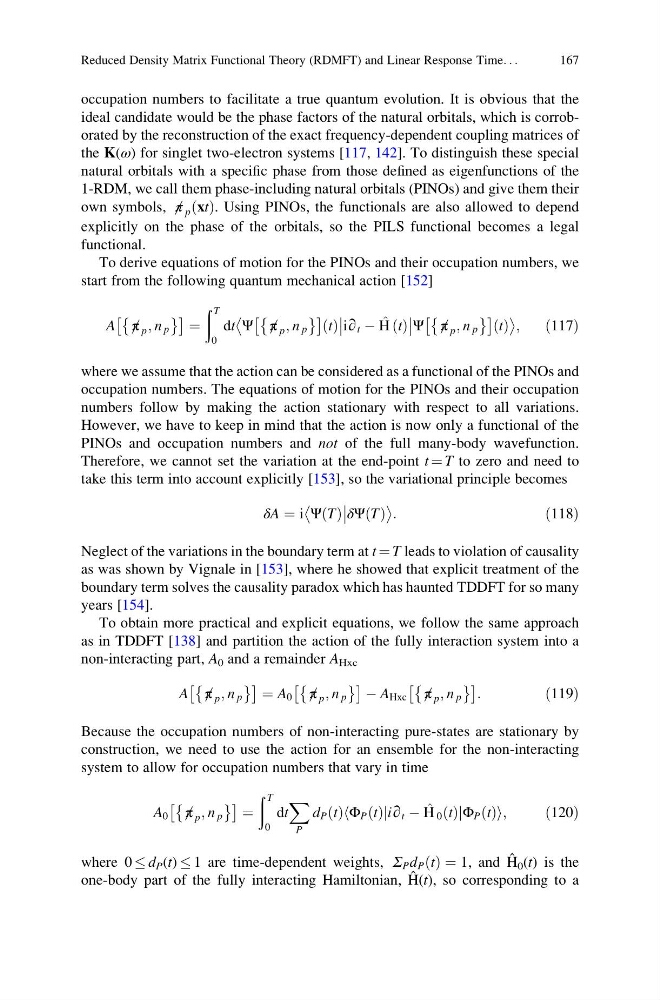
To derive equations of motion for the PINOs and their occupation numbers, we
start from the following quantum mechanical action [152]
A 6 π p ; n p
È
É
Â
à ¼
ð T
0
dt Ψ 6 π p ; n p
È
É
Â
Ã
t
ð Þ
i∂ t À ^
H t
ð Þ Ψ 6 π p ; n p
È
É
Â
Ã
t
ð Þ
;
ð117Þ
where we assume that the action can be considered as a functional of the PINOs and
occupation numbers. The equations of motion for the PINOs and their occupation
numbers follow by making the action stationary with respect to all variations.
However, we have to keep in mind that the action is now only a functional of the
PINOs and occupation numbers and not of the full many-body wavefunction.
Therefore, we cannot set the variation at the end-point t ¼ T to zero and need to
take this term into account explicitly [153], so the variational principle becomes
δA ¼ i Ψ T
ð Þ
δΨ T
ð Þ
:
ð118Þ
Neglect of the variations in the boundary term at t ¼ T leads to violation of causality
as was shown by Vignale in [153], where he showed that explicit treatment of the
boundary term solves the causality paradox which has haunted TDDFT for so many
years [154].
To obtain more practical and explicit equations, we follow the same approach
as in TDDFT [138] and partition the action of the fully interaction system into a
non-interacting part, A 0 and a remainder A Hxc
A 6 π p ; n p
È
É
Â
à ¼ A 0 6 π p ; n p
È
É
Â
à À A Hxc 6 π p ; n p
È
É
Â
Ã
:
ð119Þ
Because the occupation numbers of non-interacting pure-states are stationary by
construction, we need to use the action for an ensemble for the non-interacting
system to allow for occupation numbers that vary in time
A 0 6 π p ; n p
È
É
Â
à ¼
ð T
0
dt
X
P
d P t
ð Þ Φ P t
ð Þ
h
ji∂ t À ^
H 0 t
ð Þ Φ P t
ð Þ
j
i;
ð120Þ
where 0 d P (t) 1 are time-dependent weights, Σ P d P t
ð Þ ¼ 1, and H ˆ 0 (t) is the
one-body part of the fully interacting Hamiltonian, H ˆ (t), so corresponding to a
Reduced Density Matrix Functional Theory (RDMFT) and Linear Response Time. . .
167
ideal candidate would be the phase factors of the natural orbitals, which is corroborated by the reconstruction of the exact frequency-dependent coupling matrices of
the K(ω) for singlet two-electron systems [117, 142]. To distinguish these special
natural orbitals with a specific phase from those defined as eigenfunctions of the
1-RDM, we call them phase-including natural orbitals (PINOs) and give them their
own symbols, 6 π p xt
ð Þ. Using PINOs, the functionals are also allowed to depend
explicitly on the phase of the orbitals, so the PILS functional becomes a legal
functional.
To derive equations of motion for the PINOs and their occupation numbers, we
start from the following quantum mechanical action [152]
A 6 π p ; n p
È
É
Â
à ¼
ð T
0
dt Ψ 6 π p ; n p
È
É
Â
Ã
t
ð Þ
i∂ t À ^
H t
ð Þ Ψ 6 π p ; n p
È
É
Â
Ã
t
ð Þ
;
ð117Þ
where we assume that the action can be considered as a functional of the PINOs and
occupation numbers. The equations of motion for the PINOs and their occupation
numbers follow by making the action stationary with respect to all variations.
However, we have to keep in mind that the action is now only a functional of the
PINOs and occupation numbers and not of the full many-body wavefunction.
Therefore, we cannot set the variation at the end-point t ¼ T to zero and need to
take this term into account explicitly [153], so the variational principle becomes
δA ¼ i Ψ T
ð Þ
δΨ T
ð Þ
:
ð118Þ
Neglect of the variations in the boundary term at t ¼ T leads to violation of causality
as was shown by Vignale in [153], where he showed that explicit treatment of the
boundary term solves the causality paradox which has haunted TDDFT for so many
years [154].
To obtain more practical and explicit equations, we follow the same approach
as in TDDFT [138] and partition the action of the fully interaction system into a
non-interacting part, A 0 and a remainder A Hxc
A 6 π p ; n p
È
É
Â
à ¼ A 0 6 π p ; n p
È
É
Â
à À A Hxc 6 π p ; n p
È
É
Â
Ã
:
ð119Þ
Because the occupation numbers of non-interacting pure-states are stationary by
construction, we need to use the action for an ensemble for the non-interacting
system to allow for occupation numbers that vary in time
A 0 6 π p ; n p
È
É
Â
à ¼
ð T
0
dt
X
P
d P t
ð Þ Φ P t
ð Þ
h
ji∂ t À ^
H 0 t
ð Þ Φ P t
ð Þ
j
i;
ð120Þ
where 0 d P (t) 1 are time-dependent weights, Σ P d P t
ð Þ ¼ 1, and H ˆ 0 (t) is the
one-body part of the fully interacting Hamiltonian, H ˆ (t), so corresponding to a
Reduced Density Matrix Functional Theory (RDMFT) and Linear Response Time. . .
167