

• The diagonal double excitations are properly accounted for without destroying
the important symmetry of the response function, χ ω
ð Þ ¼ χ* Àω
ð Þ
• The PILS functional is a proper PINO functional, so the exact PINO functional is
known for the two-electron system
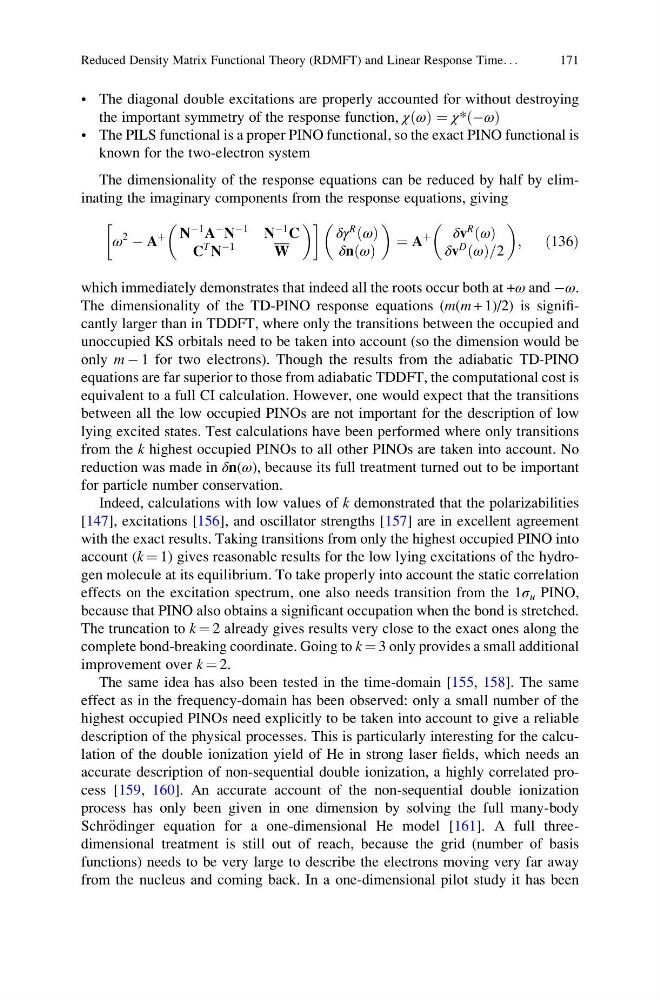
The dimensionality of the response equations can be reduced by half by eliminating the imaginary components from the response equations, giving
ω
2
À A
þ N
À1 A
À N
À1 N
À1 C
C
T N
À1
W
! δγ
R
ω
ð Þ
δn ω
ð Þ
¼ A
þ
δv
R
ω
ð Þ
δv
D
ω
ð Þ=2
;
ð136Þ
which immediately demonstrates that indeed all the roots occur both at +ω and Àω.
The dimensionality of the TD-PINO response equations (m(m + 1)/2) is significantly larger than in TDDFT, where only the transitions between the occupied and
unoccupied KS orbitals need to be taken into account (so the dimension would be
only m À 1 for two electrons). Though the results from the adiabatic TD-PINO
equations are far superior to those from adiabatic TDDFT, the computational cost is
equivalent to a full CI calculation. However, one would expect that the transitions
between all the low occupied PINOs are not important for the description of low
lying excited states. Test calculations have been performed where only transitions
from the k highest occupied PINOs to all other PINOs are taken into account. No
reduction was made in δn(ω), because its full treatment turned out to be important
for particle number conservation.
Indeed, calculations with low values of k demonstrated that the polarizabilities
[147], excitations [156], and oscillator strengths [157] are in excellent agreement
with the exact results. Taking transitions from only the highest occupied PINO into
account (k ¼ 1) gives reasonable results for the low lying excitations of the hydrogen molecule at its equilibrium. To take properly into account the static correlation
effects on the excitation spectrum, one also needs transition from the 1σ u PINO,
because that PINO also obtains a significant occupation when the bond is stretched.
The truncation to k ¼ 2 already gives results very close to the exact ones along the
complete bond-breaking coordinate. Going to k ¼ 3 only provides a small additional
improvement over k ¼ 2.
The same idea has also been tested in the time-domain [155, 158]. The same
effect as in the frequency-domain has been observed: only a small number of the
highest occupied PINOs need explicitly to be taken into account to give a reliable
description of the physical processes. This is particularly interesting for the calculation of the double ionization yield of He in strong laser fields, which needs an
accurate description of non-sequential double ionization, a highly correlated process [159, 160]. An accurate account of the non-sequential double ionization
process has only been given in one dimension by solving the full many-body
Schr€ odinger equation for a one-dimensional He model [161]. A full threedimensional treatment is still out of reach, because the grid (number of basis
functions) needs to be very large to describe the electrons moving very far away
from the nucleus and coming back. In a one-dimensional pilot study it has been
Reduced Density Matrix Functional Theory (RDMFT) and Linear Response Time. . .
171
the important symmetry of the response function, χ ω
ð Þ ¼ χ* Àω
ð Þ
• The PILS functional is a proper PINO functional, so the exact PINO functional is
known for the two-electron system
The dimensionality of the response equations can be reduced by half by eliminating the imaginary components from the response equations, giving
ω
2
À A
þ N
À1 A
À N
À1 N
À1 C
C
T N
À1
W
! δγ
R
ω
ð Þ
δn ω
ð Þ
¼ A
þ
δv
R
ω
ð Þ
δv
D
ω
ð Þ=2
;
ð136Þ
which immediately demonstrates that indeed all the roots occur both at +ω and Àω.
The dimensionality of the TD-PINO response equations (m(m + 1)/2) is significantly larger than in TDDFT, where only the transitions between the occupied and
unoccupied KS orbitals need to be taken into account (so the dimension would be
only m À 1 for two electrons). Though the results from the adiabatic TD-PINO
equations are far superior to those from adiabatic TDDFT, the computational cost is
equivalent to a full CI calculation. However, one would expect that the transitions
between all the low occupied PINOs are not important for the description of low
lying excited states. Test calculations have been performed where only transitions
from the k highest occupied PINOs to all other PINOs are taken into account. No
reduction was made in δn(ω), because its full treatment turned out to be important
for particle number conservation.
Indeed, calculations with low values of k demonstrated that the polarizabilities
[147], excitations [156], and oscillator strengths [157] are in excellent agreement
with the exact results. Taking transitions from only the highest occupied PINO into
account (k ¼ 1) gives reasonable results for the low lying excitations of the hydrogen molecule at its equilibrium. To take properly into account the static correlation
effects on the excitation spectrum, one also needs transition from the 1σ u PINO,
because that PINO also obtains a significant occupation when the bond is stretched.
The truncation to k ¼ 2 already gives results very close to the exact ones along the
complete bond-breaking coordinate. Going to k ¼ 3 only provides a small additional
improvement over k ¼ 2.
The same idea has also been tested in the time-domain [155, 158]. The same
effect as in the frequency-domain has been observed: only a small number of the
highest occupied PINOs need explicitly to be taken into account to give a reliable
description of the physical processes. This is particularly interesting for the calculation of the double ionization yield of He in strong laser fields, which needs an
accurate description of non-sequential double ionization, a highly correlated process [159, 160]. An accurate account of the non-sequential double ionization
process has only been given in one dimension by solving the full many-body
Schr€ odinger equation for a one-dimensional He model [161]. A full threedimensional treatment is still out of reach, because the grid (number of basis
functions) needs to be very large to describe the electrons moving very far away
from the nucleus and coming back. In a one-dimensional pilot study it has been
Reduced Density Matrix Functional Theory (RDMFT) and Linear Response Time. . .
171