

0 ¼
dF
dα p t
ð Þ
¼ i
ð
dx φ
*
p xt
ð Þ
∂F
∂φ *
p xt
ð Þ
À
∂F
∂φ p xt
ð Þ
φ p xt
ð Þ
!
:
ð107Þ
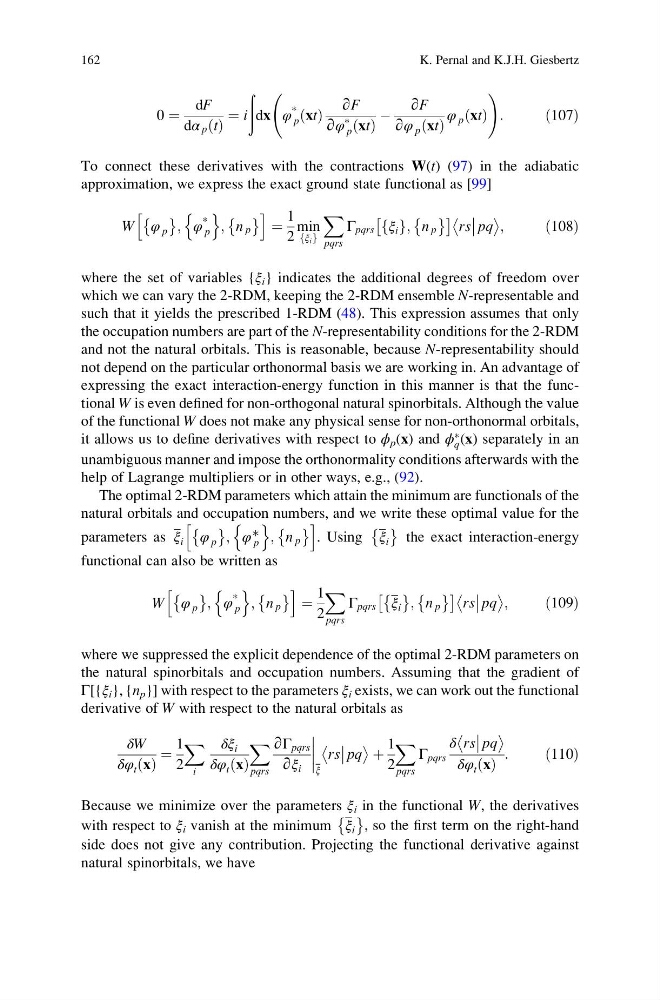
To connect these derivatives with the contractions W(t) (97) in the adiabatic
approximation, we express the exact ground state functional as [99]
W φ p
È É ; φ
*
p
n o
; n p
È É
h
i
¼
1
2
min
ξ i
f g
X
pqrs
Γ pqrs ξ i
f g; n p
È É
Â
Ã
rs
pq
;
ð108Þ
where the set of variables {ξ i } indicates the additional degrees of freedom over
which we can vary the 2-RDM, keeping the 2-RDM ensemble N-representable and
such that it yields the prescribed 1-RDM (48). This expression assumes that only
the occupation numbers are part of the N-representability conditions for the 2-RDM
and not the natural orbitals. This is reasonable, because N-representability should
not depend on the particular orthonormal basis we are working in. An advantage of
expressing the exact interaction-energy function in this manner is that the functional W is even defined for non-orthogonal natural spinorbitals. Although the value
of the functional W does not make any physical sense for non-orthonormal orbitals,
it allows us to define derivatives with respect to ϕ p (x) and ϕ
Ã
q (x) separately in an
unambiguous manner and impose the orthonormality conditions afterwards with the
help of Lagrange multipliers or in other ways, e.g., (92).
The optimal 2-RDM parameters which attain the minimum are functionals of the
natural orbitals and occupation numbers, and we write these optimal value for the
parameters as ξ i φ p
È É ; φ
∗
p
n o
; n p
È É
h
i
. Using ξ i
È É
the exact interaction-energy
functional can also be written as
W φ p
È É ; φ
*
p
n o
; n p
È É
h
i
¼
1
2
X
pqrs
Γ pqrs ξ i
È É ; n p
È É
Â
Ã
rs
pq
;
ð109Þ
where we suppressed the explicit dependence of the optimal 2-RDM parameters on
the natural spinorbitals and occupation numbers. Assuming that the gradient of
Γ[{ξ i }, {n p }] with respect to the parameters ξ i exists, we can work out the functional
derivative of W with respect to the natural orbitals as
δW
δφ t x
ð Þ
¼
1
2
X
i
δξ i
δφ t x
ð Þ
X
pqrs
∂Γ pqrs
∂ξ i
ξ
rs
pq
þ
1
2
X
pqrs
Γ pqrs
δ rs
pq
δφ t x
ð Þ
:
ð110Þ
Because we minimize over the parameters ξ i in the functional W, the derivatives
with respect to ξ i vanish at the minimum ξ i
È É
, so the first term on the right-hand
side does not give any contribution. Projecting the functional derivative against
natural spinorbitals, we have
162
K. Pernal and K.J.H. Giesbertz
dF
dα p t
ð Þ
¼ i
ð
dx φ
*
p xt
ð Þ
∂F
∂φ *
p xt
ð Þ
À
∂F
∂φ p xt
ð Þ
φ p xt
ð Þ
!
:
ð107Þ
To connect these derivatives with the contractions W(t) (97) in the adiabatic
approximation, we express the exact ground state functional as [99]
W φ p
È É ; φ
*
p
n o
; n p
È É
h
i
¼
1
2
min
ξ i
f g
X
pqrs
Γ pqrs ξ i
f g; n p
È É
Â
Ã
rs
pq
;
ð108Þ
where the set of variables {ξ i } indicates the additional degrees of freedom over
which we can vary the 2-RDM, keeping the 2-RDM ensemble N-representable and
such that it yields the prescribed 1-RDM (48). This expression assumes that only
the occupation numbers are part of the N-representability conditions for the 2-RDM
and not the natural orbitals. This is reasonable, because N-representability should
not depend on the particular orthonormal basis we are working in. An advantage of
expressing the exact interaction-energy function in this manner is that the functional W is even defined for non-orthogonal natural spinorbitals. Although the value
of the functional W does not make any physical sense for non-orthonormal orbitals,
it allows us to define derivatives with respect to ϕ p (x) and ϕ
Ã
q (x) separately in an
unambiguous manner and impose the orthonormality conditions afterwards with the
help of Lagrange multipliers or in other ways, e.g., (92).
The optimal 2-RDM parameters which attain the minimum are functionals of the
natural orbitals and occupation numbers, and we write these optimal value for the
parameters as ξ i φ p
È É ; φ
∗
p
n o
; n p
È É
h
i
. Using ξ i
È É
the exact interaction-energy
functional can also be written as
W φ p
È É ; φ
*
p
n o
; n p
È É
h
i
¼
1
2
X
pqrs
Γ pqrs ξ i
È É ; n p
È É
Â
Ã
rs
pq
;
ð109Þ
where we suppressed the explicit dependence of the optimal 2-RDM parameters on
the natural spinorbitals and occupation numbers. Assuming that the gradient of
Γ[{ξ i }, {n p }] with respect to the parameters ξ i exists, we can work out the functional
derivative of W with respect to the natural orbitals as
δW
δφ t x
ð Þ
¼
1
2
X
i
δξ i
δφ t x
ð Þ
X
pqrs
∂Γ pqrs
∂ξ i
ξ
rs
pq
þ
1
2
X
pqrs
Γ pqrs
δ rs
pq
δφ t x
ð Þ
:
ð110Þ
Because we minimize over the parameters ξ i in the functional W, the derivatives
with respect to ξ i vanish at the minimum ξ i
È É
, so the first term on the right-hand
side does not give any contribution. Projecting the functional derivative against
natural spinorbitals, we have
162
K. Pernal and K.J.H. Giesbertz