

ð
dx
δW
δφ p x
ð Þ
φ q x
ð Þ ¼
X
rst
Γ prst st
qr
¼ W pq :
ð111Þ
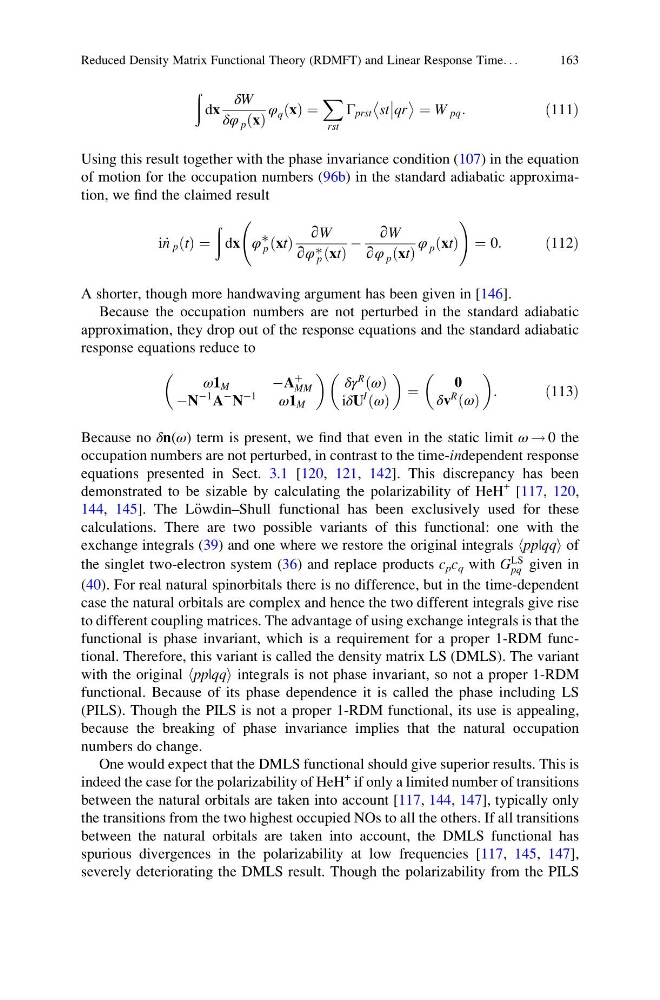
Using this result together with the phase invariance condition (107) in the equation
of motion for the occupation numbers (96b) in the standard adiabatic approximation, we find the claimed result
i _
n p t
ð Þ ¼
ð
dx φ
∗
p xt
ð Þ
∂W
∂φ ∗
p xt
ð Þ
À
∂W
∂φ p xt
ð Þ
φ p xt
ð Þ
!
¼ 0:
ð112Þ
A shorter, though more handwaving argument has been given in [146].
Because the occupation numbers are not perturbed in the standard adiabatic
approximation, they drop out of the response equations and the standard adiabatic
response equations reduce to
ω1 M
ÀA
þ
MM
ÀN
À1 A
À N
À1
ω1 M
δγ
R
ω
ð Þ
iδU
I
ω
ð Þ
¼
0
δv
R
ω
ð Þ
:
ð113Þ
Because no δn(ω) term is present, we find that even in the static limit ω ! 0 the
occupation numbers are not perturbed, in contrast to the time-independent response
equations presented in Sect. 3.1 [120, 121, 142]. This discrepancy has been
demonstrated to be sizable by calculating the polarizability of HeH
+ [117, 120,
144, 145]. The L€ owdin–Shull functional has been exclusively used for these
calculations. There are two possible variants of this functional: one with the
exchange integrals (39) and one where we restore the original integrals hpp|qqi of
the singlet two-electron system (36) and replace products c p c q with G
LS
pq given in
(40). For real natural spinorbitals there is no difference, but in the time-dependent
case the natural orbitals are complex and hence the two different integrals give rise
to different coupling matrices. The advantage of using exchange integrals is that the
functional is phase invariant, which is a requirement for a proper 1-RDM functional. Therefore, this variant is called the density matrix LS (DMLS). The variant
with the original hpp|qqi integrals is not phase invariant, so not a proper 1-RDM
functional. Because of its phase dependence it is called the phase including LS
(PILS). Though the PILS is not a proper 1-RDM functional, its use is appealing,
because the breaking of phase invariance implies that the natural occupation
numbers do change.
One would expect that the DMLS functional should give superior results. This is
indeed the case for the polarizability of HeH
+ if only a limited number of transitions
between the natural orbitals are taken into account [117, 144, 147], typically only
the transitions from the two highest occupied NOs to all the others. If all transitions
between the natural orbitals are taken into account, the DMLS functional has
spurious divergences in the polarizability at low frequencies [117, 145, 147],
severely deteriorating the DMLS result. Though the polarizability from the PILS
Reduced Density Matrix Functional Theory (RDMFT) and Linear Response Time. . .
163
dx
δW
δφ p x
ð Þ
φ q x
ð Þ ¼
X
rst
Γ prst st
qr
¼ W pq :
ð111Þ
Using this result together with the phase invariance condition (107) in the equation
of motion for the occupation numbers (96b) in the standard adiabatic approximation, we find the claimed result
i _
n p t
ð Þ ¼
ð
dx φ
∗
p xt
ð Þ
∂W
∂φ ∗
p xt
ð Þ
À
∂W
∂φ p xt
ð Þ
φ p xt
ð Þ
!
¼ 0:
ð112Þ
A shorter, though more handwaving argument has been given in [146].
Because the occupation numbers are not perturbed in the standard adiabatic
approximation, they drop out of the response equations and the standard adiabatic
response equations reduce to
ω1 M
ÀA
þ
MM
ÀN
À1 A
À N
À1
ω1 M
δγ
R
ω
ð Þ
iδU
I
ω
ð Þ
¼
0
δv
R
ω
ð Þ
:
ð113Þ
Because no δn(ω) term is present, we find that even in the static limit ω ! 0 the
occupation numbers are not perturbed, in contrast to the time-independent response
equations presented in Sect. 3.1 [120, 121, 142]. This discrepancy has been
demonstrated to be sizable by calculating the polarizability of HeH
+ [117, 120,
144, 145]. The L€ owdin–Shull functional has been exclusively used for these
calculations. There are two possible variants of this functional: one with the
exchange integrals (39) and one where we restore the original integrals hpp|qqi of
the singlet two-electron system (36) and replace products c p c q with G
LS
pq given in
(40). For real natural spinorbitals there is no difference, but in the time-dependent
case the natural orbitals are complex and hence the two different integrals give rise
to different coupling matrices. The advantage of using exchange integrals is that the
functional is phase invariant, which is a requirement for a proper 1-RDM functional. Therefore, this variant is called the density matrix LS (DMLS). The variant
with the original hpp|qqi integrals is not phase invariant, so not a proper 1-RDM
functional. Because of its phase dependence it is called the phase including LS
(PILS). Though the PILS is not a proper 1-RDM functional, its use is appealing,
because the breaking of phase invariance implies that the natural occupation
numbers do change.
One would expect that the DMLS functional should give superior results. This is
indeed the case for the polarizability of HeH
+ if only a limited number of transitions
between the natural orbitals are taken into account [117, 144, 147], typically only
the transitions from the two highest occupied NOs to all the others. If all transitions
between the natural orbitals are taken into account, the DMLS functional has
spurious divergences in the polarizability at low frequencies [117, 145, 147],
severely deteriorating the DMLS result. Though the polarizability from the PILS
Reduced Density Matrix Functional Theory (RDMFT) and Linear Response Time. . .
163