

5.3 Standard Adiabatic Approximation
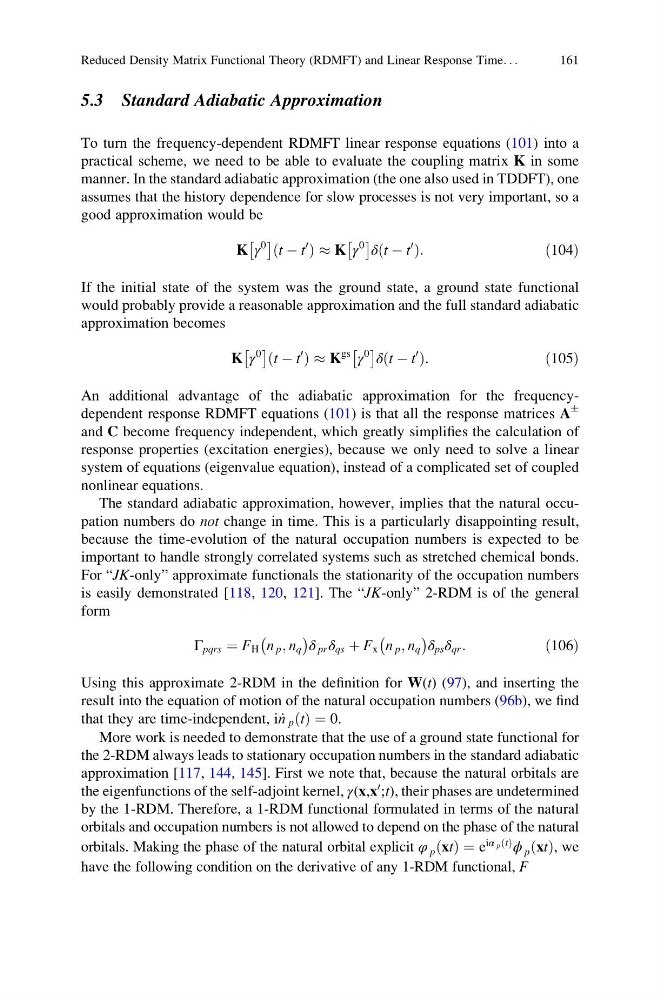
To turn the frequency-dependent RDMFT linear response equations (101) into a
practical scheme, we need to be able to evaluate the coupling matrix K in some
manner. In the standard adiabatic approximation (the one also used in TDDFT), one
assumes that the history dependence for slow processes is not very important, so a
good approximation would be
K γ
0
 Ã
t À t
0
ð
Þ%K γ
0
 Ã
δ t À t
0
ð
Þ:
ð104Þ
If the initial state of the system was the ground state, a ground state functional
would probably provide a reasonable approximation and the full standard adiabatic
approximation becomes
K γ
0
 Ã
t À t
0
ð
Þ%K
gs
γ
0
 Ã
δ t À t
0
ð
Þ:
ð105Þ
An additional advantage of the adiabatic approximation for the frequencydependent response RDMFT equations (101) is that all the response matrices A
Æ
and C become frequency independent, which greatly simplifies the calculation of
response properties (excitation energies), because we only need to solve a linear
system of equations (eigenvalue equation), instead of a complicated set of coupled
nonlinear equations.
The standard adiabatic approximation, however, implies that the natural occupation numbers do not change in time. This is a particularly disappointing result,
because the time-evolution of the natural occupation numbers is expected to be
important to handle strongly correlated systems such as stretched chemical bonds.
For “JK-only” approximate functionals the stationarity of the occupation numbers
is easily demonstrated [118, 120, 121]. The “JK-only” 2-RDM is of the general
form
Γ pqrs ¼ F H n p ; n q
À
Á δ pr δ qs þ F x n p ; n q
À
Á δ ps δ qr :
ð106Þ
Using this approximate 2-RDM in the definition for W(t) (97), and inserting the
result into the equation of motion of the natural occupation numbers (96b), we find
that they are time-independent, i _
n p t
ð Þ ¼ 0.
More work is needed to demonstrate that the use of a ground state functional for
the 2-RDM always leads to stationary occupation numbers in the standard adiabatic
approximation [117, 144, 145]. First we note that, because the natural orbitals are
the eigenfunctions of the self-adjoint kernel, γ(x,x
0 ;t), their phases are undetermined
by the 1-RDM. Therefore, a 1-RDM functional formulated in terms of the natural
orbitals and occupation numbers is not allowed to depend on the phase of the natural
orbitals. Making the phase of the natural orbital explicit φ p xt
ð Þ ¼ e
iα p t
ð Þ
ϕ p xt
ð Þ, we
have the following condition on the derivative of any 1-RDM functional, F
Reduced Density Matrix Functional Theory (RDMFT) and Linear Response Time. . .
161
To turn the frequency-dependent RDMFT linear response equations (101) into a
practical scheme, we need to be able to evaluate the coupling matrix K in some
manner. In the standard adiabatic approximation (the one also used in TDDFT), one
assumes that the history dependence for slow processes is not very important, so a
good approximation would be
K γ
0
 Ã
t À t
0
ð
Þ%K γ
0
 Ã
δ t À t
0
ð
Þ:
ð104Þ
If the initial state of the system was the ground state, a ground state functional
would probably provide a reasonable approximation and the full standard adiabatic
approximation becomes
K γ
0
 Ã
t À t
0
ð
Þ%K
gs
γ
0
 Ã
δ t À t
0
ð
Þ:
ð105Þ
An additional advantage of the adiabatic approximation for the frequencydependent response RDMFT equations (101) is that all the response matrices A
Æ
and C become frequency independent, which greatly simplifies the calculation of
response properties (excitation energies), because we only need to solve a linear
system of equations (eigenvalue equation), instead of a complicated set of coupled
nonlinear equations.
The standard adiabatic approximation, however, implies that the natural occupation numbers do not change in time. This is a particularly disappointing result,
because the time-evolution of the natural occupation numbers is expected to be
important to handle strongly correlated systems such as stretched chemical bonds.
For “JK-only” approximate functionals the stationarity of the occupation numbers
is easily demonstrated [118, 120, 121]. The “JK-only” 2-RDM is of the general
form
Γ pqrs ¼ F H n p ; n q
À
Á δ pr δ qs þ F x n p ; n q
À
Á δ ps δ qr :
ð106Þ
Using this approximate 2-RDM in the definition for W(t) (97), and inserting the
result into the equation of motion of the natural occupation numbers (96b), we find
that they are time-independent, i _
n p t
ð Þ ¼ 0.
More work is needed to demonstrate that the use of a ground state functional for
the 2-RDM always leads to stationary occupation numbers in the standard adiabatic
approximation [117, 144, 145]. First we note that, because the natural orbitals are
the eigenfunctions of the self-adjoint kernel, γ(x,x
0 ;t), their phases are undetermined
by the 1-RDM. Therefore, a 1-RDM functional formulated in terms of the natural
orbitals and occupation numbers is not allowed to depend on the phase of the natural
orbitals. Making the phase of the natural orbital explicit φ p xt
ð Þ ¼ e
iα p t
ð Þ
ϕ p xt
ð Þ, we
have the following condition on the derivative of any 1-RDM functional, F
Reduced Density Matrix Functional Theory (RDMFT) and Linear Response Time. . .
161