

The response matrix K[γ
0 ](τ) is the coupling matrix defined as [117, 119, 121,
141, 142]
K pq, rs γ
0
 Ã
t À t
0
ð
Þ¼
δ W
{
pq t
ð Þ À W pq t
ð Þ
δγ rs t 0
ð Þ
γ 0
ð100Þ
and plays the same role as the Hartree-exchange-correlation kernel, f Hxc (r, r
0 ,
t À t
0 ), in TDDFT [138, 143]. To obtain the frequency-dependent response equations, we simply need to take the Fourier transform of the time-dependent response
equations. Because the time-integral over the coupling matrix K(t À t
0 ) and the
perturbation in the 1-RDM has the form of a convolution, the Fourier transform
turns this integral into a simple product. If we further assume that the natural
spinorbitals of the unperturbed 1-RDM can be chosen to be real (no magnetic
fields), the frequency-dependent response equations can be cast into a particular
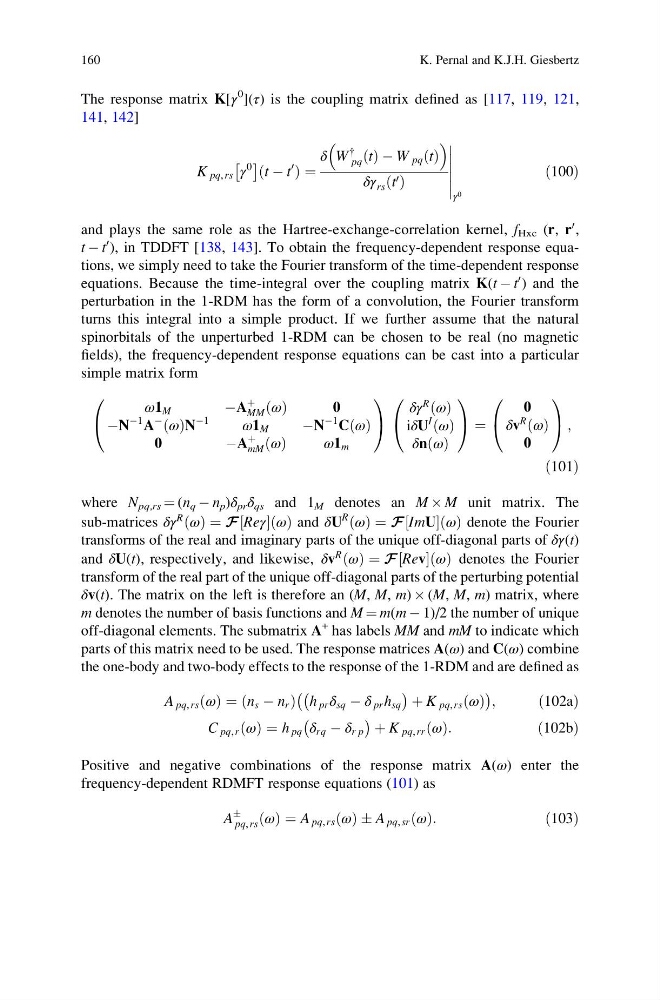
simple matrix form
ω1 M
ÀA
þ
MM ω
ð Þ
0
ÀN
À1 A
À
ω
ð ÞN
À1
ω1 M
ÀN
À1 C ω
ð Þ
0
ÀA
þ
mM ω
ð Þ
ω1 m
0
@
1
A
δγ
R
ω
ð Þ
iδU
I
ω
ð Þ
δn ω
ð Þ
0
@
1
A ¼
0
δv
R
ω
ð Þ
0
0
@
1
A ;
ð101Þ
where N pq,rs ¼ (n q À n p )δ pr δ qs and 1 M denotes an M Â M unit matrix. The
sub-matrices δγ
R
ω
ð Þ ¼ F Reγ
½
ω
ð Þ and δU
R
ω
ð Þ ¼ F ImU
½
ω
ð Þ denote the Fourier
transforms of the real and imaginary parts of the unique off-diagonal parts of δγ(t)
and δU(t), respectively, and likewise, δv
R
ω
ð Þ ¼ F Rev
½
ω
ð Þ denotes the Fourier
transform of the real part of the unique off-diagonal parts of the perturbing potential
δv(t). The matrix on the left is therefore an (M, M, m) Â (M, M, m) matrix, where
m denotes the number of basis functions and M ¼ m(m À 1)/2 the number of unique
off-diagonal elements. The submatrix A
+ has labels MM and mM to indicate which
parts of this matrix need to be used. The response matrices A(ω) and C(ω) combine
the one-body and two-body effects to the response of the 1-RDM and are defined as
A pq, rs ω
ð Þ ¼ n s À n r
ð
Þ h pr δ sq À δ pr h sq
À
Á þ K pq, rs ω
ð Þ
À
Á ;
ð102aÞ
C pq, r ω
ð Þ ¼ h pq δ rq À δ r p
À
Á þ K pq, rr ω
ð Þ:
ð102bÞ
Positive and negative combinations of the response matrix A(ω) enter the
frequency-dependent RDMFT response equations (101) as
A
Æ
pq, rs ω
ð Þ ¼ A pq, rs ω
ð Þ Æ A pq, sr ω
ð Þ:
ð103Þ
160
K. Pernal and K.J.H. Giesbertz
0 ](τ) is the coupling matrix defined as [117, 119, 121,
141, 142]
K pq, rs γ
0
 Ã
t À t
0
ð
Þ¼
δ W
{
pq t
ð Þ À W pq t
ð Þ
δγ rs t 0
ð Þ
γ 0
ð100Þ
and plays the same role as the Hartree-exchange-correlation kernel, f Hxc (r, r
0 ,
t À t
0 ), in TDDFT [138, 143]. To obtain the frequency-dependent response equations, we simply need to take the Fourier transform of the time-dependent response
equations. Because the time-integral over the coupling matrix K(t À t
0 ) and the
perturbation in the 1-RDM has the form of a convolution, the Fourier transform
turns this integral into a simple product. If we further assume that the natural
spinorbitals of the unperturbed 1-RDM can be chosen to be real (no magnetic
fields), the frequency-dependent response equations can be cast into a particular
simple matrix form
ω1 M
ÀA
þ
MM ω
ð Þ
0
ÀN
À1 A
À
ω
ð ÞN
À1
ω1 M
ÀN
À1 C ω
ð Þ
0
ÀA
þ
mM ω
ð Þ
ω1 m
0
@
1
A
δγ
R
ω
ð Þ
iδU
I
ω
ð Þ
δn ω
ð Þ
0
@
1
A ¼
0
δv
R
ω
ð Þ
0
0
@
1
A ;
ð101Þ
where N pq,rs ¼ (n q À n p )δ pr δ qs and 1 M denotes an M Â M unit matrix. The
sub-matrices δγ
R
ω
ð Þ ¼ F Reγ
½
ω
ð Þ and δU
R
ω
ð Þ ¼ F ImU
½
ω
ð Þ denote the Fourier
transforms of the real and imaginary parts of the unique off-diagonal parts of δγ(t)
and δU(t), respectively, and likewise, δv
R
ω
ð Þ ¼ F Rev
½
ω
ð Þ denotes the Fourier
transform of the real part of the unique off-diagonal parts of the perturbing potential
δv(t). The matrix on the left is therefore an (M, M, m) Â (M, M, m) matrix, where
m denotes the number of basis functions and M ¼ m(m À 1)/2 the number of unique
off-diagonal elements. The submatrix A
+ has labels MM and mM to indicate which
parts of this matrix need to be used. The response matrices A(ω) and C(ω) combine
the one-body and two-body effects to the response of the 1-RDM and are defined as
A pq, rs ω
ð Þ ¼ n s À n r
ð
Þ h pr δ sq À δ pr h sq
À
Á þ K pq, rs ω
ð Þ
À
Á ;
ð102aÞ
C pq, r ω
ð Þ ¼ h pq δ rq À δ r p
À
Á þ K pq, rr ω
ð Þ:
ð102bÞ
Positive and negative combinations of the response matrix A(ω) enter the
frequency-dependent RDMFT response equations (101) as
A
Æ
pq, rs ω
ð Þ ¼ A pq, rs ω
ð Þ Æ A pq, sr ω
ð Þ:
ð103Þ
160
K. Pernal and K.J.H. Giesbertz