

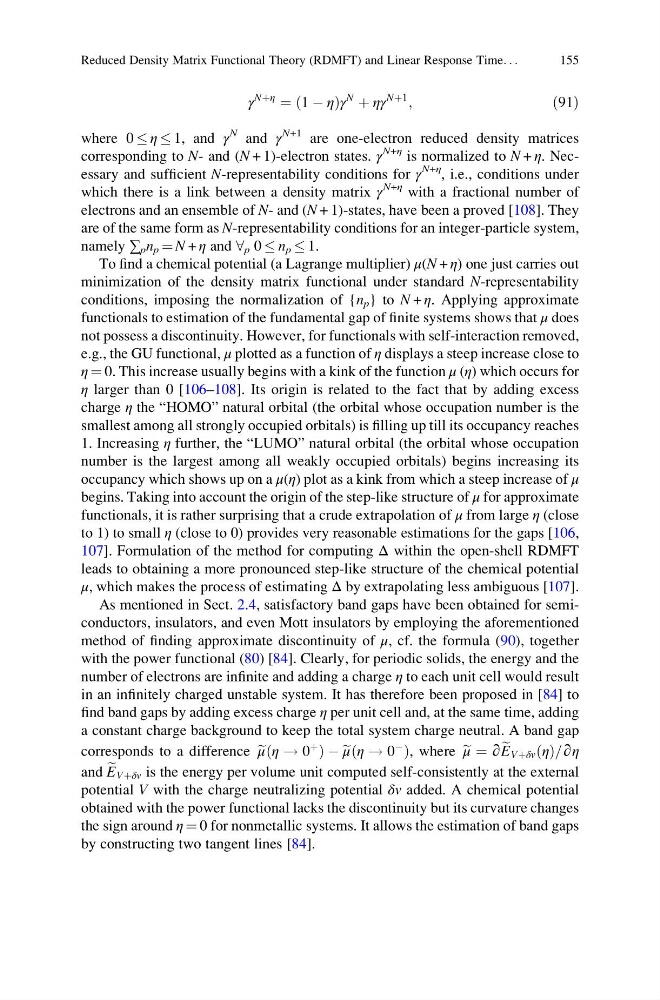
γ
Nþη
¼ 1 À η
ð
Þγ
N
þ ηγ
Nþ1
;
ð91Þ
where 0 η 1, and γ
N and γ
N+1 are one-electron reduced density matrices
corresponding to N- and (N + 1)-electron states. γ
N+η is normalized to N + η. Necessary and sufficient N-representability conditions for γ
N+η , i.e., conditions under
which there is a link between a density matrix γ
N+η with a fractional number of
electrons and an ensemble of N- and (N + 1)-states, have been a proved [108]. They
are of the same form as N-representability conditions for an integer-particle system,
namely ∑ p n p ¼ N + η and 8 p 0 n p 1.
To find a chemical potential (a Lagrange multiplier) μ(N + η) one just carries out
minimization of the density matrix functional under standard N-representability
conditions, imposing the normalization of {n p } to N + η. Applying approximate
functionals to estimation of the fundamental gap of finite systems shows that μ does
not possess a discontinuity. However, for functionals with self-interaction removed,
e.g., the GU functional, μ plotted as a function of η displays a steep increase close to
η ¼ 0. This increase usually begins with a kink of the function μ (η) which occurs for
η larger than 0 [106–108]. Its origin is related to the fact that by adding excess
charge η the “HOMO” natural orbital (the orbital whose occupation number is the
smallest among all strongly occupied orbitals) is filling up till its occupancy reaches
1. Increasing η further, the “LUMO” natural orbital (the orbital whose occupation
number is the largest among all weakly occupied orbitals) begins increasing its
occupancy which shows up on a μ(η) plot as a kink from which a steep increase of μ
begins. Taking into account the origin of the step-like structure of μ for approximate
functionals, it is rather surprising that a crude extrapolation of μ from large η (close
to 1) to small η (close to 0) provides very reasonable estimations for the gaps [106,
107]. Formulation of the method for computing Δ within the open-shell RDMFT
leads to obtaining a more pronounced step-like structure of the chemical potential
μ, which makes the process of estimating Δ by extrapolating less ambiguous [107].
As mentioned in Sect. 2.4, satisfactory band gaps have been obtained for semiconductors, insulators, and even Mott insulators by employing the aforementioned
method of finding approximate discontinuity of μ, cf. the formula (90), together
with the power functional (80) [84]. Clearly, for periodic solids, the energy and the
number of electrons are infinite and adding a charge η to each unit cell would result
in an infinitely charged unstable system. It has therefore been proposed in [84] to
find band gaps by adding excess charge η per unit cell and, at the same time, adding
a constant charge background to keep the total system charge neutral. A band gap
corresponds to a difference e
μ η ! 0
þ
ð
ÞÀe μ η ! 0
À
ð
Þ , where e
μ ¼ ∂ e
E Vþδv η
ð Þ=∂η
and e
E Vþδv is the energy per volume unit computed self-consistently at the external
potential V with the charge neutralizing potential δv added. A chemical potential
obtained with the power functional lacks the discontinuity but its curvature changes
the sign around η ¼ 0 for nonmetallic systems. It allows the estimation of band gaps
by constructing two tangent lines [84].
Reduced Density Matrix Functional Theory (RDMFT) and Linear Response Time. . .
155
Nþη
¼ 1 À η
ð
Þγ
N
þ ηγ
Nþ1
;
ð91Þ
where 0 η 1, and γ
N and γ
N+1 are one-electron reduced density matrices
corresponding to N- and (N + 1)-electron states. γ
N+η is normalized to N + η. Necessary and sufficient N-representability conditions for γ
N+η , i.e., conditions under
which there is a link between a density matrix γ
N+η with a fractional number of
electrons and an ensemble of N- and (N + 1)-states, have been a proved [108]. They
are of the same form as N-representability conditions for an integer-particle system,
namely ∑ p n p ¼ N + η and 8 p 0 n p 1.
To find a chemical potential (a Lagrange multiplier) μ(N + η) one just carries out
minimization of the density matrix functional under standard N-representability
conditions, imposing the normalization of {n p } to N + η. Applying approximate
functionals to estimation of the fundamental gap of finite systems shows that μ does
not possess a discontinuity. However, for functionals with self-interaction removed,
e.g., the GU functional, μ plotted as a function of η displays a steep increase close to
η ¼ 0. This increase usually begins with a kink of the function μ (η) which occurs for
η larger than 0 [106–108]. Its origin is related to the fact that by adding excess
charge η the “HOMO” natural orbital (the orbital whose occupation number is the
smallest among all strongly occupied orbitals) is filling up till its occupancy reaches
1. Increasing η further, the “LUMO” natural orbital (the orbital whose occupation
number is the largest among all weakly occupied orbitals) begins increasing its
occupancy which shows up on a μ(η) plot as a kink from which a steep increase of μ
begins. Taking into account the origin of the step-like structure of μ for approximate
functionals, it is rather surprising that a crude extrapolation of μ from large η (close
to 1) to small η (close to 0) provides very reasonable estimations for the gaps [106,
107]. Formulation of the method for computing Δ within the open-shell RDMFT
leads to obtaining a more pronounced step-like structure of the chemical potential
μ, which makes the process of estimating Δ by extrapolating less ambiguous [107].
As mentioned in Sect. 2.4, satisfactory band gaps have been obtained for semiconductors, insulators, and even Mott insulators by employing the aforementioned
method of finding approximate discontinuity of μ, cf. the formula (90), together
with the power functional (80) [84]. Clearly, for periodic solids, the energy and the
number of electrons are infinite and adding a charge η to each unit cell would result
in an infinitely charged unstable system. It has therefore been proposed in [84] to
find band gaps by adding excess charge η per unit cell and, at the same time, adding
a constant charge background to keep the total system charge neutral. A band gap
corresponds to a difference e
μ η ! 0
þ
ð
ÞÀe μ η ! 0
À
ð
Þ , where e
μ ¼ ∂ e
E Vþδv η
ð Þ=∂η
and e
E Vþδv is the energy per volume unit computed self-consistently at the external
potential V with the charge neutralizing potential δv added. A chemical potential
obtained with the power functional lacks the discontinuity but its curvature changes
the sign around η ¼ 0 for nonmetallic systems. It allows the estimation of band gaps
by constructing two tangent lines [84].
Reduced Density Matrix Functional Theory (RDMFT) and Linear Response Time. . .
155