

4 Optimization of Density Matrix Functionals
As mentioned in the introduction, the RDMFT approximations, apart from being
accurate, are expected to be competitive with one-electron methods in terms of
computational efficiency. RDMFT is based on the variational principle given in
(11) according to which a ground state energy of a given system can be obtained by
minimizing the energy functional on the set of N-representable density matrices.
Thus, the optimization is of the constrained-type, because it must take into account
N-representability conditions provided in (3)–(5). Because the conditions are given
in the forms of equalities and inequalities involving eigenvalues and eigenvectors
of 1-RDM, it implies that imposing N-representability conditions would require
carrying out diagonalization of γ even for explicit functionals of γ.
An efficient algorithm offering optimization of the functional directly with
respect to the whole density matrix or its square root has been proposed
[109]. The N-representability of γ is imposed in each iteration step by projecting
γ resulting from unconstrained directional optimization onto the space of N-representable 1-RDMs. An advantage of the proposed projected gradient algorithm is
that, because the gradient is taken with respect to the elements of γ, changes in
natural orbitals are coupled with variations of the occupancies which should lead to
faster convergence. The proposed projection algorithm has been shown to work
efficiently for Hartree–Fock (15) or BB (20) functionals. For other functionals,
which are given in terms of orbitals and occupation numbers and are not proper
functionals of γ (e.g., GU or BBC functionals), it is still possible to compute the
gradient with respect to γ but the projected gradient algorithm converges disappointingly slowly [109].
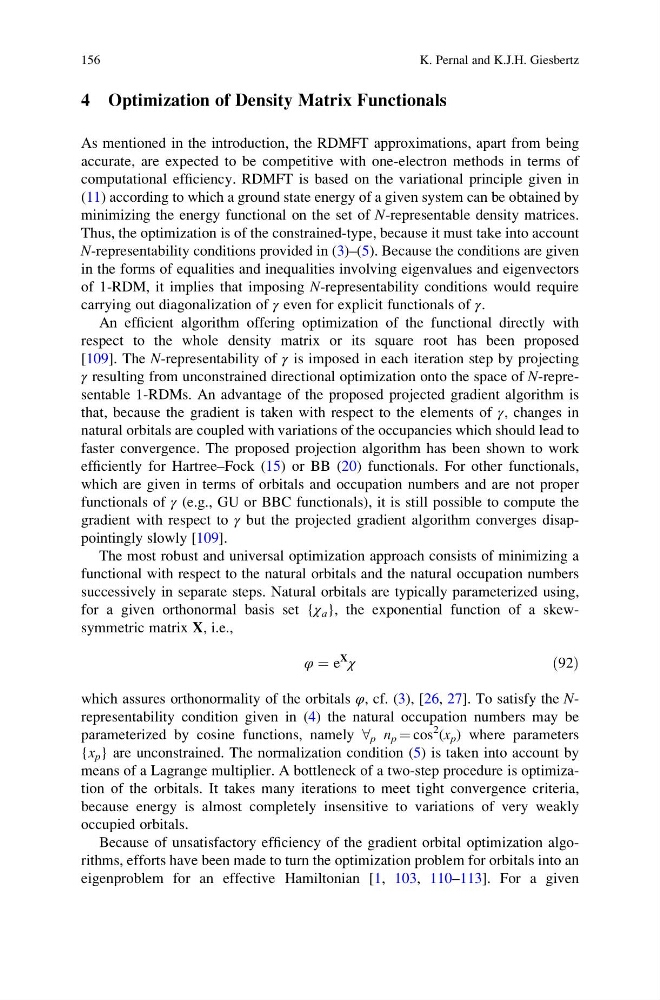
The most robust and universal optimization approach consists of minimizing a
functional with respect to the natural orbitals and the natural occupation numbers
successively in separate steps. Natural orbitals are typically parameterized using,
for a given orthonormal basis set {χ a }, the exponential function of a skewsymmetric matrix X, i.e.,
φ ¼ e
X
χ
ð92Þ
which assures orthonormality of the orbitals φ, cf. (3), [26, 27]. To satisfy the Nrepresentability condition given in (4) the natural occupation numbers may be
parameterized by cosine functions, namely 8 p n p ¼ cos
2 (x p ) where parameters
{x p } are unconstrained. The normalization condition (5) is taken into account by
means of a Lagrange multiplier. A bottleneck of a two-step procedure is optimization of the orbitals. It takes many iterations to meet tight convergence criteria,
because energy is almost completely insensitive to variations of very weakly
occupied orbitals.
Because of unsatisfactory efficiency of the gradient orbital optimization algorithms, efforts have been made to turn the optimization problem for orbitals into an
eigenproblem for an effective Hamiltonian [1, 103, 110–113]. For a given
156
K. Pernal and K.J.H. Giesbertz
As mentioned in the introduction, the RDMFT approximations, apart from being
accurate, are expected to be competitive with one-electron methods in terms of
computational efficiency. RDMFT is based on the variational principle given in
(11) according to which a ground state energy of a given system can be obtained by
minimizing the energy functional on the set of N-representable density matrices.
Thus, the optimization is of the constrained-type, because it must take into account
N-representability conditions provided in (3)–(5). Because the conditions are given
in the forms of equalities and inequalities involving eigenvalues and eigenvectors
of 1-RDM, it implies that imposing N-representability conditions would require
carrying out diagonalization of γ even for explicit functionals of γ.
An efficient algorithm offering optimization of the functional directly with
respect to the whole density matrix or its square root has been proposed
[109]. The N-representability of γ is imposed in each iteration step by projecting
γ resulting from unconstrained directional optimization onto the space of N-representable 1-RDMs. An advantage of the proposed projected gradient algorithm is
that, because the gradient is taken with respect to the elements of γ, changes in
natural orbitals are coupled with variations of the occupancies which should lead to
faster convergence. The proposed projection algorithm has been shown to work
efficiently for Hartree–Fock (15) or BB (20) functionals. For other functionals,
which are given in terms of orbitals and occupation numbers and are not proper
functionals of γ (e.g., GU or BBC functionals), it is still possible to compute the
gradient with respect to γ but the projected gradient algorithm converges disappointingly slowly [109].
The most robust and universal optimization approach consists of minimizing a
functional with respect to the natural orbitals and the natural occupation numbers
successively in separate steps. Natural orbitals are typically parameterized using,
for a given orthonormal basis set {χ a }, the exponential function of a skewsymmetric matrix X, i.e.,
φ ¼ e
X
χ
ð92Þ
which assures orthonormality of the orbitals φ, cf. (3), [26, 27]. To satisfy the Nrepresentability condition given in (4) the natural occupation numbers may be
parameterized by cosine functions, namely 8 p n p ¼ cos
2 (x p ) where parameters
{x p } are unconstrained. The normalization condition (5) is taken into account by
means of a Lagrange multiplier. A bottleneck of a two-step procedure is optimization of the orbitals. It takes many iterations to meet tight convergence criteria,
because energy is almost completely insensitive to variations of very weakly
occupied orbitals.
Because of unsatisfactory efficiency of the gradient orbital optimization algorithms, efforts have been made to turn the optimization problem for orbitals into an
eigenproblem for an effective Hamiltonian [1, 103, 110–113]. For a given
156
K. Pernal and K.J.H. Giesbertz