

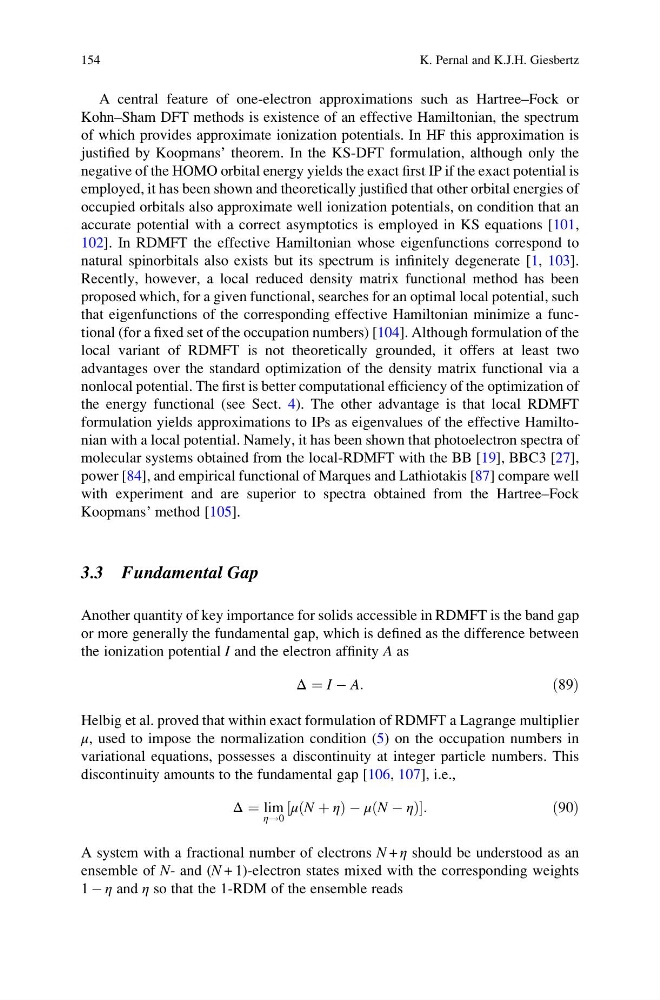
A central feature of one-electron approximations such as Hartree–Fock or
Kohn–Sham DFT methods is existence of an effective Hamiltonian, the spectrum
of which provides approximate ionization potentials. In HF this approximation is
justified by Koopmans’ theorem. In the KS-DFT formulation, although only the
negative of the HOMO orbital energy yields the exact first IP if the exact potential is
employed, it has been shown and theoretically justified that other orbital energies of
occupied orbitals also approximate well ionization potentials, on condition that an
accurate potential with a correct asymptotics is employed in KS equations [101,
102]. In RDMFT the effective Hamiltonian whose eigenfunctions correspond to
natural spinorbitals also exists but its spectrum is infinitely degenerate [1, 103].
Recently, however, a local reduced density matrix functional method has been
proposed which, for a given functional, searches for an optimal local potential, such
that eigenfunctions of the corresponding effective Hamiltonian minimize a functional (for a fixed set of the occupation numbers) [104]. Although formulation of the
local variant of RDMFT is not theoretically grounded, it offers at least two
advantages over the standard optimization of the density matrix functional via a
nonlocal potential. The first is better computational efficiency of the optimization of
the energy functional (see Sect. 4). The other advantage is that local RDMFT
formulation yields approximations to IPs as eigenvalues of the effective Hamiltonian with a local potential. Namely, it has been shown that photoelectron spectra of
molecular systems obtained from the local-RDMFT with the BB [19], BBC3 [27],
power [84], and empirical functional of Marques and Lathiotakis [87] compare well
with experiment and are superior to spectra obtained from the Hartree–Fock
Koopmans’ method [105].
3.3 Fundamental Gap
Another quantity of key importance for solids accessible in RDMFT is the band gap
or more generally the fundamental gap, which is defined as the difference between
the ionization potential I and the electron affinity A as
Δ ¼ I À A:
ð89Þ
Helbig et al. proved that within exact formulation of RDMFT a Lagrange multiplier
μ, used to impose the normalization condition (5) on the occupation numbers in
variational equations, possesses a discontinuity at integer particle numbers. This
discontinuity amounts to the fundamental gap [106, 107], i.e.,
Δ ¼ lim
η!0
μ N þ η
ð
ÞÀμ N À η
ð
Þ
½
:
ð90Þ
A system with a fractional number of electrons N + η should be understood as an
ensemble of N- and (N + 1)-electron states mixed with the corresponding weights
1 À η and η so that the 1-RDM of the ensemble reads
154
K. Pernal and K.J.H. Giesbertz
Kohn–Sham DFT methods is existence of an effective Hamiltonian, the spectrum
of which provides approximate ionization potentials. In HF this approximation is
justified by Koopmans’ theorem. In the KS-DFT formulation, although only the
negative of the HOMO orbital energy yields the exact first IP if the exact potential is
employed, it has been shown and theoretically justified that other orbital energies of
occupied orbitals also approximate well ionization potentials, on condition that an
accurate potential with a correct asymptotics is employed in KS equations [101,
102]. In RDMFT the effective Hamiltonian whose eigenfunctions correspond to
natural spinorbitals also exists but its spectrum is infinitely degenerate [1, 103].
Recently, however, a local reduced density matrix functional method has been
proposed which, for a given functional, searches for an optimal local potential, such
that eigenfunctions of the corresponding effective Hamiltonian minimize a functional (for a fixed set of the occupation numbers) [104]. Although formulation of the
local variant of RDMFT is not theoretically grounded, it offers at least two
advantages over the standard optimization of the density matrix functional via a
nonlocal potential. The first is better computational efficiency of the optimization of
the energy functional (see Sect. 4). The other advantage is that local RDMFT
formulation yields approximations to IPs as eigenvalues of the effective Hamiltonian with a local potential. Namely, it has been shown that photoelectron spectra of
molecular systems obtained from the local-RDMFT with the BB [19], BBC3 [27],
power [84], and empirical functional of Marques and Lathiotakis [87] compare well
with experiment and are superior to spectra obtained from the Hartree–Fock
Koopmans’ method [105].
3.3 Fundamental Gap
Another quantity of key importance for solids accessible in RDMFT is the band gap
or more generally the fundamental gap, which is defined as the difference between
the ionization potential I and the electron affinity A as
Δ ¼ I À A:
ð89Þ
Helbig et al. proved that within exact formulation of RDMFT a Lagrange multiplier
μ, used to impose the normalization condition (5) on the occupation numbers in
variational equations, possesses a discontinuity at integer particle numbers. This
discontinuity amounts to the fundamental gap [106, 107], i.e.,
Δ ¼ lim
η!0
μ N þ η
ð
ÞÀμ N À η
ð
Þ
½
:
ð90Þ
A system with a fractional number of electrons N + η should be understood as an
ensemble of N- and (N + 1)-electron states mixed with the corresponding weights
1 À η and η so that the 1-RDM of the ensemble reads
154
K. Pernal and K.J.H. Giesbertz