

3.2 Ionization Potentials
A number of methods for predicting vertical ionization potentials (IPs) have been
proposed within RDMFT. The most straightforward approach involves performing
calculations of energies for a neutral and ionized species [93–95]. Apart from the
fact that such multiple calculations are time consuming, it has been pointed out in
[95] that inaccuracy may arise because of different treatment of closed- and openshell systems in RDMFT.
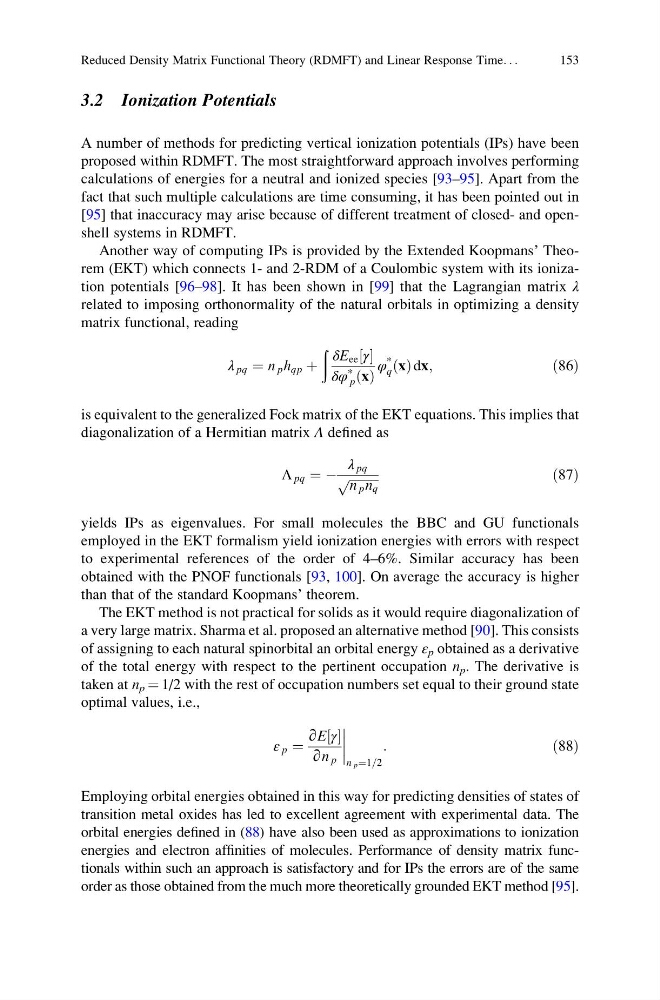
Another way of computing IPs is provided by the Extended Koopmans’ Theorem (EKT) which connects 1- and 2-RDM of a Coulombic system with its ionization potentials [96–98]. It has been shown in [99] that the Lagrangian matrix λ
related to imposing orthonormality of the natural orbitals in optimizing a density
matrix functional, reading
λ pq ¼ n p h qp þ
ð δE ee γ
½
δφ *
p x
ð Þ
φ
*
q x
ð Þdx;
ð86Þ
is equivalent to the generalized Fock matrix of the EKT equations. This implies that
diagonalization of a Hermitian matrix Λ defined as
Λ pq ¼ À
λ pq
ffiffiffiffiffiffiffiffiffi ffi
n p n q
p
ð87Þ
yields IPs as eigenvalues. For small molecules the BBC and GU functionals
employed in the EKT formalism yield ionization energies with errors with respect
to experimental references of the order of 4–6%. Similar accuracy has been
obtained with the PNOF functionals [93, 100]. On average the accuracy is higher
than that of the standard Koopmans’ theorem.
The EKT method is not practical for solids as it would require diagonalization of
a very large matrix. Sharma et al. proposed an alternative method [90]. This consists
of assigning to each natural spinorbital an orbital energy ε p obtained as a derivative
of the total energy with respect to the pertinent occupation n p . The derivative is
taken at n p ¼ 1/2 with the rest of occupation numbers set equal to their ground state
optimal values, i.e.,
ε p ¼
∂E γ
½
∂n p
n p ¼1=2
:
ð88Þ
Employing orbital energies obtained in this way for predicting densities of states of
transition metal oxides has led to excellent agreement with experimental data. The
orbital energies defined in (88) have also been used as approximations to ionization
energies and electron affinities of molecules. Performance of density matrix functionals within such an approach is satisfactory and for IPs the errors are of the same
order as those obtained from the much more theoretically grounded EKT method [95].
Reduced Density Matrix Functional Theory (RDMFT) and Linear Response Time. . .
153
A number of methods for predicting vertical ionization potentials (IPs) have been
proposed within RDMFT. The most straightforward approach involves performing
calculations of energies for a neutral and ionized species [93–95]. Apart from the
fact that such multiple calculations are time consuming, it has been pointed out in
[95] that inaccuracy may arise because of different treatment of closed- and openshell systems in RDMFT.
Another way of computing IPs is provided by the Extended Koopmans’ Theorem (EKT) which connects 1- and 2-RDM of a Coulombic system with its ionization potentials [96–98]. It has been shown in [99] that the Lagrangian matrix λ
related to imposing orthonormality of the natural orbitals in optimizing a density
matrix functional, reading
λ pq ¼ n p h qp þ
ð δE ee γ
½
δφ *
p x
ð Þ
φ
*
q x
ð Þdx;
ð86Þ
is equivalent to the generalized Fock matrix of the EKT equations. This implies that
diagonalization of a Hermitian matrix Λ defined as
Λ pq ¼ À
λ pq
ffiffiffiffiffiffiffiffiffi ffi
n p n q
p
ð87Þ
yields IPs as eigenvalues. For small molecules the BBC and GU functionals
employed in the EKT formalism yield ionization energies with errors with respect
to experimental references of the order of 4–6%. Similar accuracy has been
obtained with the PNOF functionals [93, 100]. On average the accuracy is higher
than that of the standard Koopmans’ theorem.
The EKT method is not practical for solids as it would require diagonalization of
a very large matrix. Sharma et al. proposed an alternative method [90]. This consists
of assigning to each natural spinorbital an orbital energy ε p obtained as a derivative
of the total energy with respect to the pertinent occupation n p . The derivative is
taken at n p ¼ 1/2 with the rest of occupation numbers set equal to their ground state
optimal values, i.e.,
ε p ¼
∂E γ
½
∂n p
n p ¼1=2
:
ð88Þ
Employing orbital energies obtained in this way for predicting densities of states of
transition metal oxides has led to excellent agreement with experimental data. The
orbital energies defined in (88) have also been used as approximations to ionization
energies and electron affinities of molecules. Performance of density matrix functionals within such an approach is satisfactory and for IPs the errors are of the same
order as those obtained from the much more theoretically grounded EKT method [95].
Reduced Density Matrix Functional Theory (RDMFT) and Linear Response Time. . .
153