

3.1 Response Properties
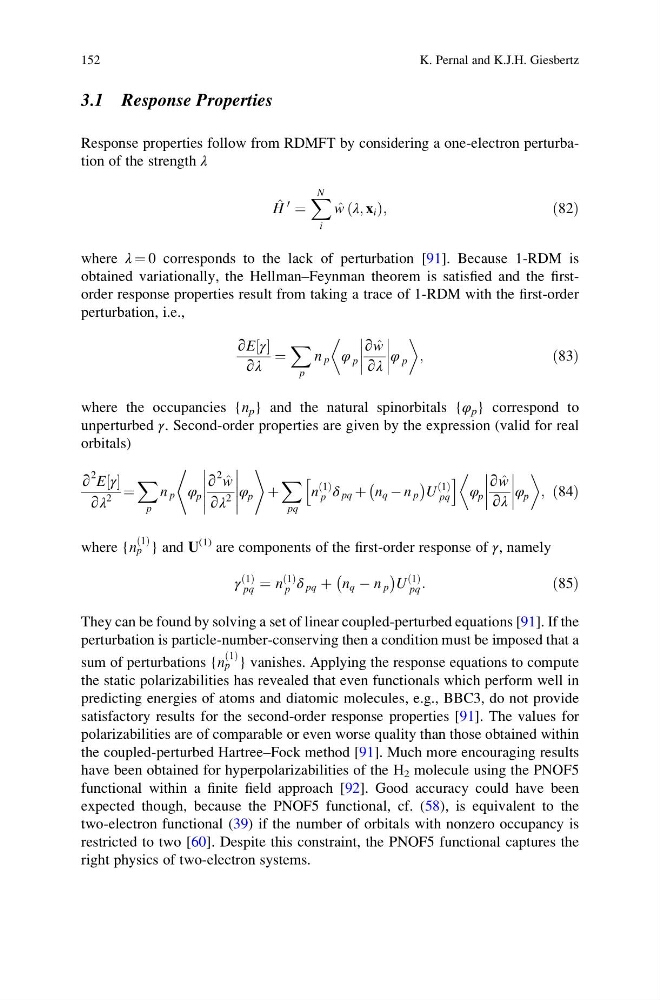
Response properties follow from RDMFT by considering a one-electron perturbation of the strength λ
^
H
0
¼
X N
i
^
w λ; x i
ð
Þ;
ð82Þ
where λ ¼ 0 corresponds to the lack of perturbation [91]. Because 1-RDM is
obtained variationally, the Hellman–Feynman theorem is satisfied and the firstorder response properties result from taking a trace of 1-RDM with the first-order
perturbation, i.e.,
∂E γ
½
∂λ
¼
X
p
n p φ p
∂ ^
w
∂λ
φ p
(
)
;
ð83Þ
where the occupancies {n p } and the natural spinorbitals {φ p } correspond to
unperturbed γ. Second-order properties are given by the expression (valid for real
orbitals)
∂
2 E γ
½
∂λ
2
¼
X
p
n p φ p
∂
2 ^
w
∂λ
2
φ p
*
+
þ
X
pq
n
1
ð Þ
p δ pq þ n q À n p
À
Á
U
1
ð Þ
pq
h
i
φ p
∂ ^
w
∂λ
φ p
(
)
; ð84Þ
where {n
ð1Þ
p } and U
(1) are components of the first-order response of γ, namely
γ
1
ð Þ
pq ¼ n
1
ð Þ
p δ pq þ n q À n p
À
Á
U
1
ð Þ
pq :
ð85Þ
They can be found by solving a set of linear coupled-perturbed equations [91]. If the
perturbation is particle-number-conserving then a condition must be imposed that a
sum of perturbations {n
ð1Þ
p } vanishes. Applying the response equations to compute
the static polarizabilities has revealed that even functionals which perform well in
predicting energies of atoms and diatomic molecules, e.g., BBC3, do not provide
satisfactory results for the second-order response properties [91]. The values for
polarizabilities are of comparable or even worse quality than those obtained within
the coupled-perturbed Hartree–Fock method [91]. Much more encouraging results
have been obtained for hyperpolarizabilities of the H 2 molecule using the PNOF5
functional within a finite field approach [92]. Good accuracy could have been
expected though, because the PNOF5 functional, cf. (58), is equivalent to the
two-electron functional (39) if the number of orbitals with nonzero occupancy is
restricted to two [60]. Despite this constraint, the PNOF5 functional captures the
right physics of two-electron systems.
152
K. Pernal and K.J.H. Giesbertz
Response properties follow from RDMFT by considering a one-electron perturbation of the strength λ
^
H
0
¼
X N
i
^
w λ; x i
ð
Þ;
ð82Þ
where λ ¼ 0 corresponds to the lack of perturbation [91]. Because 1-RDM is
obtained variationally, the Hellman–Feynman theorem is satisfied and the firstorder response properties result from taking a trace of 1-RDM with the first-order
perturbation, i.e.,
∂E γ
½
∂λ
¼
X
p
n p φ p
∂ ^
w
∂λ
φ p
(
)
;
ð83Þ
where the occupancies {n p } and the natural spinorbitals {φ p } correspond to
unperturbed γ. Second-order properties are given by the expression (valid for real
orbitals)
∂
2 E γ
½
∂λ
2
¼
X
p
n p φ p
∂
2 ^
w
∂λ
2
φ p
*
+
þ
X
pq
n
1
ð Þ
p δ pq þ n q À n p
À
Á
U
1
ð Þ
pq
h
i
φ p
∂ ^
w
∂λ
φ p
(
)
; ð84Þ
where {n
ð1Þ
p } and U
(1) are components of the first-order response of γ, namely
γ
1
ð Þ
pq ¼ n
1
ð Þ
p δ pq þ n q À n p
À
Á
U
1
ð Þ
pq :
ð85Þ
They can be found by solving a set of linear coupled-perturbed equations [91]. If the
perturbation is particle-number-conserving then a condition must be imposed that a
sum of perturbations {n
ð1Þ
p } vanishes. Applying the response equations to compute
the static polarizabilities has revealed that even functionals which perform well in
predicting energies of atoms and diatomic molecules, e.g., BBC3, do not provide
satisfactory results for the second-order response properties [91]. The values for
polarizabilities are of comparable or even worse quality than those obtained within
the coupled-perturbed Hartree–Fock method [91]. Much more encouraging results
have been obtained for hyperpolarizabilities of the H 2 molecule using the PNOF5
functional within a finite field approach [92]. Good accuracy could have been
expected though, because the PNOF5 functional, cf. (58), is equivalent to the
two-electron functional (39) if the number of orbitals with nonzero occupancy is
restricted to two [60]. Despite this constraint, the PNOF5 functional captures the
right physics of two-electron systems.
152
K. Pernal and K.J.H. Giesbertz