

2.4 Empirical Density Matrix Functionals
Approximate density matrix functionals cannot be rigorously derived. Rather, the
form of the functional is proposed by taking into account properties of the exact
functional. The applicability of density matrix functionals is not limited to finite
systems (atoms and molecules); in principle, most of them could also be applied to
solids. However, functionals such as BBC, AC3, or the recent PNOF approximations account for a sophisticated interplay between orbitals which is necessary to
predict bond stretching and breaking. It is therefore not so surprising that performance of BBC1 and BBC2 functionals for a model extended system, namely the
homogeneous electron gas (HEG), is quite poor. The accuracy of predicted correlation energy and the quality of momentum distribution for the HEG described with
these functionals are unsatisfactory even for metallic densities. Admittedly, they
still perform better than the other simple density matrix functionals defined in (20)
and (23) such as BB or CHF [82, 83]. It should be noted that an exact exchangecorrelation density matrix functional working for the HEG is not known even for a
high-density limit, which is the reason why this system does not serve as a starting
point for developing new density matrix functionals. In order to develop functionals
for extended systems one could try introducing some empirical parameters into
known approximate functionals and fitting them to experimental data.
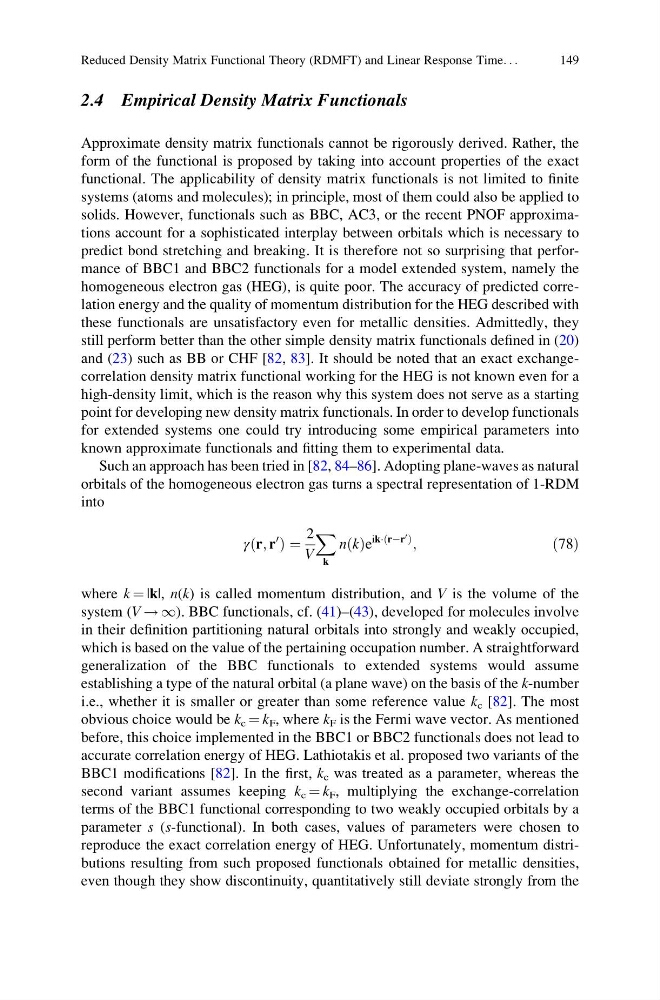
Such an approach has been tried in [82, 84–86]. Adopting plane-waves as natural
orbitals of the homogeneous electron gas turns a spectral representation of 1-RDM
into
γ r; r
0
ð
Þ ¼
2
V
X
k
n k
ð Þe
ikÁ rÀr
0
ð
Þ
;
ð78Þ
where k ¼ |k|, n(k) is called momentum distribution, and V is the volume of the
system (V ! 1). BBC functionals, cf. (41)–(43), developed for molecules involve
in their definition partitioning natural orbitals into strongly and weakly occupied,
which is based on the value of the pertaining occupation number. A straightforward
generalization of the BBC functionals to extended systems would assume
establishing a type of the natural orbital (a plane wave) on the basis of the k-number
i.e., whether it is smaller or greater than some reference value k c [82]. The most
obvious choice would be k c ¼ k F , where k F is the Fermi wave vector. As mentioned
before, this choice implemented in the BBC1 or BBC2 functionals does not lead to
accurate correlation energy of HEG. Lathiotakis et al. proposed two variants of the
BBC1 modifications [82]. In the first, k c was treated as a parameter, whereas the
second variant assumes keeping k c ¼ k F , multiplying the exchange-correlation
terms of the BBC1 functional corresponding to two weakly occupied orbitals by a
parameter s (s-functional). In both cases, values of parameters were chosen to
reproduce the exact correlation energy of HEG. Unfortunately, momentum distributions resulting from such proposed functionals obtained for metallic densities,
even though they show discontinuity, quantitatively still deviate strongly from the
Reduced Density Matrix Functional Theory (RDMFT) and Linear Response Time. . .
149
Approximate density matrix functionals cannot be rigorously derived. Rather, the
form of the functional is proposed by taking into account properties of the exact
functional. The applicability of density matrix functionals is not limited to finite
systems (atoms and molecules); in principle, most of them could also be applied to
solids. However, functionals such as BBC, AC3, or the recent PNOF approximations account for a sophisticated interplay between orbitals which is necessary to
predict bond stretching and breaking. It is therefore not so surprising that performance of BBC1 and BBC2 functionals for a model extended system, namely the
homogeneous electron gas (HEG), is quite poor. The accuracy of predicted correlation energy and the quality of momentum distribution for the HEG described with
these functionals are unsatisfactory even for metallic densities. Admittedly, they
still perform better than the other simple density matrix functionals defined in (20)
and (23) such as BB or CHF [82, 83]. It should be noted that an exact exchangecorrelation density matrix functional working for the HEG is not known even for a
high-density limit, which is the reason why this system does not serve as a starting
point for developing new density matrix functionals. In order to develop functionals
for extended systems one could try introducing some empirical parameters into
known approximate functionals and fitting them to experimental data.
Such an approach has been tried in [82, 84–86]. Adopting plane-waves as natural
orbitals of the homogeneous electron gas turns a spectral representation of 1-RDM
into
γ r; r
0
ð
Þ ¼
2
V
X
k
n k
ð Þe
ikÁ rÀr
0
ð
Þ
;
ð78Þ
where k ¼ |k|, n(k) is called momentum distribution, and V is the volume of the
system (V ! 1). BBC functionals, cf. (41)–(43), developed for molecules involve
in their definition partitioning natural orbitals into strongly and weakly occupied,
which is based on the value of the pertaining occupation number. A straightforward
generalization of the BBC functionals to extended systems would assume
establishing a type of the natural orbital (a plane wave) on the basis of the k-number
i.e., whether it is smaller or greater than some reference value k c [82]. The most
obvious choice would be k c ¼ k F , where k F is the Fermi wave vector. As mentioned
before, this choice implemented in the BBC1 or BBC2 functionals does not lead to
accurate correlation energy of HEG. Lathiotakis et al. proposed two variants of the
BBC1 modifications [82]. In the first, k c was treated as a parameter, whereas the
second variant assumes keeping k c ¼ k F , multiplying the exchange-correlation
terms of the BBC1 functional corresponding to two weakly occupied orbitals by a
parameter s (s-functional). In both cases, values of parameters were chosen to
reproduce the exact correlation energy of HEG. Unfortunately, momentum distributions resulting from such proposed functionals obtained for metallic densities,
even though they show discontinuity, quantitatively still deviate strongly from the
Reduced Density Matrix Functional Theory (RDMFT) and Linear Response Time. . .
149