

accurate references. Adaptation of the s-functional developed for the electron gas to
finite systems has led to surprisingly accurate values of energy for molecules at
their equilibrium geometry but it has been also revealed that the functional is not
size-consistent and it fails in the description of potential energy curves [85].
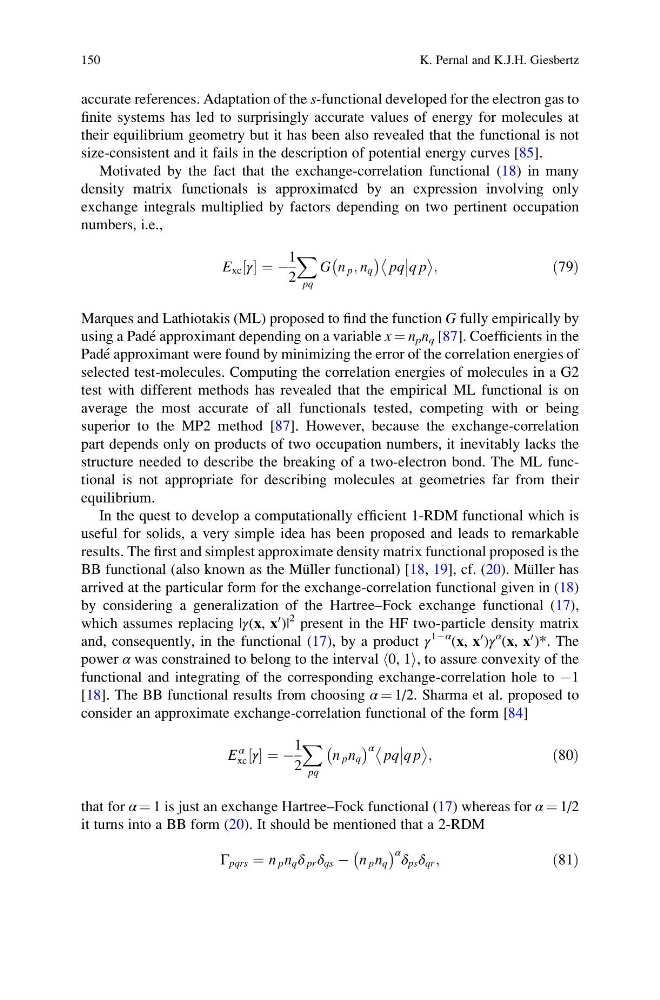
Motivated by the fact that the exchange-correlation functional (18) in many
density matrix functionals is approximated by an expression involving only
exchange integrals multiplied by factors depending on two pertinent occupation
numbers, i.e.,
E xc γ
½ ¼ À
1
2
X
pq
G n p ; n q
À
Á
pq
q p
;
ð79Þ
Marques and Lathiotakis (ML) proposed to find the function G fully empirically by
using a Pade ´ approximant depending on a variable x ¼ n p n q [87]. Coefficients in the
Pade ´ approximant were found by minimizing the error of the correlation energies of
selected test-molecules. Computing the correlation energies of molecules in a G2
test with different methods has revealed that the empirical ML functional is on
average the most accurate of all functionals tested, competing with or being
superior to the MP2 method [87]. However, because the exchange-correlation
part depends only on products of two occupation numbers, it inevitably lacks the
structure needed to describe the breaking of a two-electron bond. The ML functional is not appropriate for describing molecules at geometries far from their
equilibrium.
In the quest to develop a computationally efficient 1-RDM functional which is
useful for solids, a very simple idea has been proposed and leads to remarkable
results. The first and simplest approximate density matrix functional proposed is the
BB functional (also known as the Mu ¨ller functional) [18, 19], cf. (20). Mu ¨ller has
arrived at the particular form for the exchange-correlation functional given in (18)
by considering a generalization of the Hartree–Fock exchange functional (17),
which assumes replacing |γ(x, x
0 )|
2 present in the HF two-particle density matrix
and, consequently, in the functional (17), by a product γ
1Àα (x, x
0 )γ
α
(x, x
0 )*. The
power α was constrained to belong to the interval h0, 1i, to assure convexity of the
functional and integrating of the corresponding exchange-correlation hole to À1
[18]. The BB functional results from choosing α ¼ 1/2. Sharma et al. proposed to
consider an approximate exchange-correlation functional of the form [84]
E
α
xc γ
½ ¼ À
1
2
X
pq
n p n q
À
Á α pq
q p
;
ð80Þ
that for α ¼ 1 is just an exchange Hartree–Fock functional (17) whereas for α ¼ 1/2
it turns into a BB form (20). It should be mentioned that a 2-RDM
Γ pqrs ¼ n p n q δ pr δ qs À n p n q
À
Á α δ ps δ qr ;
ð81Þ
150
K. Pernal and K.J.H. Giesbertz
finite systems has led to surprisingly accurate values of energy for molecules at
their equilibrium geometry but it has been also revealed that the functional is not
size-consistent and it fails in the description of potential energy curves [85].
Motivated by the fact that the exchange-correlation functional (18) in many
density matrix functionals is approximated by an expression involving only
exchange integrals multiplied by factors depending on two pertinent occupation
numbers, i.e.,
E xc γ
½ ¼ À
1
2
X
pq
G n p ; n q
À
Á
pq
q p
;
ð79Þ
Marques and Lathiotakis (ML) proposed to find the function G fully empirically by
using a Pade ´ approximant depending on a variable x ¼ n p n q [87]. Coefficients in the
Pade ´ approximant were found by minimizing the error of the correlation energies of
selected test-molecules. Computing the correlation energies of molecules in a G2
test with different methods has revealed that the empirical ML functional is on
average the most accurate of all functionals tested, competing with or being
superior to the MP2 method [87]. However, because the exchange-correlation
part depends only on products of two occupation numbers, it inevitably lacks the
structure needed to describe the breaking of a two-electron bond. The ML functional is not appropriate for describing molecules at geometries far from their
equilibrium.
In the quest to develop a computationally efficient 1-RDM functional which is
useful for solids, a very simple idea has been proposed and leads to remarkable
results. The first and simplest approximate density matrix functional proposed is the
BB functional (also known as the Mu ¨ller functional) [18, 19], cf. (20). Mu ¨ller has
arrived at the particular form for the exchange-correlation functional given in (18)
by considering a generalization of the Hartree–Fock exchange functional (17),
which assumes replacing |γ(x, x
0 )|
2 present in the HF two-particle density matrix
and, consequently, in the functional (17), by a product γ
1Àα (x, x
0 )γ
α
(x, x
0 )*. The
power α was constrained to belong to the interval h0, 1i, to assure convexity of the
functional and integrating of the corresponding exchange-correlation hole to À1
[18]. The BB functional results from choosing α ¼ 1/2. Sharma et al. proposed to
consider an approximate exchange-correlation functional of the form [84]
E
α
xc γ
½ ¼ À
1
2
X
pq
n p n q
À
Á α pq
q p
;
ð80Þ
that for α ¼ 1 is just an exchange Hartree–Fock functional (17) whereas for α ¼ 1/2
it turns into a BB form (20). It should be mentioned that a 2-RDM
Γ pqrs ¼ n p n q δ pr δ qs À n p n q
À
Á α δ ps δ qr ;
ð81Þ
150
K. Pernal and K.J.H. Giesbertz