

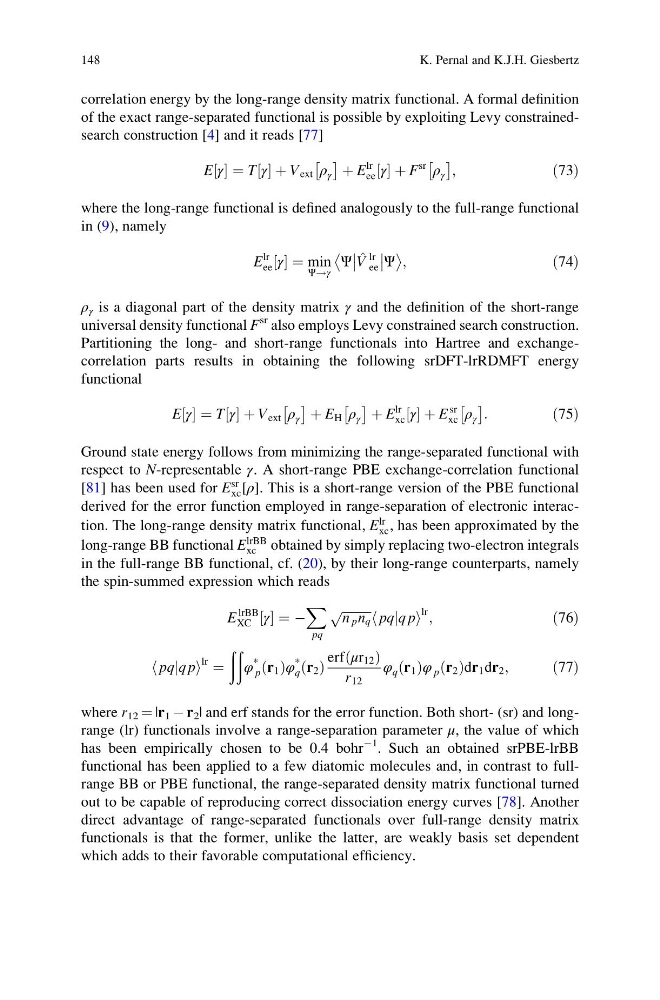
correlation energy by the long-range density matrix functional. A formal definition
of the exact range-separated functional is possible by exploiting Levy constrainedsearch construction [4] and it reads [77]
E γ
½ ¼ T γ
½ þ V ext ρ γ
 à þ E
lr
ee γ
½ þ F
sr
ρ γ
 à ;
ð73Þ
where the long-range functional is defined analogously to the full-range functional
in (9), namely
E
lr
ee γ
½ ¼ min
Ψ!γ
Ψ ^
V
lr
ee
Ψ
;
ð74Þ
ρ γ is a diagonal part of the density matrix γ and the definition of the short-range
universal density functional F
sr also employs Levy constrained search construction.
Partitioning the long- and short-range functionals into Hartree and exchangecorrelation parts results in obtaining the following srDFT-lrRDMFT energy
functional
E γ
½ ¼ T γ
½ þ V ext ρ γ
 à þ E H ρ γ
 à þ E
lr
xc γ
½ þ E
sr
xc ρ γ
 Ã
:
ð75Þ
Ground state energy follows from minimizing the range-separated functional with
respect to N-representable γ. A short-range PBE exchange-correlation functional
[81] has been used for E
sr
xc [ρ]. This is a short-range version of the PBE functional
derived for the error function employed in range-separation of electronic interaction. The long-range density matrix functional, E
lr
xc , has been approximated by the
long-range BB functional E
lrBB
xc obtained by simply replacing two-electron integrals
in the full-range BB functional, cf. (20), by their long-range counterparts, namely
the spin-summed expression which reads
E
lrBB
XC γ
½ ¼ À
X
pq
ffiffiffiffiffiffiffiffiffi ffi
n p n q
p
pqjq p
h
i
lr ;
ð76Þ
pqjq p
h
i
lr ¼
ðð
φ
*
p r 1
ð Þφ
*
q r 2
ð Þ
erf μr 12
ð
Þ
r 12
φ q r 1
ð Þφ p r 2
ð Þdr 1 dr 2 ;
ð77Þ
where r 12 ¼ |r 1 À r 2 | and erf stands for the error function. Both short- (sr) and longrange (lr) functionals involve a range-separation parameter μ, the value of which
has been empirically chosen to be 0.4 bohr
À1 . Such an obtained srPBE-lrBB
functional has been applied to a few diatomic molecules and, in contrast to fullrange BB or PBE functional, the range-separated density matrix functional turned
out to be capable of reproducing correct dissociation energy curves [78]. Another
direct advantage of range-separated functionals over full-range density matrix
functionals is that the former, unlike the latter, are weakly basis set dependent
which adds to their favorable computational efficiency.
148
K. Pernal and K.J.H. Giesbertz
of the exact range-separated functional is possible by exploiting Levy constrainedsearch construction [4] and it reads [77]
E γ
½ ¼ T γ
½ þ V ext ρ γ
 à þ E
lr
ee γ
½ þ F
sr
ρ γ
 à ;
ð73Þ
where the long-range functional is defined analogously to the full-range functional
in (9), namely
E
lr
ee γ
½ ¼ min
Ψ!γ
Ψ ^
V
lr
ee
Ψ
;
ð74Þ
ρ γ is a diagonal part of the density matrix γ and the definition of the short-range
universal density functional F
sr also employs Levy constrained search construction.
Partitioning the long- and short-range functionals into Hartree and exchangecorrelation parts results in obtaining the following srDFT-lrRDMFT energy
functional
E γ
½ ¼ T γ
½ þ V ext ρ γ
 à þ E H ρ γ
 à þ E
lr
xc γ
½ þ E
sr
xc ρ γ
 Ã
:
ð75Þ
Ground state energy follows from minimizing the range-separated functional with
respect to N-representable γ. A short-range PBE exchange-correlation functional
[81] has been used for E
sr
xc [ρ]. This is a short-range version of the PBE functional
derived for the error function employed in range-separation of electronic interaction. The long-range density matrix functional, E
lr
xc , has been approximated by the
long-range BB functional E
lrBB
xc obtained by simply replacing two-electron integrals
in the full-range BB functional, cf. (20), by their long-range counterparts, namely
the spin-summed expression which reads
E
lrBB
XC γ
½ ¼ À
X
pq
ffiffiffiffiffiffiffiffiffi ffi
n p n q
p
pqjq p
h
i
lr ;
ð76Þ
pqjq p
h
i
lr ¼
ðð
φ
*
p r 1
ð Þφ
*
q r 2
ð Þ
erf μr 12
ð
Þ
r 12
φ q r 1
ð Þφ p r 2
ð Þdr 1 dr 2 ;
ð77Þ
where r 12 ¼ |r 1 À r 2 | and erf stands for the error function. Both short- (sr) and longrange (lr) functionals involve a range-separation parameter μ, the value of which
has been empirically chosen to be 0.4 bohr
À1 . Such an obtained srPBE-lrBB
functional has been applied to a few diatomic molecules and, in contrast to fullrange BB or PBE functional, the range-separated density matrix functional turned
out to be capable of reproducing correct dissociation energy curves [78]. Another
direct advantage of range-separated functionals over full-range density matrix
functionals is that the former, unlike the latter, are weakly basis set dependent
which adds to their favorable computational efficiency.
148
K. Pernal and K.J.H. Giesbertz