

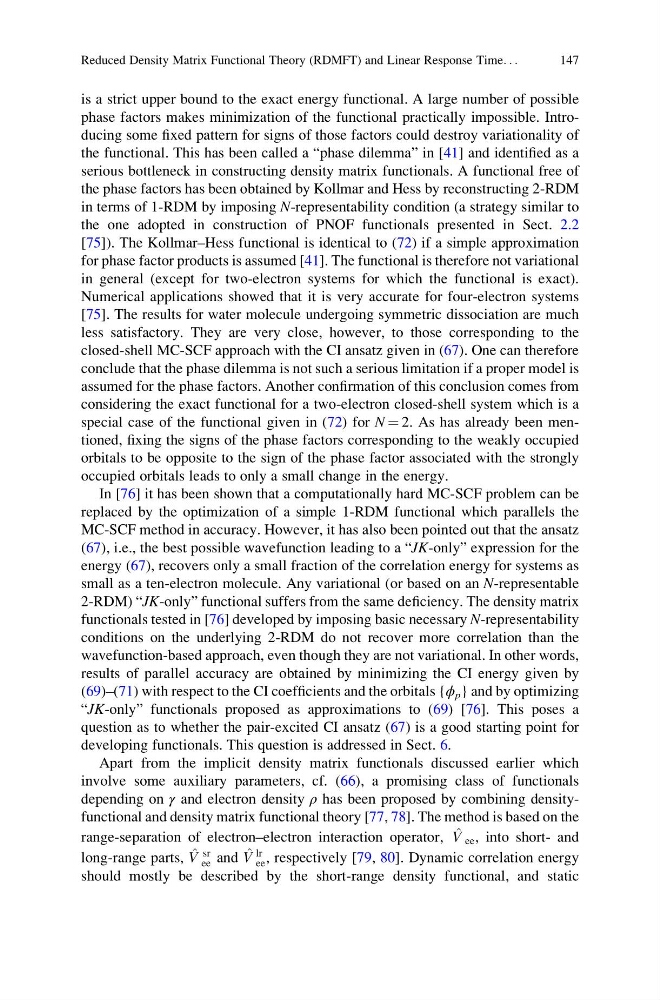
is a strict upper bound to the exact energy functional. A large number of possible
phase factors makes minimization of the functional practically impossible. Introducing some fixed pattern for signs of those factors could destroy variationality of
the functional. This has been called a “phase dilemma” in [41] and identified as a
serious bottleneck in constructing density matrix functionals. A functional free of
the phase factors has been obtained by Kollmar and Hess by reconstructing 2-RDM
in terms of 1-RDM by imposing N-representability condition (a strategy similar to
the one adopted in construction of PNOF functionals presented in Sect. 2.2
[75]). The Kollmar–Hess functional is identical to (72) if a simple approximation
for phase factor products is assumed [41]. The functional is therefore not variational
in general (except for two-electron systems for which the functional is exact).
Numerical applications showed that it is very accurate for four-electron systems
[75]. The results for water molecule undergoing symmetric dissociation are much
less satisfactory. They are very close, however, to those corresponding to the
closed-shell MC-SCF approach with the CI ansatz given in (67). One can therefore
conclude that the phase dilemma is not such a serious limitation if a proper model is
assumed for the phase factors. Another confirmation of this conclusion comes from
considering the exact functional for a two-electron closed-shell system which is a
special case of the functional given in (72) for N ¼ 2. As has already been mentioned, fixing the signs of the phase factors corresponding to the weakly occupied
orbitals to be opposite to the sign of the phase factor associated with the strongly
occupied orbitals leads to only a small change in the energy.
In [76] it has been shown that a computationally hard MC-SCF problem can be
replaced by the optimization of a simple 1-RDM functional which parallels the
MC-SCF method in accuracy. However, it has also been pointed out that the ansatz
(67), i.e., the best possible wavefunction leading to a “JK-only” expression for the
energy (67), recovers only a small fraction of the correlation energy for systems as
small as a ten-electron molecule. Any variational (or based on an N-representable
2-RDM) “JK-only” functional suffers from the same deficiency. The density matrix
functionals tested in [76] developed by imposing basic necessary N-representability
conditions on the underlying 2-RDM do not recover more correlation than the
wavefunction-based approach, even though they are not variational. In other words,
results of parallel accuracy are obtained by minimizing the CI energy given by
(69)–(71) with respect to the CI coefficients and the orbitals {ϕ p } and by optimizing
“JK-only” functionals proposed as approximations to (69) [76]. This poses a
question as to whether the pair-excited CI ansatz (67) is a good starting point for
developing functionals. This question is addressed in Sect. 6.
Apart from the implicit density matrix functionals discussed earlier which
involve some auxiliary parameters, cf. (66), a promising class of functionals
depending on γ and electron density ρ has been proposed by combining densityfunctional and density matrix functional theory [77, 78]. The method is based on the
range-separation of electron–electron interaction operator, ^
V ee , into short- and
long-range parts, ^
V
sr
ee and ^
V
lr
ee , respectively [79, 80]. Dynamic correlation energy
should mostly be described by the short-range density functional, and static
Reduced Density Matrix Functional Theory (RDMFT) and Linear Response Time. . .
147
phase factors makes minimization of the functional practically impossible. Introducing some fixed pattern for signs of those factors could destroy variationality of
the functional. This has been called a “phase dilemma” in [41] and identified as a
serious bottleneck in constructing density matrix functionals. A functional free of
the phase factors has been obtained by Kollmar and Hess by reconstructing 2-RDM
in terms of 1-RDM by imposing N-representability condition (a strategy similar to
the one adopted in construction of PNOF functionals presented in Sect. 2.2
[75]). The Kollmar–Hess functional is identical to (72) if a simple approximation
for phase factor products is assumed [41]. The functional is therefore not variational
in general (except for two-electron systems for which the functional is exact).
Numerical applications showed that it is very accurate for four-electron systems
[75]. The results for water molecule undergoing symmetric dissociation are much
less satisfactory. They are very close, however, to those corresponding to the
closed-shell MC-SCF approach with the CI ansatz given in (67). One can therefore
conclude that the phase dilemma is not such a serious limitation if a proper model is
assumed for the phase factors. Another confirmation of this conclusion comes from
considering the exact functional for a two-electron closed-shell system which is a
special case of the functional given in (72) for N ¼ 2. As has already been mentioned, fixing the signs of the phase factors corresponding to the weakly occupied
orbitals to be opposite to the sign of the phase factor associated with the strongly
occupied orbitals leads to only a small change in the energy.
In [76] it has been shown that a computationally hard MC-SCF problem can be
replaced by the optimization of a simple 1-RDM functional which parallels the
MC-SCF method in accuracy. However, it has also been pointed out that the ansatz
(67), i.e., the best possible wavefunction leading to a “JK-only” expression for the
energy (67), recovers only a small fraction of the correlation energy for systems as
small as a ten-electron molecule. Any variational (or based on an N-representable
2-RDM) “JK-only” functional suffers from the same deficiency. The density matrix
functionals tested in [76] developed by imposing basic necessary N-representability
conditions on the underlying 2-RDM do not recover more correlation than the
wavefunction-based approach, even though they are not variational. In other words,
results of parallel accuracy are obtained by minimizing the CI energy given by
(69)–(71) with respect to the CI coefficients and the orbitals {ϕ p } and by optimizing
“JK-only” functionals proposed as approximations to (69) [76]. This poses a
question as to whether the pair-excited CI ansatz (67) is a good starting point for
developing functionals. This question is addressed in Sect. 6.
Apart from the implicit density matrix functionals discussed earlier which
involve some auxiliary parameters, cf. (66), a promising class of functionals
depending on γ and electron density ρ has been proposed by combining densityfunctional and density matrix functional theory [77, 78]. The method is based on the
range-separation of electron–electron interaction operator, ^
V ee , into short- and
long-range parts, ^
V
sr
ee and ^
V
lr
ee , respectively [79, 80]. Dynamic correlation energy
should mostly be described by the short-range density functional, and static
Reduced Density Matrix Functional Theory (RDMFT) and Linear Response Time. . .
147