

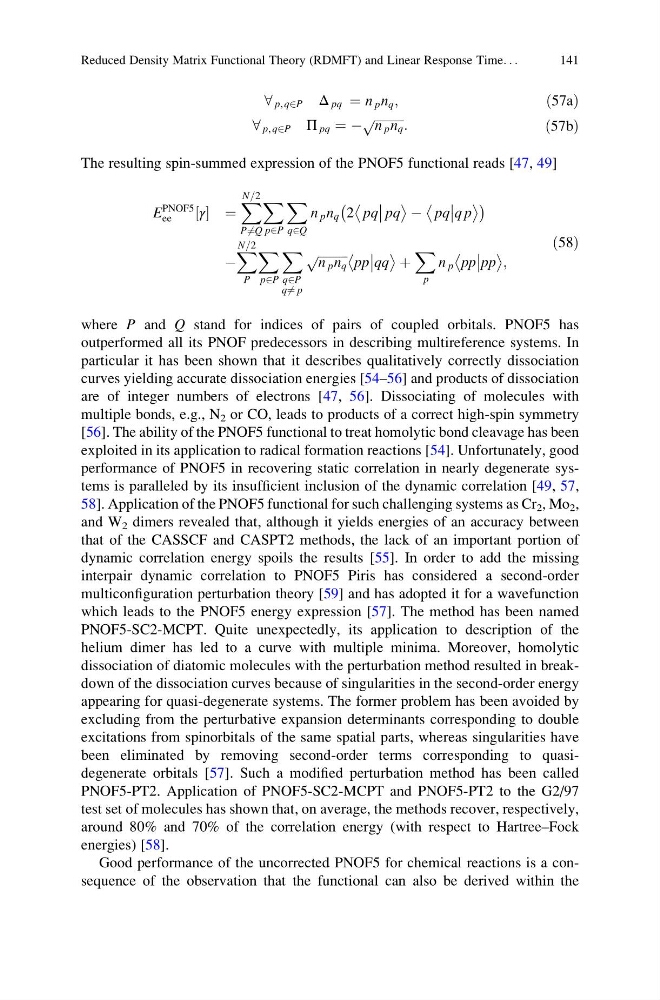
8 p, q2P Δ pq ¼ n p n q ;
ð57aÞ
8 p, q2P Π pq ¼ À
ffiffiffiffiffiffiffiffiffi ffi
n p n q
p
:
ð57bÞ
The resulting spin-summed expression of the PNOF5 functional reads [47, 49]
E
PNOF5
ee
γ
½ ¼
X N=2
P6 ¼Q
X
p2P
X
q2Q
n p n q 2 pq
pq
À pq
q p
À
Á
À
X N=2
P
X
p2P
X
q2P
q6 ¼ p
ffiffiffiffiffiffiffiffiffi ffi
n p n q
p
pp
qq
þ
X
p
n p pp
pp
;
ð58Þ
where P and Q stand for indices of pairs of coupled orbitals. PNOF5 has
outperformed all its PNOF predecessors in describing multireference systems. In
particular it has been shown that it describes qualitatively correctly dissociation
curves yielding accurate dissociation energies [54–56] and products of dissociation
are of integer numbers of electrons [47, 56]. Dissociating of molecules with
multiple bonds, e.g., N 2 or CO, leads to products of a correct high-spin symmetry
[56]. The ability of the PNOF5 functional to treat homolytic bond cleavage has been
exploited in its application to radical formation reactions [54]. Unfortunately, good
performance of PNOF5 in recovering static correlation in nearly degenerate systems is paralleled by its insufficient inclusion of the dynamic correlation [49, 57,
58]. Application of the PNOF5 functional for such challenging systems as Cr 2 , Mo 2 ,
and W 2 dimers revealed that, although it yields energies of an accuracy between
that of the CASSCF and CASPT2 methods, the lack of an important portion of
dynamic correlation energy spoils the results [55]. In order to add the missing
interpair dynamic correlation to PNOF5 Piris has considered a second-order
multiconfiguration perturbation theory [59] and has adopted it for a wavefunction
which leads to the PNOF5 energy expression [57]. The method has been named
PNOF5-SC2-MCPT. Quite unexpectedly, its application to description of the
helium dimer has led to a curve with multiple minima. Moreover, homolytic
dissociation of diatomic molecules with the perturbation method resulted in breakdown of the dissociation curves because of singularities in the second-order energy
appearing for quasi-degenerate systems. The former problem has been avoided by
excluding from the perturbative expansion determinants corresponding to double
excitations from spinorbitals of the same spatial parts, whereas singularities have
been eliminated by removing second-order terms corresponding to quasidegenerate orbitals [57]. Such a modified perturbation method has been called
PNOF5-PT2. Application of PNOF5-SC2-MCPT and PNOF5-PT2 to the G2/97
test set of molecules has shown that, on average, the methods recover, respectively,
around 80% and 70% of the correlation energy (with respect to Hartree–Fock
energies) [58].
Good performance of the uncorrected PNOF5 for chemical reactions is a consequence of the observation that the functional can also be derived within the
Reduced Density Matrix Functional Theory (RDMFT) and Linear Response Time. . .
141
ð57aÞ
8 p, q2P Π pq ¼ À
ffiffiffiffiffiffiffiffiffi ffi
n p n q
p
:
ð57bÞ
The resulting spin-summed expression of the PNOF5 functional reads [47, 49]
E
PNOF5
ee
γ
½ ¼
X N=2
P6 ¼Q
X
p2P
X
q2Q
n p n q 2 pq
pq
À pq
q p
À
Á
À
X N=2
P
X
p2P
X
q2P
q6 ¼ p
ffiffiffiffiffiffiffiffiffi ffi
n p n q
p
pp
þ
X
p
n p pp
pp
;
ð58Þ
where P and Q stand for indices of pairs of coupled orbitals. PNOF5 has
outperformed all its PNOF predecessors in describing multireference systems. In
particular it has been shown that it describes qualitatively correctly dissociation
curves yielding accurate dissociation energies [54–56] and products of dissociation
are of integer numbers of electrons [47, 56]. Dissociating of molecules with
multiple bonds, e.g., N 2 or CO, leads to products of a correct high-spin symmetry
[56]. The ability of the PNOF5 functional to treat homolytic bond cleavage has been
exploited in its application to radical formation reactions [54]. Unfortunately, good
performance of PNOF5 in recovering static correlation in nearly degenerate systems is paralleled by its insufficient inclusion of the dynamic correlation [49, 57,
58]. Application of the PNOF5 functional for such challenging systems as Cr 2 , Mo 2 ,
and W 2 dimers revealed that, although it yields energies of an accuracy between
that of the CASSCF and CASPT2 methods, the lack of an important portion of
dynamic correlation energy spoils the results [55]. In order to add the missing
interpair dynamic correlation to PNOF5 Piris has considered a second-order
multiconfiguration perturbation theory [59] and has adopted it for a wavefunction
which leads to the PNOF5 energy expression [57]. The method has been named
PNOF5-SC2-MCPT. Quite unexpectedly, its application to description of the
helium dimer has led to a curve with multiple minima. Moreover, homolytic
dissociation of diatomic molecules with the perturbation method resulted in breakdown of the dissociation curves because of singularities in the second-order energy
appearing for quasi-degenerate systems. The former problem has been avoided by
excluding from the perturbative expansion determinants corresponding to double
excitations from spinorbitals of the same spatial parts, whereas singularities have
been eliminated by removing second-order terms corresponding to quasidegenerate orbitals [57]. Such a modified perturbation method has been called
PNOF5-PT2. Application of PNOF5-SC2-MCPT and PNOF5-PT2 to the G2/97
test set of molecules has shown that, on average, the methods recover, respectively,
around 80% and 70% of the correlation energy (with respect to Hartree–Fock
energies) [58].
Good performance of the uncorrected PNOF5 for chemical reactions is a consequence of the observation that the functional can also be derived within the
Reduced Density Matrix Functional Theory (RDMFT) and Linear Response Time. . .
141