

antisymmetrized product of strongly orthogonal geminals (APSG) theory
[60]. APSG has not only proven to be successful in describing dissociation curves
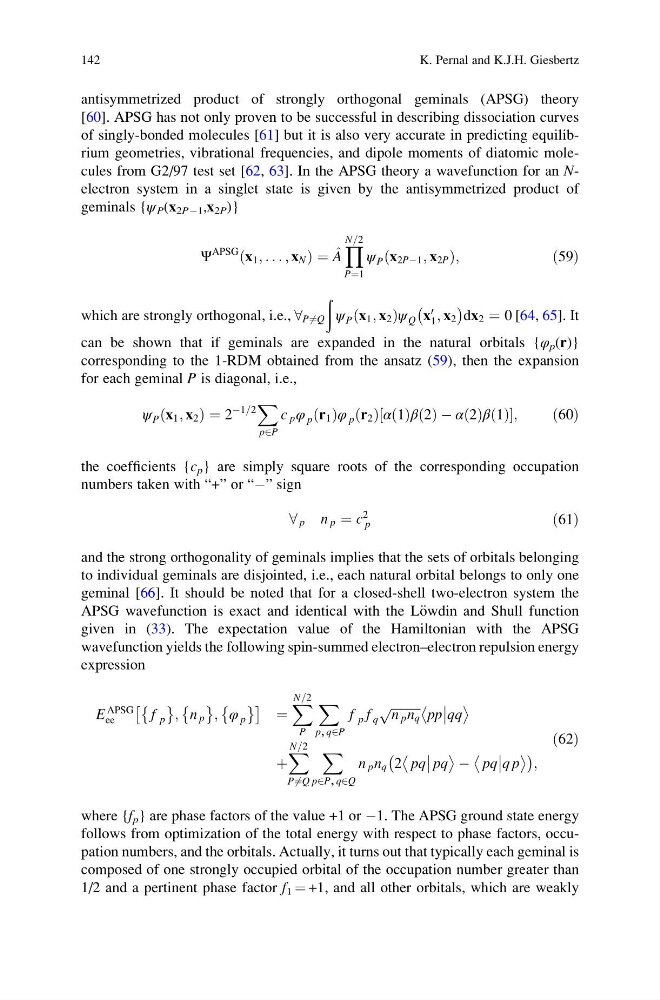
of singly-bonded molecules [61] but it is also very accurate in predicting equilibrium geometries, vibrational frequencies, and dipole moments of diatomic molecules from G2/97 test set [62, 63]. In the APSG theory a wavefunction for an Nelectron system in a singlet state is given by the antisymmetrized product of
geminals {ψ P (x 2PÀ1 ,x 2P )}
Ψ
APSG x 1 ; . . . ; x N
ð
Þ¼ ^
A
Y N=2
P¼1
ψ P x 2PÀ1 ; x 2P
ð
Þ ;
ð59Þ
which are strongly orthogonal, i.e., 8 P6 ¼Q
ð
ψ P x 1 ; x 2
ð
Þψ Q x
0
1 ; x 2
À
Á
dx 2 ¼ 0 [64, 65]. It
can be shown that if geminals are expanded in the natural orbitals {φ p (r)}
corresponding to the 1-RDM obtained from the ansatz (59), then the expansion
for each geminal P is diagonal, i.e.,
ψ P x 1 ; x 2
ð
Þ¼2
À1=2
X
p2P
c p φ p r 1
ð Þφ p r 2
ð Þ α 1
ð Þβ 2
ð Þ À α 2
ð Þβ 1
ð Þ
½
;
ð60Þ
the coefficients {c p } are simply square roots of the corresponding occupation
numbers taken with “+” or “À” sign
8 p n p ¼ c
2
p
ð61Þ
and the strong orthogonality of geminals implies that the sets of orbitals belonging
to individual geminals are disjointed, i.e., each natural orbital belongs to only one
geminal [66]. It should be noted that for a closed-shell two-electron system the
APSG wavefunction is exact and identical with the L€ owdin and Shull function
given in (33). The expectation value of the Hamiltonian with the APSG
wavefunction yields the following spin-summed electron–electron repulsion energy
expression
E
APSG
ee
f p
È É ; n p
È É ; φ p
È É
Â
à ¼
X N=2
P
X
p, q2P
f p f q
ffiffiffiffiffiffiffiffiffi ffi
n p n q
p
pp
qq
þ
X N=2
P6 ¼Q
X
p2P, q2Q
n p n q 2 pq
pq
À pq
q p
À
Á ;
ð62Þ
where {f p } are phase factors of the value +1 or À1. The APSG ground state energy
follows from optimization of the total energy with respect to phase factors, occupation numbers, and the orbitals. Actually, it turns out that typically each geminal is
composed of one strongly occupied orbital of the occupation number greater than
1/2 and a pertinent phase factor f 1 ¼ +1, and all other orbitals, which are weakly
142
K. Pernal and K.J.H. Giesbertz
[60]. APSG has not only proven to be successful in describing dissociation curves
of singly-bonded molecules [61] but it is also very accurate in predicting equilibrium geometries, vibrational frequencies, and dipole moments of diatomic molecules from G2/97 test set [62, 63]. In the APSG theory a wavefunction for an Nelectron system in a singlet state is given by the antisymmetrized product of
geminals {ψ P (x 2PÀ1 ,x 2P )}
Ψ
APSG x 1 ; . . . ; x N
ð
Þ¼ ^
A
Y N=2
P¼1
ψ P x 2PÀ1 ; x 2P
ð
Þ ;
ð59Þ
which are strongly orthogonal, i.e., 8 P6 ¼Q
ð
ψ P x 1 ; x 2
ð
Þψ Q x
0
1 ; x 2
À
Á
dx 2 ¼ 0 [64, 65]. It
can be shown that if geminals are expanded in the natural orbitals {φ p (r)}
corresponding to the 1-RDM obtained from the ansatz (59), then the expansion
for each geminal P is diagonal, i.e.,
ψ P x 1 ; x 2
ð
Þ¼2
À1=2
X
p2P
c p φ p r 1
ð Þφ p r 2
ð Þ α 1
ð Þβ 2
ð Þ À α 2
ð Þβ 1
ð Þ
½
;
ð60Þ
the coefficients {c p } are simply square roots of the corresponding occupation
numbers taken with “+” or “À” sign
8 p n p ¼ c
2
p
ð61Þ
and the strong orthogonality of geminals implies that the sets of orbitals belonging
to individual geminals are disjointed, i.e., each natural orbital belongs to only one
geminal [66]. It should be noted that for a closed-shell two-electron system the
APSG wavefunction is exact and identical with the L€ owdin and Shull function
given in (33). The expectation value of the Hamiltonian with the APSG
wavefunction yields the following spin-summed electron–electron repulsion energy
expression
E
APSG
ee
f p
È É ; n p
È É ; φ p
È É
Â
à ¼
X N=2
P
X
p, q2P
f p f q
ffiffiffiffiffiffiffiffiffi ffi
n p n q
p
pp
þ
X N=2
P6 ¼Q
X
p2P, q2Q
n p n q 2 pq
pq
À pq
q p
À
Á ;
ð62Þ
where {f p } are phase factors of the value +1 or À1. The APSG ground state energy
follows from optimization of the total energy with respect to phase factors, occupation numbers, and the orbitals. Actually, it turns out that typically each geminal is
composed of one strongly occupied orbital of the occupation number greater than
1/2 and a pertinent phase factor f 1 ¼ +1, and all other orbitals, which are weakly
142
K. Pernal and K.J.H. Giesbertz