

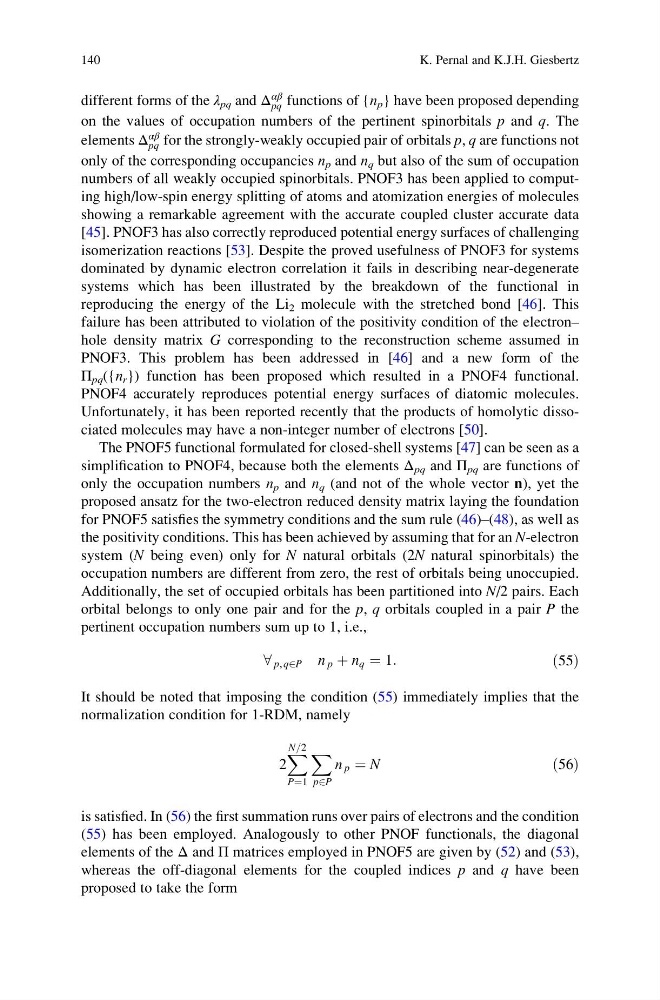
different forms of the λ pq and Δ
αβ
pq functions of {n p } have been proposed depending
on the values of occupation numbers of the pertinent spinorbitals p and q. The
elements Δ
αβ
pq for the strongly-weakly occupied pair of orbitals p, q are functions not
only of the corresponding occupancies n p and n q but also of the sum of occupation
numbers of all weakly occupied spinorbitals. PNOF3 has been applied to computing high/low-spin energy splitting of atoms and atomization energies of molecules
showing a remarkable agreement with the accurate coupled cluster accurate data
[45]. PNOF3 has also correctly reproduced potential energy surfaces of challenging
isomerization reactions [53]. Despite the proved usefulness of PNOF3 for systems
dominated by dynamic electron correlation it fails in describing near-degenerate
systems which has been illustrated by the breakdown of the functional in
reproducing the energy of the Li 2 molecule with the stretched bond [46]. This
failure has been attributed to violation of the positivity condition of the electron–
hole density matrix G corresponding to the reconstruction scheme assumed in
PNOF3. This problem has been addressed in [46] and a new form of the
Π pq ({n r }) function has been proposed which resulted in a PNOF4 functional.
PNOF4 accurately reproduces potential energy surfaces of diatomic molecules.
Unfortunately, it has been reported recently that the products of homolytic dissociated molecules may have a non-integer number of electrons [50].
The PNOF5 functional formulated for closed-shell systems [47] can be seen as a
simplification to PNOF4, because both the elements Δ pq and Π pq are functions of
only the occupation numbers n p and n q (and not of the whole vector n), yet the
proposed ansatz for the two-electron reduced density matrix laying the foundation
for PNOF5 satisfies the symmetry conditions and the sum rule (46)–(48), as well as
the positivity conditions. This has been achieved by assuming that for an N-electron
system (N being even) only for N natural orbitals (2N natural spinorbitals) the
occupation numbers are different from zero, the rest of orbitals being unoccupied.
Additionally, the set of occupied orbitals has been partitioned into N/2 pairs. Each
orbital belongs to only one pair and for the p, q orbitals coupled in a pair P the
pertinent occupation numbers sum up to 1, i.e.,
8 p, q2P n p þ n q ¼ 1:
ð55Þ
It should be noted that imposing the condition (55) immediately implies that the
normalization condition for 1-RDM, namely
2
X N=2
P¼1
X
p2P
n p ¼ N
ð56Þ
is satisfied. In (56) the first summation runs over pairs of electrons and the condition
(55) has been employed. Analogously to other PNOF functionals, the diagonal
elements of the Δ and Π matrices employed in PNOF5 are given by (52) and (53),
whereas the off-diagonal elements for the coupled indices p and q have been
proposed to take the form
140
K. Pernal and K.J.H. Giesbertz
αβ
pq functions of {n p } have been proposed depending
on the values of occupation numbers of the pertinent spinorbitals p and q. The
elements Δ
αβ
pq for the strongly-weakly occupied pair of orbitals p, q are functions not
only of the corresponding occupancies n p and n q but also of the sum of occupation
numbers of all weakly occupied spinorbitals. PNOF3 has been applied to computing high/low-spin energy splitting of atoms and atomization energies of molecules
showing a remarkable agreement with the accurate coupled cluster accurate data
[45]. PNOF3 has also correctly reproduced potential energy surfaces of challenging
isomerization reactions [53]. Despite the proved usefulness of PNOF3 for systems
dominated by dynamic electron correlation it fails in describing near-degenerate
systems which has been illustrated by the breakdown of the functional in
reproducing the energy of the Li 2 molecule with the stretched bond [46]. This
failure has been attributed to violation of the positivity condition of the electron–
hole density matrix G corresponding to the reconstruction scheme assumed in
PNOF3. This problem has been addressed in [46] and a new form of the
Π pq ({n r }) function has been proposed which resulted in a PNOF4 functional.
PNOF4 accurately reproduces potential energy surfaces of diatomic molecules.
Unfortunately, it has been reported recently that the products of homolytic dissociated molecules may have a non-integer number of electrons [50].
The PNOF5 functional formulated for closed-shell systems [47] can be seen as a
simplification to PNOF4, because both the elements Δ pq and Π pq are functions of
only the occupation numbers n p and n q (and not of the whole vector n), yet the
proposed ansatz for the two-electron reduced density matrix laying the foundation
for PNOF5 satisfies the symmetry conditions and the sum rule (46)–(48), as well as
the positivity conditions. This has been achieved by assuming that for an N-electron
system (N being even) only for N natural orbitals (2N natural spinorbitals) the
occupation numbers are different from zero, the rest of orbitals being unoccupied.
Additionally, the set of occupied orbitals has been partitioned into N/2 pairs. Each
orbital belongs to only one pair and for the p, q orbitals coupled in a pair P the
pertinent occupation numbers sum up to 1, i.e.,
8 p, q2P n p þ n q ¼ 1:
ð55Þ
It should be noted that imposing the condition (55) immediately implies that the
normalization condition for 1-RDM, namely
2
X N=2
P¼1
X
p2P
n p ¼ N
ð56Þ
is satisfied. In (56) the first summation runs over pairs of electrons and the condition
(55) has been employed. Analogously to other PNOF functionals, the diagonal
elements of the Δ and Π matrices employed in PNOF5 are given by (52) and (53),
whereas the off-diagonal elements for the coupled indices p and q have been
proposed to take the form
140
K. Pernal and K.J.H. Giesbertz