

E
PNOF
ee
γ
½ ¼
X
pq
n p n q 2 pq
pq
À pq
q p
À
Á
À
X
pq
Δ
αα
pq þ Δ
αβ
pq
pq
pq
À Δ
αα
pq pq
q p
h
i
þ
X
pq
Π pq pp
qq
;
ð51Þ
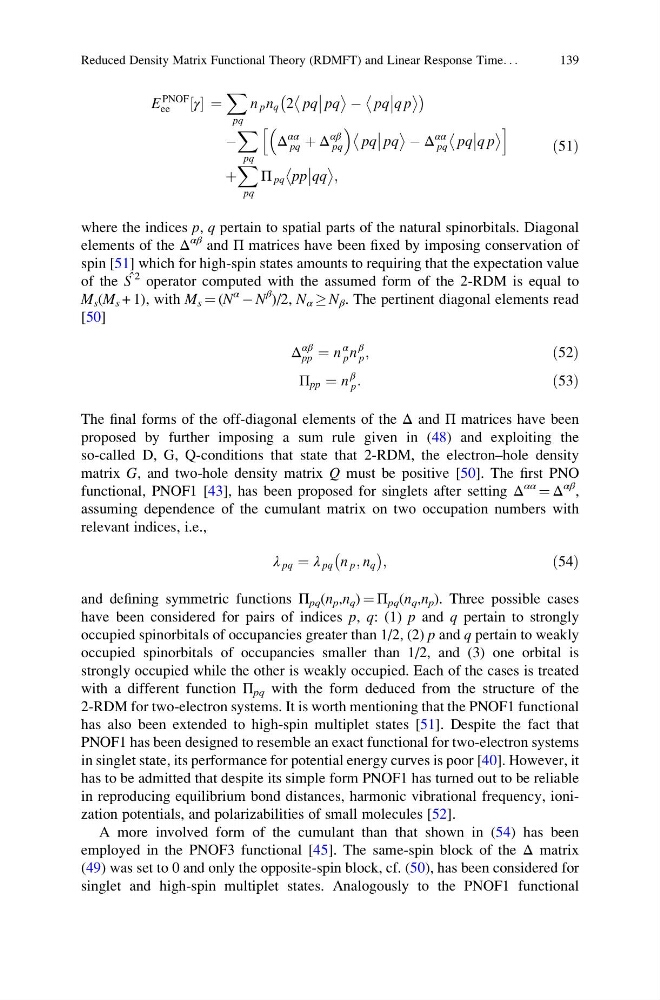
where the indices p, q pertain to spatial parts of the natural spinorbitals. Diagonal
elements of the Δ
αβ and Π matrices have been fixed by imposing conservation of
spin [51] which for high-spin states amounts to requiring that the expectation value
of the S ˆ 2 operator computed with the assumed form of the 2-RDM is equal to
M s (M s + 1), with M s ¼ (N
α
À N
β )/2, N α ! N β . The pertinent diagonal elements read
[50]
Δ
αβ
pp ¼ n
α
p n
β
p ;
ð52Þ
Π pp ¼ n
β
p :
ð53Þ
The final forms of the off-diagonal elements of the Δ and Π matrices have been
proposed by further imposing a sum rule given in (48) and exploiting the
so-called D, G, Q-conditions that state that 2-RDM, the electron–hole density
matrix G, and two-hole density matrix Q must be positive [50]. The first PNO
functional, PNOF1 [43], has been proposed for singlets after setting Δ
αα
¼ Δ
αβ ,
assuming dependence of the cumulant matrix on two occupation numbers with
relevant indices, i.e.,
λ pq ¼ λ pq n p ; n q
À
Á ;
ð54Þ
and defining symmetric functions Π pq (n p ,n q ) ¼ Π pq (n q ,n p ). Three possible cases
have been considered for pairs of indices p, q: (1) p and q pertain to strongly
occupied spinorbitals of occupancies greater than 1/2, (2) p and q pertain to weakly
occupied spinorbitals of occupancies smaller than 1/2, and (3) one orbital is
strongly occupied while the other is weakly occupied. Each of the cases is treated
with a different function Π pq with the form deduced from the structure of the
2-RDM for two-electron systems. It is worth mentioning that the PNOF1 functional
has also been extended to high-spin multiplet states [51]. Despite the fact that
PNOF1 has been designed to resemble an exact functional for two-electron systems
in singlet state, its performance for potential energy curves is poor [40]. However, it
has to be admitted that despite its simple form PNOF1 has turned out to be reliable
in reproducing equilibrium bond distances, harmonic vibrational frequency, ionization potentials, and polarizabilities of small molecules [52].
A more involved form of the cumulant than that shown in (54) has been
employed in the PNOF3 functional [45]. The same-spin block of the Δ matrix
(49) was set to 0 and only the opposite-spin block, cf. (50), has been considered for
singlet and high-spin multiplet states. Analogously to the PNOF1 functional
Reduced Density Matrix Functional Theory (RDMFT) and Linear Response Time. . .
139
PNOF
ee
γ
½ ¼
X
pq
n p n q 2 pq
pq
À pq
q p
À
Á
À
X
pq
Δ
αα
pq þ Δ
αβ
pq
pq
pq
À Δ
αα
pq pq
q p
h
i
þ
X
pq
Π pq pp
;
ð51Þ
where the indices p, q pertain to spatial parts of the natural spinorbitals. Diagonal
elements of the Δ
αβ and Π matrices have been fixed by imposing conservation of
spin [51] which for high-spin states amounts to requiring that the expectation value
of the S ˆ 2 operator computed with the assumed form of the 2-RDM is equal to
M s (M s + 1), with M s ¼ (N
α
À N
β )/2, N α ! N β . The pertinent diagonal elements read
[50]
Δ
αβ
pp ¼ n
α
p n
β
p ;
ð52Þ
Π pp ¼ n
β
p :
ð53Þ
The final forms of the off-diagonal elements of the Δ and Π matrices have been
proposed by further imposing a sum rule given in (48) and exploiting the
so-called D, G, Q-conditions that state that 2-RDM, the electron–hole density
matrix G, and two-hole density matrix Q must be positive [50]. The first PNO
functional, PNOF1 [43], has been proposed for singlets after setting Δ
αα
¼ Δ
αβ ,
assuming dependence of the cumulant matrix on two occupation numbers with
relevant indices, i.e.,
λ pq ¼ λ pq n p ; n q
À
Á ;
ð54Þ
and defining symmetric functions Π pq (n p ,n q ) ¼ Π pq (n q ,n p ). Three possible cases
have been considered for pairs of indices p, q: (1) p and q pertain to strongly
occupied spinorbitals of occupancies greater than 1/2, (2) p and q pertain to weakly
occupied spinorbitals of occupancies smaller than 1/2, and (3) one orbital is
strongly occupied while the other is weakly occupied. Each of the cases is treated
with a different function Π pq with the form deduced from the structure of the
2-RDM for two-electron systems. It is worth mentioning that the PNOF1 functional
has also been extended to high-spin multiplet states [51]. Despite the fact that
PNOF1 has been designed to resemble an exact functional for two-electron systems
in singlet state, its performance for potential energy curves is poor [40]. However, it
has to be admitted that despite its simple form PNOF1 has turned out to be reliable
in reproducing equilibrium bond distances, harmonic vibrational frequency, ionization potentials, and polarizabilities of small molecules [52].
A more involved form of the cumulant than that shown in (54) has been
employed in the PNOF3 functional [45]. The same-spin block of the Δ matrix
(49) was set to 0 and only the opposite-spin block, cf. (50), has been considered for
singlet and high-spin multiplet states. Analogously to the PNOF1 functional
Reduced Density Matrix Functional Theory (RDMFT) and Linear Response Time. . .
139