

be recovered by allowing nonidempotent γ in the optimization, in other words by
allowing fractional occupancies of the natural orbitals. However, it has been shown
by Lieb, that for electronic systems the minimum of the functional involving only
Hartree and exchange contributions to the electronic repulsion, cf. (15), is achieved
at an idempotent 1-RDM [14]. Thus, the minimum of the functional free of the
correlation part simply coincides with the Hartree–Fock energy. To go beyond the
Hartree–Fock approximation requires not only admitting nonidempotent γ but also
including nonzero cumulant part in the reconstructed 2-RDM. Recently, Piris and
collaborators proposed a series of natural orbital functionals known as PNOFi
(i ¼ 1–6) [43–48] by finding approximations to the cumulant matrix γ in terms of
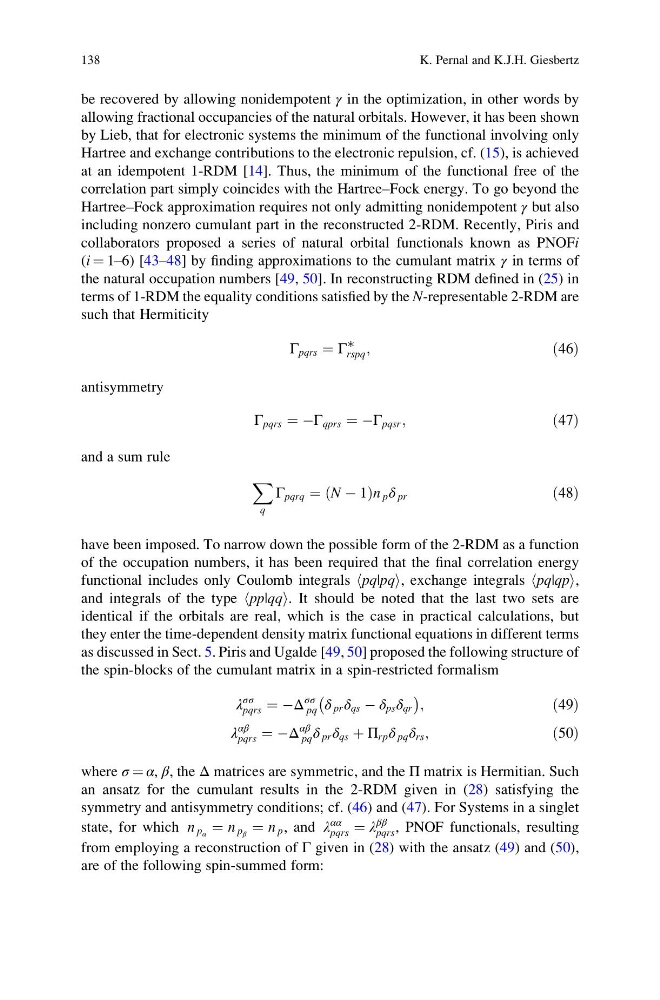
the natural occupation numbers [49, 50]. In reconstructing RDM defined in (25) in
terms of 1-RDM the equality conditions satisfied by the N-representable 2-RDM are
such that Hermiticity
Γ pqrs ¼ Γ
∗
rspq ;
ð46Þ
antisymmetry
Γ pqrs ¼ ÀΓ qprs ¼ ÀΓ pqsr ;
ð47Þ
and a sum rule
X
q
Γ pqrq ¼ N À 1
ð
Þn p δ pr
ð48Þ
have been imposed. To narrow down the possible form of the 2-RDM as a function
of the occupation numbers, it has been required that the final correlation energy
functional includes only Coulomb integrals hpq|pqi, exchange integrals hpq|qpi,
and integrals of the type hpp|qqi. It should be noted that the last two sets are
identical if the orbitals are real, which is the case in practical calculations, but
they enter the time-dependent density matrix functional equations in different terms
as discussed in Sect. 5. Piris and Ugalde [49, 50] proposed the following structure of
the spin-blocks of the cumulant matrix in a spin-restricted formalism
λ
σσ
pqrs ¼ ÀΔ
σσ
pq δ pr δ qs À δ ps δ qr
À
Á ;
ð49Þ
λ
αβ
pqrs ¼ ÀΔ
αβ
pq δ pr δ qs þ Π rp δ pq δ rs ;
ð50Þ
where σ ¼ α, β, the Δ matrices are symmetric, and the Π matrix is Hermitian. Such
an ansatz for the cumulant results in the 2-RDM given in (28) satisfying the
symmetry and antisymmetry conditions; cf. (46) and (47). For Systems in a singlet
state, for which n p α ¼ n p β ¼ n p , and λ
αα
pqrs ¼ λ
ββ
pqrs , PNOF functionals, resulting
from employing a reconstruction of Γ given in (28) with the ansatz (49) and (50),
are of the following spin-summed form:
138
K. Pernal and K.J.H. Giesbertz
allowing fractional occupancies of the natural orbitals. However, it has been shown
by Lieb, that for electronic systems the minimum of the functional involving only
Hartree and exchange contributions to the electronic repulsion, cf. (15), is achieved
at an idempotent 1-RDM [14]. Thus, the minimum of the functional free of the
correlation part simply coincides with the Hartree–Fock energy. To go beyond the
Hartree–Fock approximation requires not only admitting nonidempotent γ but also
including nonzero cumulant part in the reconstructed 2-RDM. Recently, Piris and
collaborators proposed a series of natural orbital functionals known as PNOFi
(i ¼ 1–6) [43–48] by finding approximations to the cumulant matrix γ in terms of
the natural occupation numbers [49, 50]. In reconstructing RDM defined in (25) in
terms of 1-RDM the equality conditions satisfied by the N-representable 2-RDM are
such that Hermiticity
Γ pqrs ¼ Γ
∗
rspq ;
ð46Þ
antisymmetry
Γ pqrs ¼ ÀΓ qprs ¼ ÀΓ pqsr ;
ð47Þ
and a sum rule
X
q
Γ pqrq ¼ N À 1
ð
Þn p δ pr
ð48Þ
have been imposed. To narrow down the possible form of the 2-RDM as a function
of the occupation numbers, it has been required that the final correlation energy
functional includes only Coulomb integrals hpq|pqi, exchange integrals hpq|qpi,
and integrals of the type hpp|qqi. It should be noted that the last two sets are
identical if the orbitals are real, which is the case in practical calculations, but
they enter the time-dependent density matrix functional equations in different terms
as discussed in Sect. 5. Piris and Ugalde [49, 50] proposed the following structure of
the spin-blocks of the cumulant matrix in a spin-restricted formalism
λ
σσ
pqrs ¼ ÀΔ
σσ
pq δ pr δ qs À δ ps δ qr
À
Á ;
ð49Þ
λ
αβ
pqrs ¼ ÀΔ
αβ
pq δ pr δ qs þ Π rp δ pq δ rs ;
ð50Þ
where σ ¼ α, β, the Δ matrices are symmetric, and the Π matrix is Hermitian. Such
an ansatz for the cumulant results in the 2-RDM given in (28) satisfying the
symmetry and antisymmetry conditions; cf. (46) and (47). For Systems in a singlet
state, for which n p α ¼ n p β ¼ n p , and λ
αα
pqrs ¼ λ
ββ
pqrs , PNOF functionals, resulting
from employing a reconstruction of Γ given in (28) with the ansatz (49) and (50),
are of the following spin-summed form:
138
K. Pernal and K.J.H. Giesbertz