

E
ELS
ee γ
½ ¼
1
2
X
p, q2outer
f p f q
ffiffiffiffiffiffiffiffiffi ffi
n p n q
p
pp
qq
þ
1
2
X
p2inner
n p pp
pp
þ
X
p2inner
X
q> p
q2inner
n p n q pq
pq
À pq
q p
À
Á
þ
X
p2inner
X
q2outer
n p n q pq
pq
À pq
q p
À
Á þ F L n p ; n q
À
Á
pp
qq
Â
Ã
;
ð44Þ
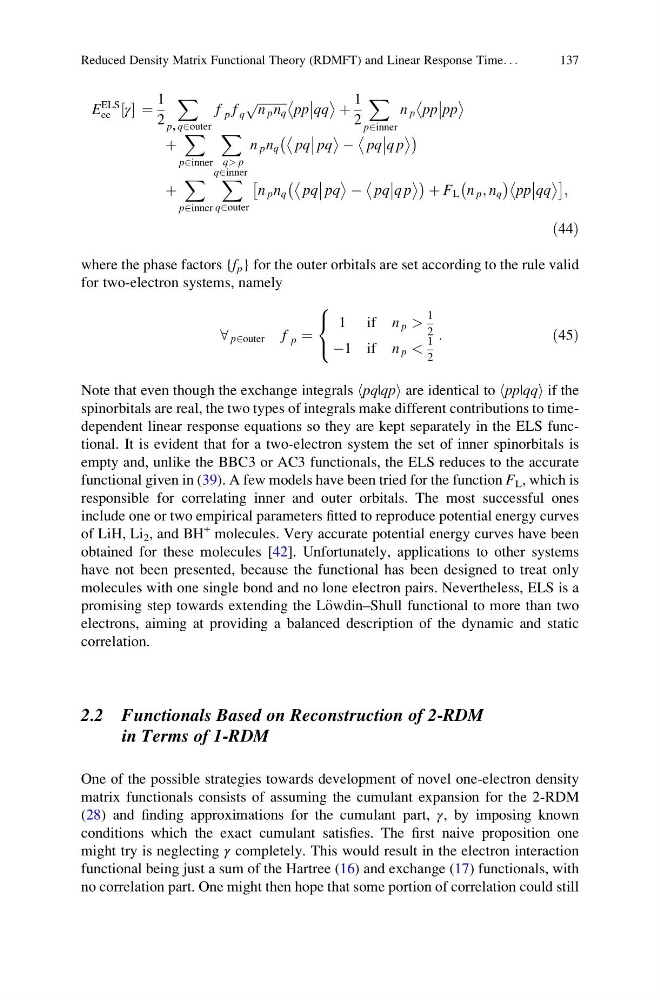
where the phase factors {f p } for the outer orbitals are set according to the rule valid
for two-electron systems, namely
8 p2outer f p ¼
1 if n p >
1
2
À1 if n p <
1
2
8
<
:
:
ð45Þ
Note that even though the exchange integrals hpq|qpi are identical to hpp|qqi if the
spinorbitals are real, the two types of integrals make different contributions to timedependent linear response equations so they are kept separately in the ELS functional. It is evident that for a two-electron system the set of inner spinorbitals is
empty and, unlike the BBC3 or AC3 functionals, the ELS reduces to the accurate
functional given in (39). A few models have been tried for the function F L , which is
responsible for correlating inner and outer orbitals. The most successful ones
include one or two empirical parameters fitted to reproduce potential energy curves
of LiH, Li 2 , and BH
+ molecules. Very accurate potential energy curves have been
obtained for these molecules [42]. Unfortunately, applications to other systems
have not been presented, because the functional has been designed to treat only
molecules with one single bond and no lone electron pairs. Nevertheless, ELS is a
promising step towards extending the L€ owdin–Shull functional to more than two
electrons, aiming at providing a balanced description of the dynamic and static
correlation.
2.2 Functionals Based on Reconstruction of 2-RDM
in Terms of 1-RDM
One of the possible strategies towards development of novel one-electron density
matrix functionals consists of assuming the cumulant expansion for the 2-RDM
(28) and finding approximations for the cumulant part, γ, by imposing known
conditions which the exact cumulant satisfies. The first naive proposition one
might try is neglecting γ completely. This would result in the electron interaction
functional being just a sum of the Hartree (16) and exchange (17) functionals, with
no correlation part. One might then hope that some portion of correlation could still
Reduced Density Matrix Functional Theory (RDMFT) and Linear Response Time. . .
137
ELS
ee γ
½ ¼
1
2
X
p, q2outer
f p f q
ffiffiffiffiffiffiffiffiffi ffi
n p n q
p
pp
þ
1
2
X
p2inner
n p pp
pp
þ
X
p2inner
X
q> p
q2inner
n p n q pq
pq
À pq
q p
À
Á
þ
X
p2inner
X
q2outer
n p n q pq
pq
À pq
q p
À
Á þ F L n p ; n q
À
Á
pp
Â
Ã
;
ð44Þ
where the phase factors {f p } for the outer orbitals are set according to the rule valid
for two-electron systems, namely
8 p2outer f p ¼
1 if n p >
1
2
À1 if n p <
1
2
8
<
:
:
ð45Þ
Note that even though the exchange integrals hpq|qpi are identical to hpp|qqi if the
spinorbitals are real, the two types of integrals make different contributions to timedependent linear response equations so they are kept separately in the ELS functional. It is evident that for a two-electron system the set of inner spinorbitals is
empty and, unlike the BBC3 or AC3 functionals, the ELS reduces to the accurate
functional given in (39). A few models have been tried for the function F L , which is
responsible for correlating inner and outer orbitals. The most successful ones
include one or two empirical parameters fitted to reproduce potential energy curves
of LiH, Li 2 , and BH
+ molecules. Very accurate potential energy curves have been
obtained for these molecules [42]. Unfortunately, applications to other systems
have not been presented, because the functional has been designed to treat only
molecules with one single bond and no lone electron pairs. Nevertheless, ELS is a
promising step towards extending the L€ owdin–Shull functional to more than two
electrons, aiming at providing a balanced description of the dynamic and static
correlation.
2.2 Functionals Based on Reconstruction of 2-RDM
in Terms of 1-RDM
One of the possible strategies towards development of novel one-electron density
matrix functionals consists of assuming the cumulant expansion for the 2-RDM
(28) and finding approximations for the cumulant part, γ, by imposing known
conditions which the exact cumulant satisfies. The first naive proposition one
might try is neglecting γ completely. This would result in the electron interaction
functional being just a sum of the Hartree (16) and exchange (17) functionals, with
no correlation part. One might then hope that some portion of correlation could still
Reduced Density Matrix Functional Theory (RDMFT) and Linear Response Time. . .
137