

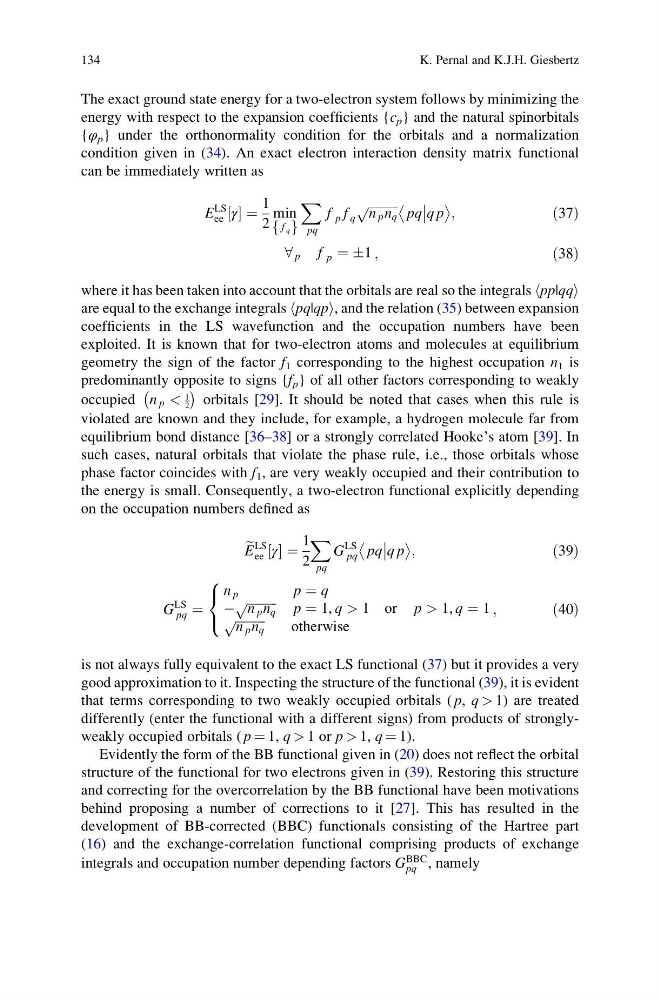
The exact ground state energy for a two-electron system follows by minimizing the
energy with respect to the expansion coefficients {c p } and the natural spinorbitals
{φ p } under the orthonormality condition for the orbitals and a normalization
condition given in (34). An exact electron interaction density matrix functional
can be immediately written as
E
LS
ee γ
½ ¼
1
2
min
f q
f g
X
pq
f p f q
ffiffiffiffiffiffiffiffiffi ffi
n p n q
p
pq
q p
;
ð37Þ
8 p f p ¼ Æ1 ;
ð38Þ
where it has been taken into account that the orbitals are real so the integrals hpp|qqi
are equal to the exchange integrals hpq|qpi, and the relation (35) between expansion
coefficients in the LS wavefunction and the occupation numbers have been
exploited. It is known that for two-electron atoms and molecules at equilibrium
geometry the sign of the factor f 1 corresponding to the highest occupation n 1 is
predominantly opposite to signs {f p } of all other factors corresponding to weakly
occupied n p <
1
2
À
Á
orbitals [29]. It should be noted that cases when this rule is
violated are known and they include, for example, a hydrogen molecule far from
equilibrium bond distance [36–38] or a strongly correlated Hooke’s atom [39]. In
such cases, natural orbitals that violate the phase rule, i.e., those orbitals whose
phase factor coincides with f 1 , are very weakly occupied and their contribution to
the energy is small. Consequently, a two-electron functional explicitly depending
on the occupation numbers defined as
e
E
LS
ee γ
½ ¼
1
2
X
pq
G
LS
pq pq
q p
;
ð39Þ
G
LS
pq ¼
n p
p ¼ q
À
ffiffiffiffiffiffiffiffiffi ffi
n p n q
p
p ¼ 1, q > 1 or p > 1, q ¼ 1
ffiffiffiffiffiffiffiffiffi ffi
n p n q
p
otherwise
8
<
:
;
ð40Þ
is not always fully equivalent to the exact LS functional (37) but it provides a very
good approximation to it. Inspecting the structure of the functional (39), it is evident
that terms corresponding to two weakly occupied orbitals ( p, q > 1) are treated
differently (enter the functional with a different signs) from products of stronglyweakly occupied orbitals ( p ¼ 1, q > 1 or p > 1, q ¼ 1).
Evidently the form of the BB functional given in (20) does not reflect the orbital
structure of the functional for two electrons given in (39). Restoring this structure
and correcting for the overcorrelation by the BB functional have been motivations
behind proposing a number of corrections to it [27]. This has resulted in the
development of BB-corrected (BBC) functionals consisting of the Hartree part
(16) and the exchange-correlation functional comprising products of exchange
integrals and occupation number depending factors G
BBC
pq , namely
134
K. Pernal and K.J.H. Giesbertz
energy with respect to the expansion coefficients {c p } and the natural spinorbitals
{φ p } under the orthonormality condition for the orbitals and a normalization
condition given in (34). An exact electron interaction density matrix functional
can be immediately written as
E
LS
ee γ
½ ¼
1
2
min
f q
f g
X
pq
f p f q
ffiffiffiffiffiffiffiffiffi ffi
n p n q
p
pq
q p
;
ð37Þ
8 p f p ¼ Æ1 ;
ð38Þ
where it has been taken into account that the orbitals are real so the integrals hpp|qqi
are equal to the exchange integrals hpq|qpi, and the relation (35) between expansion
coefficients in the LS wavefunction and the occupation numbers have been
exploited. It is known that for two-electron atoms and molecules at equilibrium
geometry the sign of the factor f 1 corresponding to the highest occupation n 1 is
predominantly opposite to signs {f p } of all other factors corresponding to weakly
occupied n p <
1
2
À
Á
orbitals [29]. It should be noted that cases when this rule is
violated are known and they include, for example, a hydrogen molecule far from
equilibrium bond distance [36–38] or a strongly correlated Hooke’s atom [39]. In
such cases, natural orbitals that violate the phase rule, i.e., those orbitals whose
phase factor coincides with f 1 , are very weakly occupied and their contribution to
the energy is small. Consequently, a two-electron functional explicitly depending
on the occupation numbers defined as
e
E
LS
ee γ
½ ¼
1
2
X
pq
G
LS
pq pq
q p
;
ð39Þ
G
LS
pq ¼
n p
p ¼ q
À
ffiffiffiffiffiffiffiffiffi ffi
n p n q
p
p ¼ 1, q > 1 or p > 1, q ¼ 1
ffiffiffiffiffiffiffiffiffi ffi
n p n q
p
otherwise
8
<
:
;
ð40Þ
is not always fully equivalent to the exact LS functional (37) but it provides a very
good approximation to it. Inspecting the structure of the functional (39), it is evident
that terms corresponding to two weakly occupied orbitals ( p, q > 1) are treated
differently (enter the functional with a different signs) from products of stronglyweakly occupied orbitals ( p ¼ 1, q > 1 or p > 1, q ¼ 1).
Evidently the form of the BB functional given in (20) does not reflect the orbital
structure of the functional for two electrons given in (39). Restoring this structure
and correcting for the overcorrelation by the BB functional have been motivations
behind proposing a number of corrections to it [27]. This has resulted in the
development of BB-corrected (BBC) functionals consisting of the Hartree part
(16) and the exchange-correlation functional comprising products of exchange
integrals and occupation number depending factors G
BBC
pq , namely
134
K. Pernal and K.J.H. Giesbertz