

E
BBC
ee
γ
½ ¼
1
2
X
pq
n p n q pp
qq
þ
1
2
X
pq
G
BBC
pq
pq
q p
:
ð41Þ
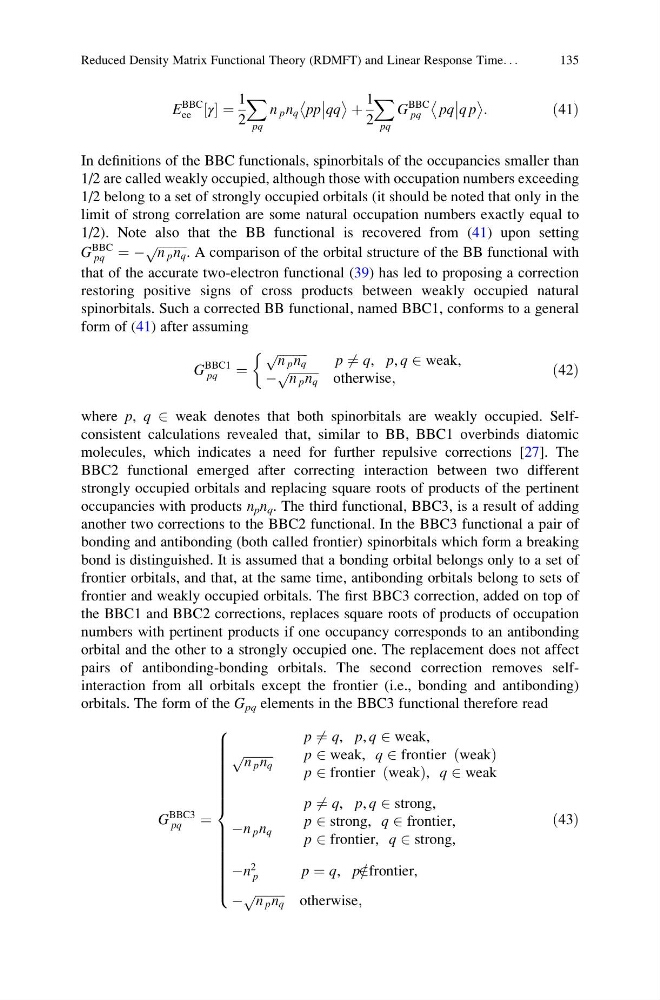
In definitions of the BBC functionals, spinorbitals of the occupancies smaller than
1/2 are called weakly occupied, although those with occupation numbers exceeding
1/2 belong to a set of strongly occupied orbitals (it should be noted that only in the
limit of strong correlation are some natural occupation numbers exactly equal to
1/2). Note also that the BB functional is recovered from (41) upon setting
G
BBC
pq ¼ À
ffiffiffiffiffiffiffiffiffi ffi
n p n q
p
. A comparison of the orbital structure of the BB functional with
that of the accurate two-electron functional (39) has led to proposing a correction
restoring positive signs of cross products between weakly occupied natural
spinorbitals. Such a corrected BB functional, named BBC1, conforms to a general
form of (41) after assuming
G
BBC1
pq
¼
ffiffiffiffiffiffiffiffiffi ffi
n p n q
p
p 6 ¼ q, p, q 2 weak,
À
ffiffiffiffiffiffiffiffiffi ffi
n p n q
p
otherwise;
&
ð42Þ
where p, q 2 weak denotes that both spinorbitals are weakly occupied. Selfconsistent calculations revealed that, similar to BB, BBC1 overbinds diatomic
molecules, which indicates a need for further repulsive corrections [27]. The
BBC2 functional emerged after correcting interaction between two different
strongly occupied orbitals and replacing square roots of products of the pertinent
occupancies with products n p n q . The third functional, BBC3, is a result of adding
another two corrections to the BBC2 functional. In the BBC3 functional a pair of
bonding and antibonding (both called frontier) spinorbitals which form a breaking
bond is distinguished. It is assumed that a bonding orbital belongs only to a set of
frontier orbitals, and that, at the same time, antibonding orbitals belong to sets of
frontier and weakly occupied orbitals. The first BBC3 correction, added on top of
the BBC1 and BBC2 corrections, replaces square roots of products of occupation
numbers with pertinent products if one occupancy corresponds to an antibonding
orbital and the other to a strongly occupied one. The replacement does not affect
pairs of antibonding-bonding orbitals. The second correction removes selfinteraction from all orbitals except the frontier (i.e., bonding and antibonding)
orbitals. The form of the G pq elements in the BBC3 functional therefore read
G
BBC3
pq
¼
ffiffiffiffiffiffiffiffiffi ffi
n p n q
p
p 6 ¼ q, p, q 2 weak,
p 2 weak, q 2 frontier weak
ð
Þ
p 2 frontier weak
ð
Þ, q 2 weak
Àn p n q
p 6 ¼ q, p, q 2 strong,
p 2 strong, q 2 frontier,
p 2 frontier, q 2 strong,
Àn
2
p
p ¼ q, p= 2frontier,
À
ffiffiffiffiffiffiffiffiffi ffi
n p n q
p
otherwise;
8
> > > > > > > > > > > > > > <
> > > > > > > > > > > > > > :
ð43Þ
Reduced Density Matrix Functional Theory (RDMFT) and Linear Response Time. . .
135
BBC
ee
γ
½ ¼
1
2
X
pq
n p n q pp
þ
1
2
X
pq
G
BBC
pq
pq
q p
:
ð41Þ
In definitions of the BBC functionals, spinorbitals of the occupancies smaller than
1/2 are called weakly occupied, although those with occupation numbers exceeding
1/2 belong to a set of strongly occupied orbitals (it should be noted that only in the
limit of strong correlation are some natural occupation numbers exactly equal to
1/2). Note also that the BB functional is recovered from (41) upon setting
G
BBC
pq ¼ À
ffiffiffiffiffiffiffiffiffi ffi
n p n q
p
. A comparison of the orbital structure of the BB functional with
that of the accurate two-electron functional (39) has led to proposing a correction
restoring positive signs of cross products between weakly occupied natural
spinorbitals. Such a corrected BB functional, named BBC1, conforms to a general
form of (41) after assuming
G
BBC1
pq
¼
ffiffiffiffiffiffiffiffiffi ffi
n p n q
p
p 6 ¼ q, p, q 2 weak,
À
ffiffiffiffiffiffiffiffiffi ffi
n p n q
p
otherwise;
&
ð42Þ
where p, q 2 weak denotes that both spinorbitals are weakly occupied. Selfconsistent calculations revealed that, similar to BB, BBC1 overbinds diatomic
molecules, which indicates a need for further repulsive corrections [27]. The
BBC2 functional emerged after correcting interaction between two different
strongly occupied orbitals and replacing square roots of products of the pertinent
occupancies with products n p n q . The third functional, BBC3, is a result of adding
another two corrections to the BBC2 functional. In the BBC3 functional a pair of
bonding and antibonding (both called frontier) spinorbitals which form a breaking
bond is distinguished. It is assumed that a bonding orbital belongs only to a set of
frontier orbitals, and that, at the same time, antibonding orbitals belong to sets of
frontier and weakly occupied orbitals. The first BBC3 correction, added on top of
the BBC1 and BBC2 corrections, replaces square roots of products of occupation
numbers with pertinent products if one occupancy corresponds to an antibonding
orbital and the other to a strongly occupied one. The replacement does not affect
pairs of antibonding-bonding orbitals. The second correction removes selfinteraction from all orbitals except the frontier (i.e., bonding and antibonding)
orbitals. The form of the G pq elements in the BBC3 functional therefore read
G
BBC3
pq
¼
ffiffiffiffiffiffiffiffiffi ffi
n p n q
p
p 6 ¼ q, p, q 2 weak,
p 2 weak, q 2 frontier weak
ð
Þ
p 2 frontier weak
ð
Þ, q 2 weak
Àn p n q
p 6 ¼ q, p, q 2 strong,
p 2 strong, q 2 frontier,
p 2 frontier, q 2 strong,
Àn
2
p
p ¼ q, p= 2frontier,
À
ffiffiffiffiffiffiffiffiffi ffi
n p n q
p
otherwise;
8
> > > > > > > > > > > > > > <
> > > > > > > > > > > > > > :
ð43Þ
Reduced Density Matrix Functional Theory (RDMFT) and Linear Response Time. . .
135