

2.1 Functionals Based on a Paradigm Two-Electron Case
Homogeneous electron gas (HEG) is a paradigm system for density functionals.
This is because the exact form of the exchange density functional for this system is
known and a highly accurate correlation energy functional is available. Consequently, electron gas has been a reference system for most approximate density
functionals and their forms are such that exact energy for a homogeneous electron
density is recovered. The situation is different in RDMFT because the exchangecorrelation density matrix functional for HEG is not known. However, the exact
density matrix functional is available for a two-electron system [29, 34], so it is now
considered to be a paradigm in RDMFT. A two-electron molecule seems to be even
a more adequate reference than the homogeneous electron gas if one aims at
developing a functional accurately describing electronic structure of molecules.
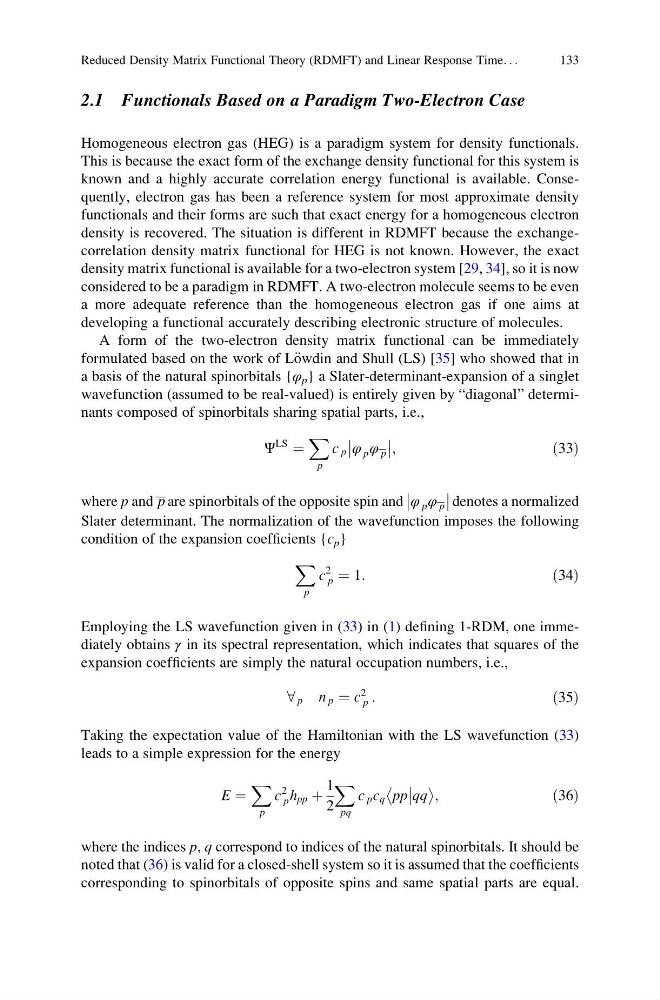
A form of the two-electron density matrix functional can be immediately
formulated based on the work of L€ owdin and Shull (LS) [35] who showed that in
a basis of the natural spinorbitals {φ p } a Slater-determinant-expansion of a singlet
wavefunction (assumed to be real-valued) is entirely given by “diagonal” determinants composed of spinorbitals sharing spatial parts, i.e.,
Ψ
LS
¼
X
p
c p φ p φ p
;
ð33Þ
where p and p are spinorbitals of the opposite spin and φ p φ p
denotes a normalized
Slater determinant. The normalization of the wavefunction imposes the following
condition of the expansion coefficients {c p }
X
p
c
2
p ¼ 1:
ð34Þ
Employing the LS wavefunction given in (33) in (1) defining 1-RDM, one immediately obtains γ in its spectral representation, which indicates that squares of the
expansion coefficients are simply the natural occupation numbers, i.e.,
8 p n p ¼ c
2
p :
ð35Þ
Taking the expectation value of the Hamiltonian with the LS wavefunction (33)
leads to a simple expression for the energy
E ¼
X
p
c
2
p h pp þ
1
2
X
pq
c p c q pp
qq
;
ð36Þ
where the indices p, q correspond to indices of the natural spinorbitals. It should be
noted that (36) is valid for a closed-shell system so it is assumed that the coefficients
corresponding to spinorbitals of opposite spins and same spatial parts are equal.
Reduced Density Matrix Functional Theory (RDMFT) and Linear Response Time. . .
133
Homogeneous electron gas (HEG) is a paradigm system for density functionals.
This is because the exact form of the exchange density functional for this system is
known and a highly accurate correlation energy functional is available. Consequently, electron gas has been a reference system for most approximate density
functionals and their forms are such that exact energy for a homogeneous electron
density is recovered. The situation is different in RDMFT because the exchangecorrelation density matrix functional for HEG is not known. However, the exact
density matrix functional is available for a two-electron system [29, 34], so it is now
considered to be a paradigm in RDMFT. A two-electron molecule seems to be even
a more adequate reference than the homogeneous electron gas if one aims at
developing a functional accurately describing electronic structure of molecules.
A form of the two-electron density matrix functional can be immediately
formulated based on the work of L€ owdin and Shull (LS) [35] who showed that in
a basis of the natural spinorbitals {φ p } a Slater-determinant-expansion of a singlet
wavefunction (assumed to be real-valued) is entirely given by “diagonal” determinants composed of spinorbitals sharing spatial parts, i.e.,
Ψ
LS
¼
X
p
c p φ p φ p
;
ð33Þ
where p and p are spinorbitals of the opposite spin and φ p φ p
denotes a normalized
Slater determinant. The normalization of the wavefunction imposes the following
condition of the expansion coefficients {c p }
X
p
c
2
p ¼ 1:
ð34Þ
Employing the LS wavefunction given in (33) in (1) defining 1-RDM, one immediately obtains γ in its spectral representation, which indicates that squares of the
expansion coefficients are simply the natural occupation numbers, i.e.,
8 p n p ¼ c
2
p :
ð35Þ
Taking the expectation value of the Hamiltonian with the LS wavefunction (33)
leads to a simple expression for the energy
E ¼
X
p
c
2
p h pp þ
1
2
X
pq
c p c q pp
;
ð36Þ
where the indices p, q correspond to indices of the natural spinorbitals. It should be
noted that (36) is valid for a closed-shell system so it is assumed that the coefficients
corresponding to spinorbitals of opposite spins and same spatial parts are equal.
Reduced Density Matrix Functional Theory (RDMFT) and Linear Response Time. . .
133