

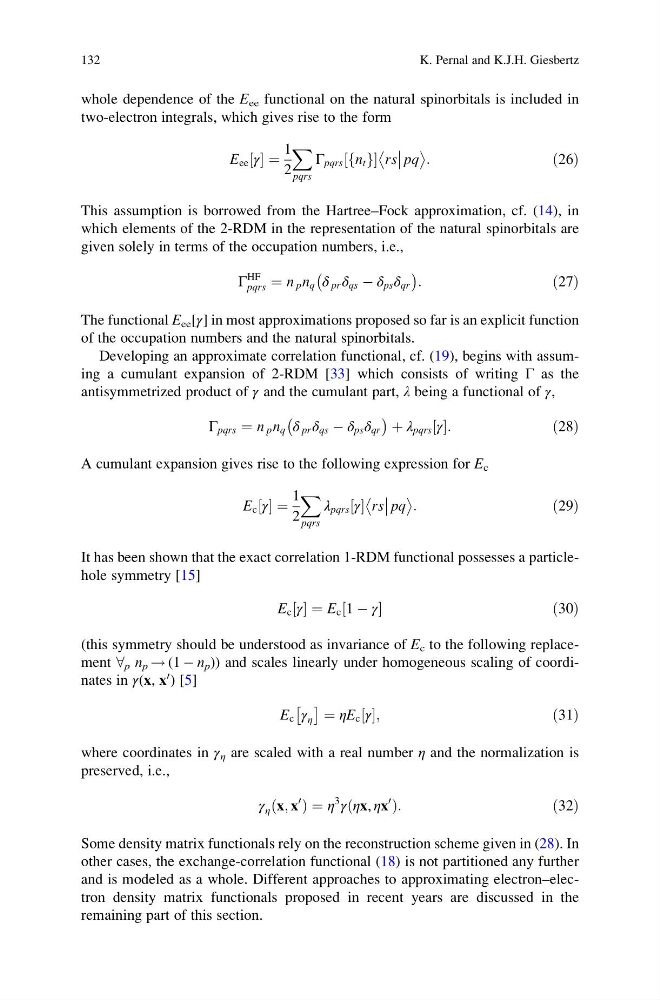
whole dependence of the E ee functional on the natural spinorbitals is included in
two-electron integrals, which gives rise to the form
E ee γ
½ ¼
1
2
X
pqrs
Γ pqrs n t
f g
½
rs
pq
:
ð26Þ
This assumption is borrowed from the Hartree–Fock approximation, cf. (14), in
which elements of the 2-RDM in the representation of the natural spinorbitals are
given solely in terms of the occupation numbers, i.e.,
Γ
HF
pqrs ¼ n p n q δ pr δ qs À δ ps δ qr
À
Á :
ð27Þ
The functional E ee [γ] in most approximations proposed so far is an explicit function
of the occupation numbers and the natural spinorbitals.
Developing an approximate correlation functional, cf. (19), begins with assuming a cumulant expansion of 2-RDM [33] which consists of writing Γ as the
antisymmetrized product of γ and the cumulant part, λ being a functional of γ,
Γ pqrs ¼ n p n q δ pr δ qs À δ ps δ qr
À
Á þ λ pqrs γ
½ :
ð28Þ
A cumulant expansion gives rise to the following expression for E c
E c γ
½ ¼
1
2
X
pqrs
λ pqrs γ
½ rs
pq
:
ð29Þ
It has been shown that the exact correlation 1-RDM functional possesses a particlehole symmetry [15]
E c γ
½ ¼ E c 1 À γ
½
ð30Þ
(this symmetry should be understood as invariance of E c to the following replacement 8 p n p ! (1 À n p )) and scales linearly under homogeneous scaling of coordinates in γ(x, x
0 ) [5]
E c γ η
 à ¼ ηE c γ
½ ;
ð31Þ
where coordinates in γ η are scaled with a real number η and the normalization is
preserved, i.e.,
γ η x; x
0
ð
Þ ¼ η
3
γ ηx, ηx
0
ð
Þ:
ð32Þ
Some density matrix functionals rely on the reconstruction scheme given in (28). In
other cases, the exchange-correlation functional (18) is not partitioned any further
and is modeled as a whole. Different approaches to approximating electron–electron density matrix functionals proposed in recent years are discussed in the
remaining part of this section.
132
K. Pernal and K.J.H. Giesbertz
two-electron integrals, which gives rise to the form
E ee γ
½ ¼
1
2
X
pqrs
Γ pqrs n t
f g
½
rs
pq
:
ð26Þ
This assumption is borrowed from the Hartree–Fock approximation, cf. (14), in
which elements of the 2-RDM in the representation of the natural spinorbitals are
given solely in terms of the occupation numbers, i.e.,
Γ
HF
pqrs ¼ n p n q δ pr δ qs À δ ps δ qr
À
Á :
ð27Þ
The functional E ee [γ] in most approximations proposed so far is an explicit function
of the occupation numbers and the natural spinorbitals.
Developing an approximate correlation functional, cf. (19), begins with assuming a cumulant expansion of 2-RDM [33] which consists of writing Γ as the
antisymmetrized product of γ and the cumulant part, λ being a functional of γ,
Γ pqrs ¼ n p n q δ pr δ qs À δ ps δ qr
À
Á þ λ pqrs γ
½ :
ð28Þ
A cumulant expansion gives rise to the following expression for E c
E c γ
½ ¼
1
2
X
pqrs
λ pqrs γ
½ rs
pq
:
ð29Þ
It has been shown that the exact correlation 1-RDM functional possesses a particlehole symmetry [15]
E c γ
½ ¼ E c 1 À γ
½
ð30Þ
(this symmetry should be understood as invariance of E c to the following replacement 8 p n p ! (1 À n p )) and scales linearly under homogeneous scaling of coordinates in γ(x, x
0 ) [5]
E c γ η
 à ¼ ηE c γ
½ ;
ð31Þ
where coordinates in γ η are scaled with a real number η and the normalization is
preserved, i.e.,
γ η x; x
0
ð
Þ ¼ η
3
γ ηx, ηx
0
ð
Þ:
ð32Þ
Some density matrix functionals rely on the reconstruction scheme given in (28). In
other cases, the exchange-correlation functional (18) is not partitioned any further
and is modeled as a whole. Different approaches to approximating electron–electron density matrix functionals proposed in recent years are discussed in the
remaining part of this section.
132
K. Pernal and K.J.H. Giesbertz