

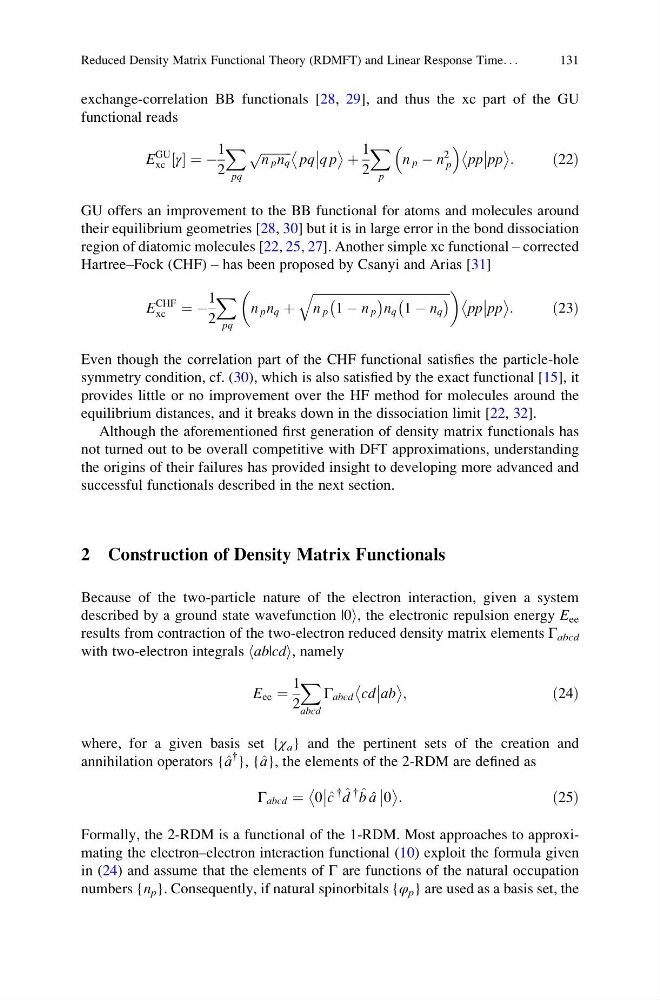
exchange-correlation BB functionals [28, 29], and thus the xc part of the GU
functional reads
E
GU
xc γ
½ ¼ À
1
2
X
pq
ffiffiffiffiffiffiffiffiffi ffi
n p n q
p
pq
q p
þ
1
2
X
p
n p À n
2
p
pp
pp
:
ð22Þ
GU offers an improvement to the BB functional for atoms and molecules around
their equilibrium geometries [28, 30] but it is in large error in the bond dissociation
region of diatomic molecules [22, 25, 27]. Another simple xc functional – corrected
Hartree–Fock (CHF) – has been proposed by Csanyi and Arias [31]
E
CHF
xc ¼ À
1
2
X
pq
n p n q þ
ffiffiffiffiffiffiffiffiffiffiffiffiffiffiffiffiffiffiffiffiffiffiffiffiffiffiffiffiffiffiffiffiffiffiffiffiffiffiffiffiffiffiffiffi
n p 1 À n p
À
Á
n q 1 À n q
À
Á
q
pp
pp
:
ð23Þ
Even though the correlation part of the CHF functional satisfies the particle-hole
symmetry condition, cf. (30), which is also satisfied by the exact functional [15], it
provides little or no improvement over the HF method for molecules around the
equilibrium distances, and it breaks down in the dissociation limit [22, 32].
Although the aforementioned first generation of density matrix functionals has
not turned out to be overall competitive with DFT approximations, understanding
the origins of their failures has provided insight to developing more advanced and
successful functionals described in the next section.
2 Construction of Density Matrix Functionals
Because of the two-particle nature of the electron interaction, given a system
described by a ground state wavefunction |0i, the electronic repulsion energy E ee
results from contraction of the two-electron reduced density matrix elements Γ abcd
with two-electron integrals hab|cdi, namely
E ee ¼
1
2
X
abcd
Γ abcd cd
ab
;
ð24Þ
where, for a given basis set {χ a } and the pertinent sets of the creation and
annihilation operators {^ a
{ }, {^ a}, the elements of the 2-RDM are defined as
Γ abcd ¼ 0 ^
c
{ ^
d
{ ^
b ^
a
0
:
ð25Þ
Formally, the 2-RDM is a functional of the 1-RDM. Most approaches to approximating the electron–electron interaction functional (10) exploit the formula given
in (24) and assume that the elements of Γ are functions of the natural occupation
numbers {n p }. Consequently, if natural spinorbitals {φ p } are used as a basis set, the
Reduced Density Matrix Functional Theory (RDMFT) and Linear Response Time. . .
131
functional reads
E
GU
xc γ
½ ¼ À
1
2
X
pq
ffiffiffiffiffiffiffiffiffi ffi
n p n q
p
pq
q p
þ
1
2
X
p
n p À n
2
p
pp
pp
:
ð22Þ
GU offers an improvement to the BB functional for atoms and molecules around
their equilibrium geometries [28, 30] but it is in large error in the bond dissociation
region of diatomic molecules [22, 25, 27]. Another simple xc functional – corrected
Hartree–Fock (CHF) – has been proposed by Csanyi and Arias [31]
E
CHF
xc ¼ À
1
2
X
pq
n p n q þ
ffiffiffiffiffiffiffiffiffiffiffiffiffiffiffiffiffiffiffiffiffiffiffiffiffiffiffiffiffiffiffiffiffiffiffiffiffiffiffiffiffiffiffiffi
n p 1 À n p
À
Á
n q 1 À n q
À
Á
q
pp
pp
:
ð23Þ
Even though the correlation part of the CHF functional satisfies the particle-hole
symmetry condition, cf. (30), which is also satisfied by the exact functional [15], it
provides little or no improvement over the HF method for molecules around the
equilibrium distances, and it breaks down in the dissociation limit [22, 32].
Although the aforementioned first generation of density matrix functionals has
not turned out to be overall competitive with DFT approximations, understanding
the origins of their failures has provided insight to developing more advanced and
successful functionals described in the next section.
2 Construction of Density Matrix Functionals
Because of the two-particle nature of the electron interaction, given a system
described by a ground state wavefunction |0i, the electronic repulsion energy E ee
results from contraction of the two-electron reduced density matrix elements Γ abcd
with two-electron integrals hab|cdi, namely
E ee ¼
1
2
X
abcd
Γ abcd cd
ab
;
ð24Þ
where, for a given basis set {χ a } and the pertinent sets of the creation and
annihilation operators {^ a
{ }, {^ a}, the elements of the 2-RDM are defined as
Γ abcd ¼ 0 ^
c
{ ^
d
{ ^
b ^
a
0
:
ð25Þ
Formally, the 2-RDM is a functional of the 1-RDM. Most approaches to approximating the electron–electron interaction functional (10) exploit the formula given
in (24) and assume that the elements of Γ are functions of the natural occupation
numbers {n p }. Consequently, if natural spinorbitals {φ p } are used as a basis set, the
Reduced Density Matrix Functional Theory (RDMFT) and Linear Response Time. . .
131