

The two cases, namely a noninteracting N-electron system and an interacting
two-electron species, cover two extreme regimes of electron correlation for an
electron pair: the former pertains to an uncorrelated pair, whereas the latter, applied
to electrons separated in space (e.g., H 2 molecule in a dissociation limit), describes
strongly correlated electrons. In other words, exact density matrix functionals for an
uncorrelated and a strongly correlated electron pair are known. Ideally, a valid
approximate functional should reduce to exact functionals for both cases.
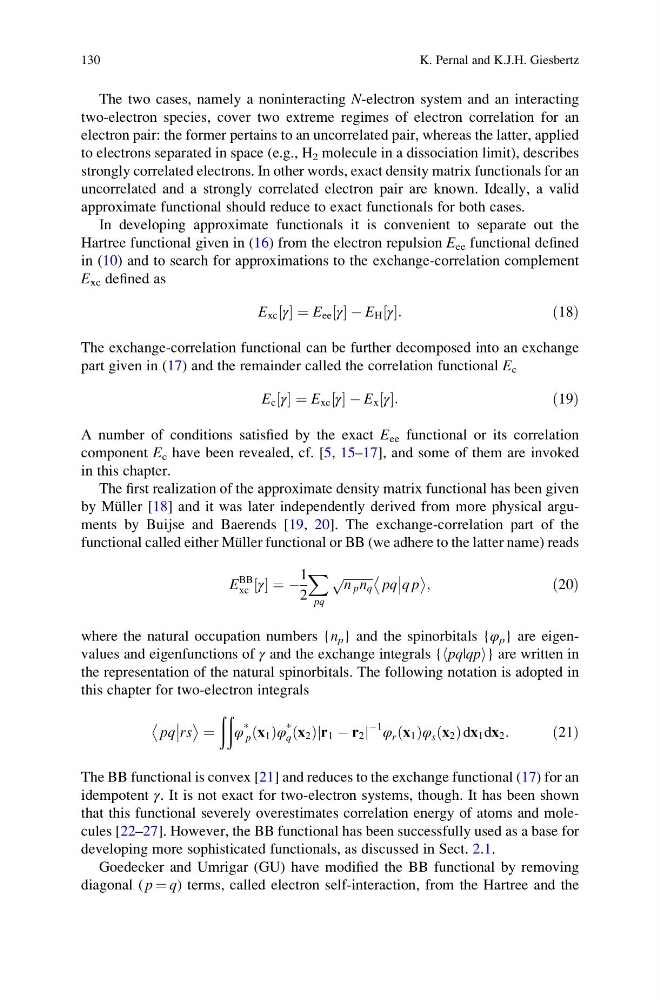
In developing approximate functionals it is convenient to separate out the
Hartree functional given in (16) from the electron repulsion E ee functional defined
in (10) and to search for approximations to the exchange-correlation complement
E xc defined as
E xc γ
½ ¼ E ee γ
½ À E H γ
½ :
ð18Þ
The exchange-correlation functional can be further decomposed into an exchange
part given in (17) and the remainder called the correlation functional E c
E c γ
½ ¼ E xc γ
½ À E x γ
½ :
ð19Þ
A number of conditions satisfied by the exact E ee functional or its correlation
component E c have been revealed, cf. [5, 15–17], and some of them are invoked
in this chapter.
The first realization of the approximate density matrix functional has been given
by Mu ¨ller [18] and it was later independently derived from more physical arguments by Buijse and Baerends [19, 20]. The exchange-correlation part of the
functional called either Mu ¨ller functional or BB (we adhere to the latter name) reads
E
BB
xc γ
½ ¼ À
1
2
X
pq
ffiffiffiffiffiffiffiffiffi ffi
n p n q
p
pq
q p
;
ð20Þ
where the natural occupation numbers {n p } and the spinorbitals {φ p } are eigenvalues and eigenfunctions of γ and the exchange integrals {hpq|qpi} are written in
the representation of the natural spinorbitals. The following notation is adopted in
this chapter for two-electron integrals
pq
rs
¼
ðð
φ
*
p x 1
ð Þφ
*
q x 2
ð Þ r 1 À r 2
j
j
À1 φ r x 1
ð Þφ s x 2
ð Þdx 1 dx 2 :
ð21Þ
The BB functional is convex [21] and reduces to the exchange functional (17) for an
idempotent γ. It is not exact for two-electron systems, though. It has been shown
that this functional severely overestimates correlation energy of atoms and molecules [22–27]. However, the BB functional has been successfully used as a base for
developing more sophisticated functionals, as discussed in Sect. 2.1.
Goedecker and Umrigar (GU) have modified the BB functional by removing
diagonal ( p ¼ q) terms, called electron self-interaction, from the Hartree and the
130
K. Pernal and K.J.H. Giesbertz
two-electron species, cover two extreme regimes of electron correlation for an
electron pair: the former pertains to an uncorrelated pair, whereas the latter, applied
to electrons separated in space (e.g., H 2 molecule in a dissociation limit), describes
strongly correlated electrons. In other words, exact density matrix functionals for an
uncorrelated and a strongly correlated electron pair are known. Ideally, a valid
approximate functional should reduce to exact functionals for both cases.
In developing approximate functionals it is convenient to separate out the
Hartree functional given in (16) from the electron repulsion E ee functional defined
in (10) and to search for approximations to the exchange-correlation complement
E xc defined as
E xc γ
½ ¼ E ee γ
½ À E H γ
½ :
ð18Þ
The exchange-correlation functional can be further decomposed into an exchange
part given in (17) and the remainder called the correlation functional E c
E c γ
½ ¼ E xc γ
½ À E x γ
½ :
ð19Þ
A number of conditions satisfied by the exact E ee functional or its correlation
component E c have been revealed, cf. [5, 15–17], and some of them are invoked
in this chapter.
The first realization of the approximate density matrix functional has been given
by Mu ¨ller [18] and it was later independently derived from more physical arguments by Buijse and Baerends [19, 20]. The exchange-correlation part of the
functional called either Mu ¨ller functional or BB (we adhere to the latter name) reads
E
BB
xc γ
½ ¼ À
1
2
X
pq
ffiffiffiffiffiffiffiffiffi ffi
n p n q
p
pq
q p
;
ð20Þ
where the natural occupation numbers {n p } and the spinorbitals {φ p } are eigenvalues and eigenfunctions of γ and the exchange integrals {hpq|qpi} are written in
the representation of the natural spinorbitals. The following notation is adopted in
this chapter for two-electron integrals
pq
rs
¼
ðð
φ
*
p x 1
ð Þφ
*
q x 2
ð Þ r 1 À r 2
j
j
À1 φ r x 1
ð Þφ s x 2
ð Þdx 1 dx 2 :
ð21Þ
The BB functional is convex [21] and reduces to the exchange functional (17) for an
idempotent γ. It is not exact for two-electron systems, though. It has been shown
that this functional severely overestimates correlation energy of atoms and molecules [22–27]. However, the BB functional has been successfully used as a base for
developing more sophisticated functionals, as discussed in Sect. 2.1.
Goedecker and Umrigar (GU) have modified the BB functional by removing
diagonal ( p ¼ q) terms, called electron self-interaction, from the Hartree and the
130
K. Pernal and K.J.H. Giesbertz