

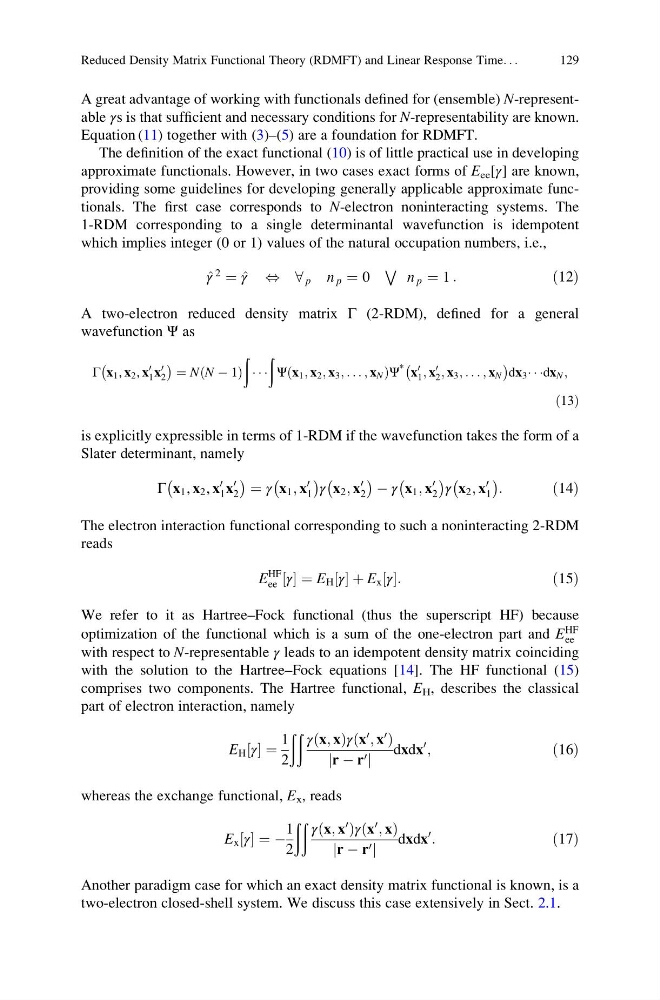
A great advantage of working with functionals defined for (ensemble) N-representable γs is that sufficient and necessary conditions for N-representability are known.
Equation (11) together with (3)–(5) are a foundation for RDMFT.
The definition of the exact functional (10) is of little practical use in developing
approximate functionals. However, in two cases exact forms of E ee [γ] are known,
providing some guidelines for developing generally applicable approximate functionals. The first case corresponds to N-electron noninteracting systems. The
1-RDM corresponding to a single determinantal wavefunction is idempotent
which implies integer (0 or 1) values of the natural occupation numbers, i.e.,
^
γ
2
¼ ^
γ , 8 p n p ¼ 0
W
n p ¼ 1 :
ð12Þ
A two-electron reduced density matrix Γ (2-RDM), defined for a general
wavefunction Ψ as
Γ x 1 , x 2 , x
0
1 x
0
2
À
Á ¼ N N À 1
ð
Þ
ð
Á Á Á
ð
Ψ x 1 ; x 2 ; x 3 ; . . . ; x N
ð
Þ Ψ
* x
0
1 ; x
0
2 ; x 3 ; . . . ; x N
À
Á
dx 3 Á Á Ádx N ;
ð13Þ
is explicitly expressible in terms of 1-RDM if the wavefunction takes the form of a
Slater determinant, namely
Γ x 1 , x 2 , x
0
1 x
0
2
À
Á ¼ γ x 1 ; x
0
1
À
Á γ x 2 ; x
0
2
À
Á À γ x 1 ; x
0
2
À
Á
γ x 2 ; x
0
1
À
Á :
ð14Þ
The electron interaction functional corresponding to such a noninteracting 2-RDM
reads
E
HF
ee γ
½ ¼ E H γ
½ þ E x γ
½ :
ð15Þ
We refer to it as Hartree–Fock functional (thus the superscript HF) because
optimization of the functional which is a sum of the one-electron part and E
HF
ee
with respect to N-representable γ leads to an idempotent density matrix coinciding
with the solution to the Hartree–Fock equations [14]. The HF functional (15)
comprises two components. The Hartree functional, E H , describes the classical
part of electron interaction, namely
E H γ
½ ¼
1
2
ðð γ x; x
ð Þγ x
0
; x
0
ð
Þ
r À r 0
j
j
dxdx
0
;
ð16Þ
whereas the exchange functional, E x , reads
E x γ
½ ¼ À
1
2
ðð γ x; x
0
ð
Þγ x
0
; x
ð
Þ
r À r 0
j
j
dxdx
0
:
ð17Þ
Another paradigm case for which an exact density matrix functional is known, is a
two-electron closed-shell system. We discuss this case extensively in Sect. 2.1.
Reduced Density Matrix Functional Theory (RDMFT) and Linear Response Time. . .
129
Equation (11) together with (3)–(5) are a foundation for RDMFT.
The definition of the exact functional (10) is of little practical use in developing
approximate functionals. However, in two cases exact forms of E ee [γ] are known,
providing some guidelines for developing generally applicable approximate functionals. The first case corresponds to N-electron noninteracting systems. The
1-RDM corresponding to a single determinantal wavefunction is idempotent
which implies integer (0 or 1) values of the natural occupation numbers, i.e.,
^
γ
2
¼ ^
γ , 8 p n p ¼ 0
W
n p ¼ 1 :
ð12Þ
A two-electron reduced density matrix Γ (2-RDM), defined for a general
wavefunction Ψ as
Γ x 1 , x 2 , x
0
1 x
0
2
À
Á ¼ N N À 1
ð
Þ
ð
Á Á Á
ð
Ψ x 1 ; x 2 ; x 3 ; . . . ; x N
ð
Þ Ψ
* x
0
1 ; x
0
2 ; x 3 ; . . . ; x N
À
Á
dx 3 Á Á Ádx N ;
ð13Þ
is explicitly expressible in terms of 1-RDM if the wavefunction takes the form of a
Slater determinant, namely
Γ x 1 , x 2 , x
0
1 x
0
2
À
Á ¼ γ x 1 ; x
0
1
À
Á γ x 2 ; x
0
2
À
Á À γ x 1 ; x
0
2
À
Á
γ x 2 ; x
0
1
À
Á :
ð14Þ
The electron interaction functional corresponding to such a noninteracting 2-RDM
reads
E
HF
ee γ
½ ¼ E H γ
½ þ E x γ
½ :
ð15Þ
We refer to it as Hartree–Fock functional (thus the superscript HF) because
optimization of the functional which is a sum of the one-electron part and E
HF
ee
with respect to N-representable γ leads to an idempotent density matrix coinciding
with the solution to the Hartree–Fock equations [14]. The HF functional (15)
comprises two components. The Hartree functional, E H , describes the classical
part of electron interaction, namely
E H γ
½ ¼
1
2
ðð γ x; x
ð Þγ x
0
; x
0
ð
Þ
r À r 0
j
j
dxdx
0
;
ð16Þ
whereas the exchange functional, E x , reads
E x γ
½ ¼ À
1
2
ðð γ x; x
0
ð
Þγ x
0
; x
ð
Þ
r À r 0
j
j
dxdx
0
:
ð17Þ
Another paradigm case for which an exact density matrix functional is known, is a
two-electron closed-shell system. We discuss this case extensively in Sect. 2.1.
Reduced Density Matrix Functional Theory (RDMFT) and Linear Response Time. . .
129