

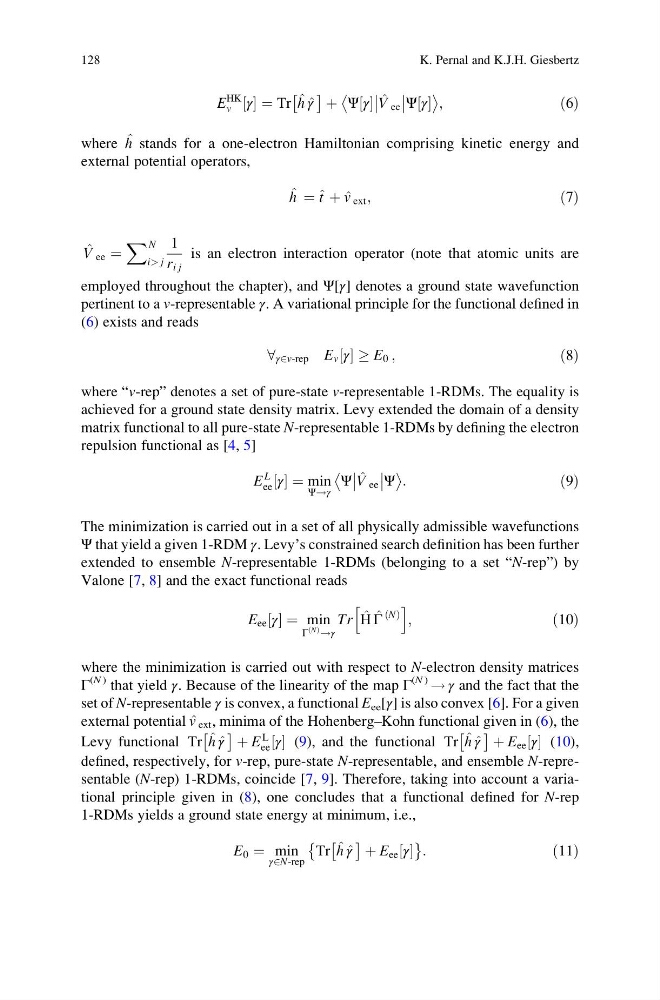
E
HK
v γ
½ ¼ Tr ^
h ^
γ
 à þ Ψ γ
½ ^
V ee
Ψ γ
½
;
ð6Þ
where ^
h stands for a one-electron Hamiltonian comprising kinetic energy and
external potential operators,
^
h ¼ ^ t þ ^
v ext ;
ð7Þ
^
V ee ¼
X N
i> j
1
r i j
is an electron interaction operator (note that atomic units are
employed throughout the chapter), and Ψ[γ] denotes a ground state wavefunction
pertinent to a v-representable γ. A variational principle for the functional defined in
(6) exists and reads
8 γ2v-rep E v γ
½ ! E 0 ;
ð8Þ
where “v-rep” denotes a set of pure-state v-representable 1-RDMs. The equality is
achieved for a ground state density matrix. Levy extended the domain of a density
matrix functional to all pure-state N-representable 1-RDMs by defining the electron
repulsion functional as [4, 5]
E
L
ee γ
½ ¼ min
Ψ!γ
Ψ ^
V ee
Ψ
:
ð9Þ
The minimization is carried out in a set of all physically admissible wavefunctions
Ψ that yield a given 1-RDM γ. Levy’s constrained search definition has been further
extended to ensemble N-representable 1-RDMs (belonging to a set “N-rep”) by
Valone [7, 8] and the exact functional reads
E ee γ
½ ¼ min
Γ
N
ð Þ !γ
Tr ^
H ^
Γ
N
ð Þ
h
i
;
ð10Þ
where the minimization is carried out with respect to N-electron density matrices
Γ
(N ) that yield γ. Because of the linearity of the map Γ
(N )
! γ and the fact that the
set of N-representable γ is convex, a functional E ee [γ] is also convex [6]. For a given
external potential ^
v ext , minima of the Hohenberg–Kohn functional given in (6), the
Levy functional Tr ^
h ^
γ
 à þ E
L
ee γ
½ (9), and the functional Tr ^
h ^
γ
 à þ E ee γ
½ (10),
defined, respectively, for v-rep, pure-state N-representable, and ensemble N-representable (N-rep) 1-RDMs, coincide [7, 9]. Therefore, taking into account a variational principle given in (8), one concludes that a functional defined for N-rep
1-RDMs yields a ground state energy at minimum, i.e.,
E 0 ¼ min
γ2N-rep
Tr ^
h ^
γ
 à þ E ee γ
½
È
É :
ð11Þ
128
K. Pernal and K.J.H. Giesbertz
HK
v γ
½ ¼ Tr ^
h ^
γ
 à þ Ψ γ
½ ^
V ee
Ψ γ
½
;
ð6Þ
where ^
h stands for a one-electron Hamiltonian comprising kinetic energy and
external potential operators,
^
h ¼ ^ t þ ^
v ext ;
ð7Þ
^
V ee ¼
X N
i> j
1
r i j
is an electron interaction operator (note that atomic units are
employed throughout the chapter), and Ψ[γ] denotes a ground state wavefunction
pertinent to a v-representable γ. A variational principle for the functional defined in
(6) exists and reads
8 γ2v-rep E v γ
½ ! E 0 ;
ð8Þ
where “v-rep” denotes a set of pure-state v-representable 1-RDMs. The equality is
achieved for a ground state density matrix. Levy extended the domain of a density
matrix functional to all pure-state N-representable 1-RDMs by defining the electron
repulsion functional as [4, 5]
E
L
ee γ
½ ¼ min
Ψ!γ
Ψ ^
V ee
Ψ
:
ð9Þ
The minimization is carried out in a set of all physically admissible wavefunctions
Ψ that yield a given 1-RDM γ. Levy’s constrained search definition has been further
extended to ensemble N-representable 1-RDMs (belonging to a set “N-rep”) by
Valone [7, 8] and the exact functional reads
E ee γ
½ ¼ min
Γ
N
ð Þ !γ
Tr ^
H ^
Γ
N
ð Þ
h
i
;
ð10Þ
where the minimization is carried out with respect to N-electron density matrices
Γ
(N ) that yield γ. Because of the linearity of the map Γ
(N )
! γ and the fact that the
set of N-representable γ is convex, a functional E ee [γ] is also convex [6]. For a given
external potential ^
v ext , minima of the Hohenberg–Kohn functional given in (6), the
Levy functional Tr ^
h ^
γ
 à þ E
L
ee γ
½ (9), and the functional Tr ^
h ^
γ
 à þ E ee γ
½ (10),
defined, respectively, for v-rep, pure-state N-representable, and ensemble N-representable (N-rep) 1-RDMs, coincide [7, 9]. Therefore, taking into account a variational principle given in (8), one concludes that a functional defined for N-rep
1-RDMs yields a ground state energy at minimum, i.e.,
E 0 ¼ min
γ2N-rep
Tr ^
h ^
γ
 à þ E ee γ
½
È
É :
ð11Þ
128
K. Pernal and K.J.H. Giesbertz