

reduced (one-electron) density matrix functional theory (RDMFT) there is no need
to introduce a fictitious noninteracting system. Moreover, orbitals present in
RDMFT are fractionally occupied so functionals of γ seem to be better suited
than their density counterparts to account for static correlation and, for example,
describe correctly a covalent bond-breaking process. As discussed in this chapter,
this presumption has been confirmed by a good performance of the most successful
density matrix functionals.
Although the theoretical foundations of RDMFT were set a long time ago [1–
11], functionals of practical usefulness which can compete with density functionals
in accuracy have only recently been proposed. In this section we present the main
ingredients of RDMFT (theorems, definitions, and conditions) and first approximate density matrix functionals proposed for electronic systems. In the following
sections more recent and successful developments in RDMFT are shown.
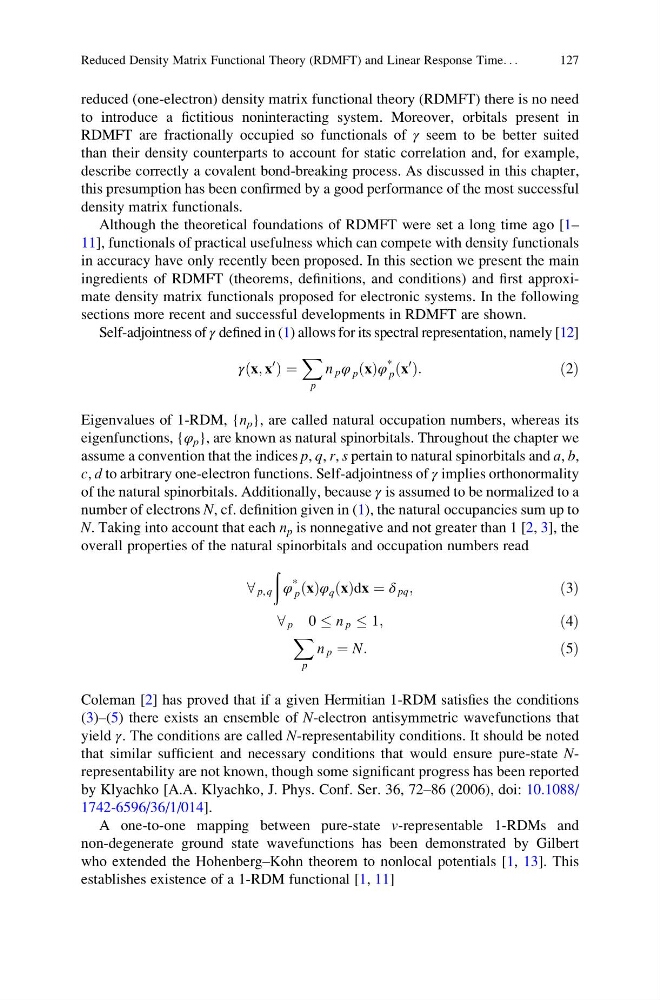
Self-adjointness of γ defined in (1) allows for its spectral representation, namely [12]
γ x; x
0
ð
Þ ¼
X
p
n p φ p x
ð Þφ
*
p x
0
ð Þ:
ð2Þ
Eigenvalues of 1-RDM, {n p }, are called natural occupation numbers, whereas its
eigenfunctions, {φ p }, are known as natural spinorbitals. Throughout the chapter we
assume a convention that the indices p, q, r, s pertain to natural spinorbitals and a, b,
c, d to arbitrary one-electron functions. Self-adjointness of γ implies orthonormality
of the natural spinorbitals. Additionally, because γ is assumed to be normalized to a
number of electrons N, cf. definition given in (1), the natural occupancies sum up to
N. Taking into account that each n p is nonnegative and not greater than 1 [2, 3], the
overall properties of the natural spinorbitals and occupation numbers read
8 p, q
ð
φ
*
p x
ð Þφ q x
ð Þdx ¼ δ pq ;
ð3Þ
8 p 0 n p 1;
ð4Þ
X
p
n p ¼ N:
ð5Þ
Coleman [2] has proved that if a given Hermitian 1-RDM satisfies the conditions
(3)–(5) there exists an ensemble of N-electron antisymmetric wavefunctions that
yield γ. The conditions are called N-representability conditions. It should be noted
that similar sufficient and necessary conditions that would ensure pure-state Nrepresentability are not known, though some significant progress has been reported
by Klyachko [A.A. Klyachko, J. Phys. Conf. Ser. 36, 72–86 (2006), doi: 10.1088/
1742-6596/36/1/014].
A one-to-one mapping between pure-state v-representable 1-RDMs and
non-degenerate ground state wavefunctions has been demonstrated by Gilbert
who extended the Hohenberg–Kohn theorem to nonlocal potentials [1, 13]. This
establishes existence of a 1-RDM functional [1, 11]
Reduced Density Matrix Functional Theory (RDMFT) and Linear Response Time. . .
127
to introduce a fictitious noninteracting system. Moreover, orbitals present in
RDMFT are fractionally occupied so functionals of γ seem to be better suited
than their density counterparts to account for static correlation and, for example,
describe correctly a covalent bond-breaking process. As discussed in this chapter,
this presumption has been confirmed by a good performance of the most successful
density matrix functionals.
Although the theoretical foundations of RDMFT were set a long time ago [1–
11], functionals of practical usefulness which can compete with density functionals
in accuracy have only recently been proposed. In this section we present the main
ingredients of RDMFT (theorems, definitions, and conditions) and first approximate density matrix functionals proposed for electronic systems. In the following
sections more recent and successful developments in RDMFT are shown.
Self-adjointness of γ defined in (1) allows for its spectral representation, namely [12]
γ x; x
0
ð
Þ ¼
X
p
n p φ p x
ð Þφ
*
p x
0
ð Þ:
ð2Þ
Eigenvalues of 1-RDM, {n p }, are called natural occupation numbers, whereas its
eigenfunctions, {φ p }, are known as natural spinorbitals. Throughout the chapter we
assume a convention that the indices p, q, r, s pertain to natural spinorbitals and a, b,
c, d to arbitrary one-electron functions. Self-adjointness of γ implies orthonormality
of the natural spinorbitals. Additionally, because γ is assumed to be normalized to a
number of electrons N, cf. definition given in (1), the natural occupancies sum up to
N. Taking into account that each n p is nonnegative and not greater than 1 [2, 3], the
overall properties of the natural spinorbitals and occupation numbers read
8 p, q
ð
φ
*
p x
ð Þφ q x
ð Þdx ¼ δ pq ;
ð3Þ
8 p 0 n p 1;
ð4Þ
X
p
n p ¼ N:
ð5Þ
Coleman [2] has proved that if a given Hermitian 1-RDM satisfies the conditions
(3)–(5) there exists an ensemble of N-electron antisymmetric wavefunctions that
yield γ. The conditions are called N-representability conditions. It should be noted
that similar sufficient and necessary conditions that would ensure pure-state Nrepresentability are not known, though some significant progress has been reported
by Klyachko [A.A. Klyachko, J. Phys. Conf. Ser. 36, 72–86 (2006), doi: 10.1088/
1742-6596/36/1/014].
A one-to-one mapping between pure-state v-representable 1-RDMs and
non-degenerate ground state wavefunctions has been demonstrated by Gilbert
who extended the Hohenberg–Kohn theorem to nonlocal potentials [1, 13]. This
establishes existence of a 1-RDM functional [1, 11]
Reduced Density Matrix Functional Theory (RDMFT) and Linear Response Time. . .
127