

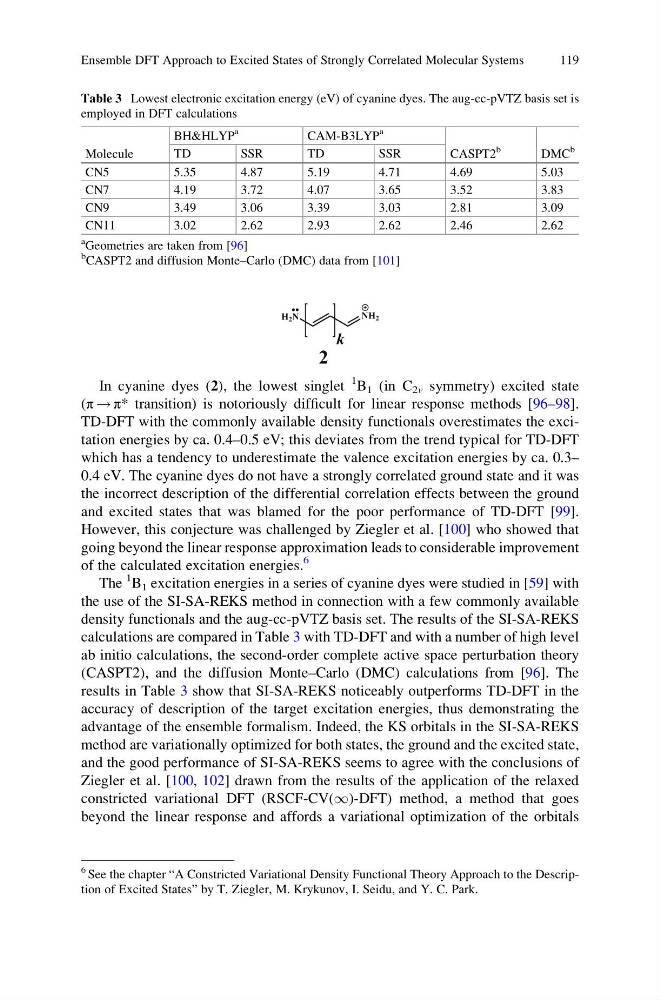
In cyanine dyes (2), the lowest singlet
1 B 1 (in C 2v symmetry) excited state
(π ! π* transition) is notoriously difficult for linear response methods [96–98].
TD-DFT with the commonly available density functionals overestimates the excitation energies by ca. 0.4–0.5 eV; this deviates from the trend typical for TD-DFT
which has a tendency to underestimate the valence excitation energies by ca. 0.3–
0.4 eV. The cyanine dyes do not have a strongly correlated ground state and it was
the incorrect description of the differential correlation effects between the ground
and excited states that was blamed for the poor performance of TD-DFT [99].
However, this conjecture was challenged by Ziegler et al. [100] who showed that
going beyond the linear response approximation leads to considerable improvement
of the calculated excitation energies.
6
The
1 B 1 excitation energies in a series of cyanine dyes were studied in [59] with
the use of the SI-SA-REKS method in connection with a few commonly available
density functionals and the aug-cc-pVTZ basis set. The results of the SI-SA-REKS
calculations are compared in Table 3 with TD-DFT and with a number of high level
ab initio calculations, the second-order complete active space perturbation theory
(CASPT2), and the diffusion Monte–Carlo (DMC) calculations from [96]. The
results in Table 3 show that SI-SA-REKS noticeably outperforms TD-DFT in the
accuracy of description of the target excitation energies, thus demonstrating the
advantage of the ensemble formalism. Indeed, the KS orbitals in the SI-SA-REKS
method are variationally optimized for both states, the ground and the excited state,
and the good performance of SI-SA-REKS seems to agree with the conclusions of
Ziegler et al. [100, 102] drawn from the results of the application of the relaxed
constricted variational DFT (RSCF-CV(1)-DFT) method, a method that goes
beyond the linear response and affords a variational optimization of the orbitals
6 See the chapter “A Constricted Variational Density Functional Theory Approach to the Description of Excited States” by T. Ziegler, M. Krykunov, I. Seidu, and Y. C. Park.
Table 3 Lowest electronic excitation energy (eV) of cyanine dyes. The aug-cc-pVTZ basis set is
employed in DFT calculations
Molecule
BH&HLYP
a
CAM-B3LYP
a
CASPT2
b
DMC
b
TD
SSR
TD
SSR
CN5
5.35
4.87
5.19
4.71
4.69
5.03
CN7
4.19
3.72
4.07
3.65
3.52
3.83
CN9
3.49
3.06
3.39
3.03
2.81
3.09
CN11
3.02
2.62
2.93
2.62
2.46
2.62
a
Geometries are taken from [96]
b
CASPT2 and diffusion Monte–Carlo (DMC) data from [101]
Ensemble DFT Approach to Excited States of Strongly Correlated Molecular Systems
119
1 B 1 (in C 2v symmetry) excited state
(π ! π* transition) is notoriously difficult for linear response methods [96–98].
TD-DFT with the commonly available density functionals overestimates the excitation energies by ca. 0.4–0.5 eV; this deviates from the trend typical for TD-DFT
which has a tendency to underestimate the valence excitation energies by ca. 0.3–
0.4 eV. The cyanine dyes do not have a strongly correlated ground state and it was
the incorrect description of the differential correlation effects between the ground
and excited states that was blamed for the poor performance of TD-DFT [99].
However, this conjecture was challenged by Ziegler et al. [100] who showed that
going beyond the linear response approximation leads to considerable improvement
of the calculated excitation energies.
6
The
1 B 1 excitation energies in a series of cyanine dyes were studied in [59] with
the use of the SI-SA-REKS method in connection with a few commonly available
density functionals and the aug-cc-pVTZ basis set. The results of the SI-SA-REKS
calculations are compared in Table 3 with TD-DFT and with a number of high level
ab initio calculations, the second-order complete active space perturbation theory
(CASPT2), and the diffusion Monte–Carlo (DMC) calculations from [96]. The
results in Table 3 show that SI-SA-REKS noticeably outperforms TD-DFT in the
accuracy of description of the target excitation energies, thus demonstrating the
advantage of the ensemble formalism. Indeed, the KS orbitals in the SI-SA-REKS
method are variationally optimized for both states, the ground and the excited state,
and the good performance of SI-SA-REKS seems to agree with the conclusions of
Ziegler et al. [100, 102] drawn from the results of the application of the relaxed
constricted variational DFT (RSCF-CV(1)-DFT) method, a method that goes
beyond the linear response and affords a variational optimization of the orbitals
6 See the chapter “A Constricted Variational Density Functional Theory Approach to the Description of Excited States” by T. Ziegler, M. Krykunov, I. Seidu, and Y. C. Park.
Table 3 Lowest electronic excitation energy (eV) of cyanine dyes. The aug-cc-pVTZ basis set is
employed in DFT calculations
Molecule
BH&HLYP
a
CAM-B3LYP
a
CASPT2
b
DMC
b
TD
SSR
TD
SSR
CN5
5.35
4.87
5.19
4.71
4.69
5.03
CN7
4.19
3.72
4.07
3.65
3.52
3.83
CN9
3.49
3.06
3.39
3.03
2.81
3.09
CN11
3.02
2.62
2.93
2.62
2.46
2.62
a
Geometries are taken from [96]
b
CASPT2 and diffusion Monte–Carlo (DMC) data from [101]
Ensemble DFT Approach to Excited States of Strongly Correlated Molecular Systems
119