

feature of TD-DFT excitation energies is independent of the density functional
employed (see [59] for more detail) and is another illustration of the failure of the
conventional KS DFT approach to strongly correlated systems.
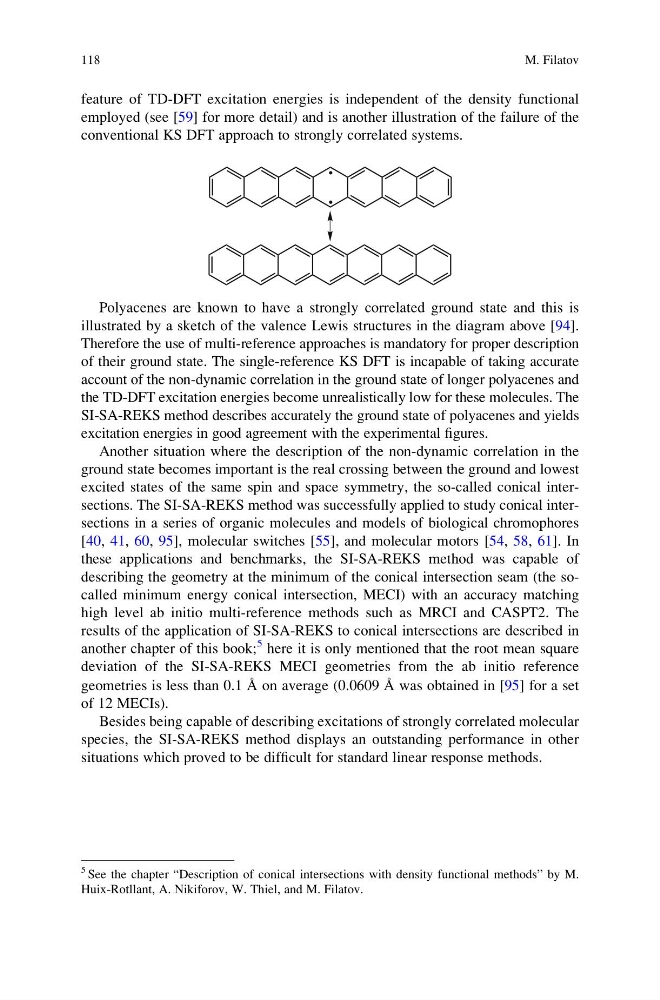
Polyacenes are known to have a strongly correlated ground state and this is
illustrated by a sketch of the valence Lewis structures in the diagram above [94].
Therefore the use of multi-reference approaches is mandatory for proper description
of their ground state. The single-reference KS DFT is incapable of taking accurate
account of the non-dynamic correlation in the ground state of longer polyacenes and
the TD-DFT excitation energies become unrealistically low for these molecules. The
SI-SA-REKS method describes accurately the ground state of polyacenes and yields
excitation energies in good agreement with the experimental figures.
Another situation where the description of the non-dynamic correlation in the
ground state becomes important is the real crossing between the ground and lowest
excited states of the same spin and space symmetry, the so-called conical intersections. The SI-SA-REKS method was successfully applied to study conical intersections in a series of organic molecules and models of biological chromophores
[40, 41, 60, 95], molecular switches [55], and molecular motors [54, 58, 61]. In
these applications and benchmarks, the SI-SA-REKS method was capable of
describing the geometry at the minimum of the conical intersection seam (the socalled minimum energy conical intersection, MECI) with an accuracy matching
high level ab initio multi-reference methods such as MRCI and CASPT2. The
results of the application of SI-SA-REKS to conical intersections are described in
another chapter of this book;
5 here it is only mentioned that the root mean square
deviation of the SI-SA-REKS MECI geometries from the ab initio reference
geometries is less than 0.1 Å on average (0.0609 Å was obtained in [95] for a set
of 12 MECIs).
Besides being capable of describing excitations of strongly correlated molecular
species, the SI-SA-REKS method displays an outstanding performance in other
situations which proved to be difficult for standard linear response methods.
5 See the chapter “Description of conical intersections with density functional methods” by M.
Huix-Rotllant, A. Nikiforov, W. Thiel, and M. Filatov.
118
M. Filatov
employed (see [59] for more detail) and is another illustration of the failure of the
conventional KS DFT approach to strongly correlated systems.
Polyacenes are known to have a strongly correlated ground state and this is
illustrated by a sketch of the valence Lewis structures in the diagram above [94].
Therefore the use of multi-reference approaches is mandatory for proper description
of their ground state. The single-reference KS DFT is incapable of taking accurate
account of the non-dynamic correlation in the ground state of longer polyacenes and
the TD-DFT excitation energies become unrealistically low for these molecules. The
SI-SA-REKS method describes accurately the ground state of polyacenes and yields
excitation energies in good agreement with the experimental figures.
Another situation where the description of the non-dynamic correlation in the
ground state becomes important is the real crossing between the ground and lowest
excited states of the same spin and space symmetry, the so-called conical intersections. The SI-SA-REKS method was successfully applied to study conical intersections in a series of organic molecules and models of biological chromophores
[40, 41, 60, 95], molecular switches [55], and molecular motors [54, 58, 61]. In
these applications and benchmarks, the SI-SA-REKS method was capable of
describing the geometry at the minimum of the conical intersection seam (the socalled minimum energy conical intersection, MECI) with an accuracy matching
high level ab initio multi-reference methods such as MRCI and CASPT2. The
results of the application of SI-SA-REKS to conical intersections are described in
another chapter of this book;
5 here it is only mentioned that the root mean square
deviation of the SI-SA-REKS MECI geometries from the ab initio reference
geometries is less than 0.1 Å on average (0.0609 Å was obtained in [95] for a set
of 12 MECIs).
Besides being capable of describing excitations of strongly correlated molecular
species, the SI-SA-REKS method displays an outstanding performance in other
situations which proved to be difficult for standard linear response methods.
5 See the chapter “Description of conical intersections with density functional methods” by M.
Huix-Rotllant, A. Nikiforov, W. Thiel, and M. Filatov.
118
M. Filatov