

REKS method can be used as a general purpose computational scheme for describing the valence excitation energies.
Obviously, the ability of the SI-SA-REKS method to describe electronic transitions in strongly correlated molecules enables one to apply this method beyond the
realm of applicability of the conventional adiabatic linear-response TD-DFT. Thus,
the method was employed to study the optically bright
1 L a electronic transitions
(
1 B 1u symmetry) in a series of linear n-acenes (1) [59].
These transitions can be accurately described as HOMO ! LUMO one-electron
transitions and for a few members of the polyacene series the excitation energies
were obtained experimentally either in the gas phase (or in solution and corrected
for the solvent effects) or in inert gas matrices (see [59] and references cited
therein). It was estimated that, with the growing number of fused rings, the
1 L a
excitation energy flattens out at a value of 1.18 Æ 0.06 eV extrapolated in [93] from
the matrix isolation values.
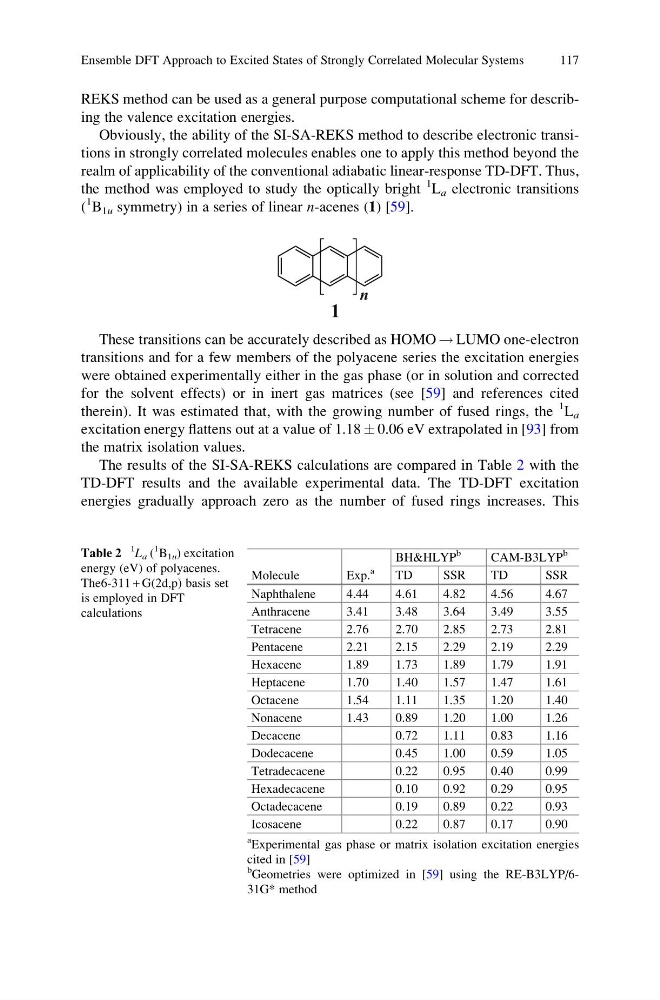
The results of the SI-SA-REKS calculations are compared in Table 2 with the
TD-DFT results and the available experimental data. The TD-DFT excitation
energies gradually approach zero as the number of fused rings increases. This
Table 2
1
L a (
1 B 1u ) excitation
energy (eV) of polyacenes.
The6-311 + G(2d,p) basis set
is employed in DFT
calculations
Molecule
Exp.
a
BH&HLYP
b
CAM-B3LYP
b
TD
SSR
TD
SSR
Naphthalene
4.44
4.61
4.82
4.56
4.67
Anthracene
3.41
3.48
3.64
3.49
3.55
Tetracene
2.76
2.70
2.85
2.73
2.81
Pentacene
2.21
2.15
2.29
2.19
2.29
Hexacene
1.89
1.73
1.89
1.79
1.91
Heptacene
1.70
1.40
1.57
1.47
1.61
Octacene
1.54
1.11
1.35
1.20
1.40
Nonacene
1.43
0.89
1.20
1.00
1.26
Decacene
0.72
1.11
0.83
1.16
Dodecacene
0.45
1.00
0.59
1.05
Tetradecacene
0.22
0.95
0.40
0.99
Hexadecacene
0.10
0.92
0.29
0.95
Octadecacene
0.19
0.89
0.22
0.93
Icosacene
0.22
0.87
0.17
0.90
a
Experimental gas phase or matrix isolation excitation energies
cited in [59]
b
Geometries were optimized in [59] using the RE-B3LYP/631G* method
Ensemble DFT Approach to Excited States of Strongly Correlated Molecular Systems
117
Obviously, the ability of the SI-SA-REKS method to describe electronic transitions in strongly correlated molecules enables one to apply this method beyond the
realm of applicability of the conventional adiabatic linear-response TD-DFT. Thus,
the method was employed to study the optically bright
1 L a electronic transitions
(
1 B 1u symmetry) in a series of linear n-acenes (1) [59].
These transitions can be accurately described as HOMO ! LUMO one-electron
transitions and for a few members of the polyacene series the excitation energies
were obtained experimentally either in the gas phase (or in solution and corrected
for the solvent effects) or in inert gas matrices (see [59] and references cited
therein). It was estimated that, with the growing number of fused rings, the
1 L a
excitation energy flattens out at a value of 1.18 Æ 0.06 eV extrapolated in [93] from
the matrix isolation values.
The results of the SI-SA-REKS calculations are compared in Table 2 with the
TD-DFT results and the available experimental data. The TD-DFT excitation
energies gradually approach zero as the number of fused rings increases. This
Table 2
1
L a (
1 B 1u ) excitation
energy (eV) of polyacenes.
The6-311 + G(2d,p) basis set
is employed in DFT
calculations
Molecule
Exp.
a
BH&HLYP
b
CAM-B3LYP
b
TD
SSR
TD
SSR
Naphthalene
4.44
4.61
4.82
4.56
4.67
Anthracene
3.41
3.48
3.64
3.49
3.55
Tetracene
2.76
2.70
2.85
2.73
2.81
Pentacene
2.21
2.15
2.29
2.19
2.29
Hexacene
1.89
1.73
1.89
1.79
1.91
Heptacene
1.70
1.40
1.57
1.47
1.61
Octacene
1.54
1.11
1.35
1.20
1.40
Nonacene
1.43
0.89
1.20
1.00
1.26
Decacene
0.72
1.11
0.83
1.16
Dodecacene
0.45
1.00
0.59
1.05
Tetradecacene
0.22
0.95
0.40
0.99
Hexadecacene
0.10
0.92
0.29
0.95
Octadecacene
0.19
0.89
0.22
0.93
Icosacene
0.22
0.87
0.17
0.90
a
Experimental gas phase or matrix isolation excitation energies
cited in [59]
b
Geometries were optimized in [59] using the RE-B3LYP/631G* method
Ensemble DFT Approach to Excited States of Strongly Correlated Molecular Systems
117