

partaking in the electronic transition [100, 102]. The SI-SA-REKS method achieves
the same effect by using the ensemble formalism.
The use of ensemble formalism based on the variational principle also turns out
to be beneficial for the description of charge transfer transitions. Linear response
methods, such as TD-DFT, experience considerable difficulties when describing
this type of electronic excitation, especially when used in connection with the
commonly available approximate density functionals [103, 104]. Although it was
not designed with these particular excitations in mind, the SI-SA-REKS method
was found to be surprisingly accurate for charge transfer excitations, even when
used in connection with the stock parameterization of the commonly available
GGA and hybrid density functionals [105].
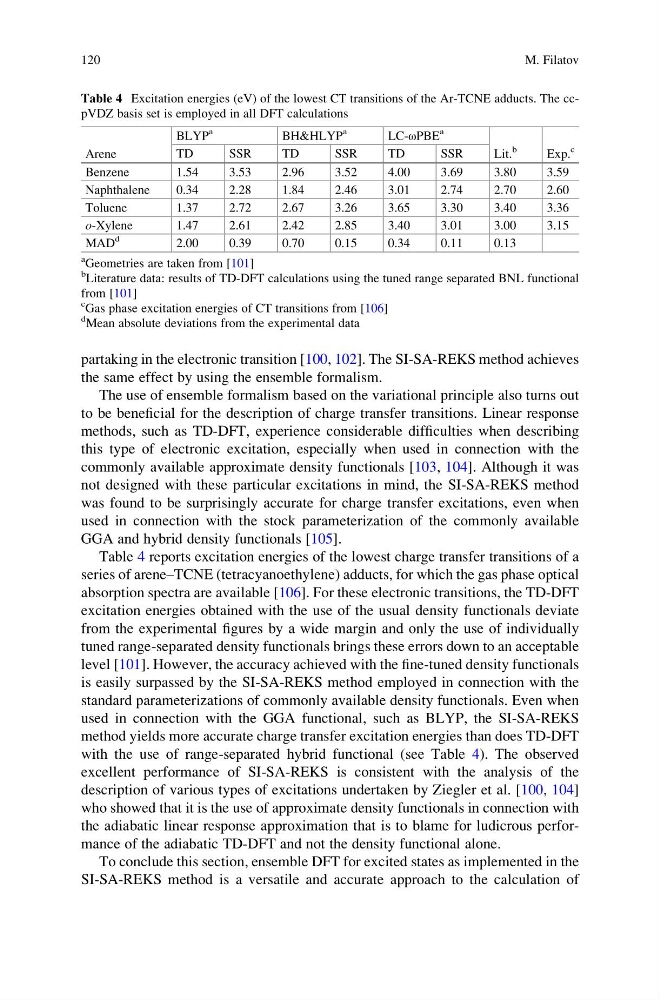
Table 4 reports excitation energies of the lowest charge transfer transitions of a
series of arene–TCNE (tetracyanoethylene) adducts, for which the gas phase optical
absorption spectra are available [106]. For these electronic transitions, the TD-DFT
excitation energies obtained with the use of the usual density functionals deviate
from the experimental figures by a wide margin and only the use of individually
tuned range-separated density functionals brings these errors down to an acceptable
level [101]. However, the accuracy achieved with the fine-tuned density functionals
is easily surpassed by the SI-SA-REKS method employed in connection with the
standard parameterizations of commonly available density functionals. Even when
used in connection with the GGA functional, such as BLYP, the SI-SA-REKS
method yields more accurate charge transfer excitation energies than does TD-DFT
with the use of range-separated hybrid functional (see Table 4). The observed
excellent performance of SI-SA-REKS is consistent with the analysis of the
description of various types of excitations undertaken by Ziegler et al. [100, 104]
who showed that it is the use of approximate density functionals in connection with
the adiabatic linear response approximation that is to blame for ludicrous performance of the adiabatic TD-DFT and not the density functional alone.
To conclude this section, ensemble DFT for excited states as implemented in the
SI-SA-REKS method is a versatile and accurate approach to the calculation of
Table 4 Excitation energies (eV) of the lowest CT transitions of the Ar-TCNE adducts. The ccpVDZ basis set is employed in all DFT calculations
Arene
BLYP
a
BH&HLYP
a
LC-ωPBE
a
Lit.
b
Exp.
c
TD
SSR
TD
SSR
TD
SSR
Benzene
1.54
3.53
2.96
3.52
4.00
3.69
3.80
3.59
Naphthalene
0.34
2.28
1.84
2.46
3.01
2.74
2.70
2.60
Toluene
1.37
2.72
2.67
3.26
3.65
3.30
3.40
3.36
o-Xylene
1.47
2.61
2.42
2.85
3.40
3.01
3.00
3.15
MAD
d
2.00
0.39
0.70
0.15
0.34
0.11
0.13
a
Geometries are taken from [101]
b
Literature data: results of TD-DFT calculations using the tuned range separated BNL functional
from [101]
c
Gas phase excitation energies of CT transitions from [106]
d
Mean absolute deviations from the experimental data
120
M. Filatov
the same effect by using the ensemble formalism.
The use of ensemble formalism based on the variational principle also turns out
to be beneficial for the description of charge transfer transitions. Linear response
methods, such as TD-DFT, experience considerable difficulties when describing
this type of electronic excitation, especially when used in connection with the
commonly available approximate density functionals [103, 104]. Although it was
not designed with these particular excitations in mind, the SI-SA-REKS method
was found to be surprisingly accurate for charge transfer excitations, even when
used in connection with the stock parameterization of the commonly available
GGA and hybrid density functionals [105].
Table 4 reports excitation energies of the lowest charge transfer transitions of a
series of arene–TCNE (tetracyanoethylene) adducts, for which the gas phase optical
absorption spectra are available [106]. For these electronic transitions, the TD-DFT
excitation energies obtained with the use of the usual density functionals deviate
from the experimental figures by a wide margin and only the use of individually
tuned range-separated density functionals brings these errors down to an acceptable
level [101]. However, the accuracy achieved with the fine-tuned density functionals
is easily surpassed by the SI-SA-REKS method employed in connection with the
standard parameterizations of commonly available density functionals. Even when
used in connection with the GGA functional, such as BLYP, the SI-SA-REKS
method yields more accurate charge transfer excitation energies than does TD-DFT
with the use of range-separated hybrid functional (see Table 4). The observed
excellent performance of SI-SA-REKS is consistent with the analysis of the
description of various types of excitations undertaken by Ziegler et al. [100, 104]
who showed that it is the use of approximate density functionals in connection with
the adiabatic linear response approximation that is to blame for ludicrous performance of the adiabatic TD-DFT and not the density functional alone.
To conclude this section, ensemble DFT for excited states as implemented in the
SI-SA-REKS method is a versatile and accurate approach to the calculation of
Table 4 Excitation energies (eV) of the lowest CT transitions of the Ar-TCNE adducts. The ccpVDZ basis set is employed in all DFT calculations
Arene
BLYP
a
BH&HLYP
a
LC-ωPBE
a
Lit.
b
Exp.
c
TD
SSR
TD
SSR
TD
SSR
Benzene
1.54
3.53
2.96
3.52
4.00
3.69
3.80
3.59
Naphthalene
0.34
2.28
1.84
2.46
3.01
2.74
2.70
2.60
Toluene
1.37
2.72
2.67
3.26
3.65
3.30
3.40
3.36
o-Xylene
1.47
2.61
2.42
2.85
3.40
3.01
3.00
3.15
MAD
d
2.00
0.39
0.70
0.15
0.34
0.11
0.13
a
Geometries are taken from [101]
b
Literature data: results of TD-DFT calculations using the tuned range separated BNL functional
from [101]
c
Gas phase excitation energies of CT transitions from [106]
d
Mean absolute deviations from the experimental data
120
M. Filatov