

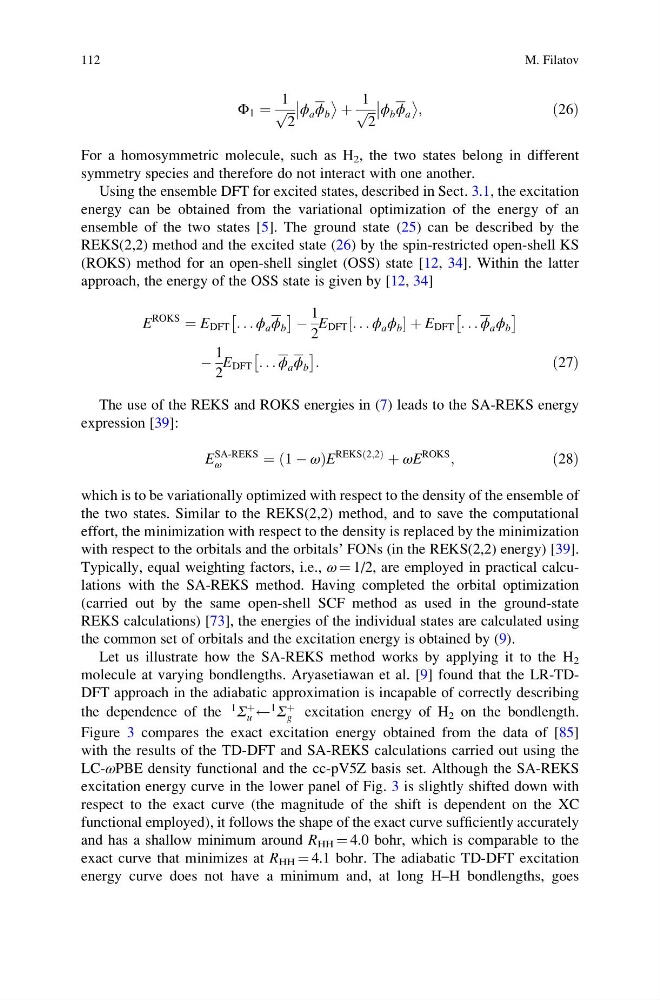
Φ 1 ¼
1
ffiffi ffi
2
p ϕ a ϕ b
þ
1
ffiffi ffi
2
p ϕ b ϕ a
;
ð26Þ
For a homosymmetric molecule, such as H 2 , the two states belong in different
symmetry species and therefore do not interact with one another.
Using the ensemble DFT for excited states, described in Sect. 3.1, the excitation
energy can be obtained from the variational optimization of the energy of an
ensemble of the two states [5]. The ground state (25) can be described by the
REKS(2,2) method and the excited state (26) by the spin-restricted open-shell KS
(ROKS) method for an open-shell singlet (OSS) state [12, 34]. Within the latter
approach, the energy of the OSS state is given by [12, 34]
E
ROKS
¼ E DFT . . . ϕ a ϕ b
Â
à 1
2
E DFT . . . ϕ a ϕ b
½
þE DFT . . . ϕ a ϕ b
Â
Ã
À
1
2
E DFT . . . ϕ a ϕ b
Â
à :
ð27Þ
The use of the REKS and ROKS energies in (7) leads to the SA-REKS energy
expression [39]:
E
SA-REKS
ω
¼ 1 À ω
ð
ÞE
REKS 2;2
ð Þ
þ ωE
ROKS
;
ð28Þ
which is to be variationally optimized with respect to the density of the ensemble of
the two states. Similar to the REKS(2,2) method, and to save the computational
effort, the minimization with respect to the density is replaced by the minimization
with respect to the orbitals and the orbitals’ FONs (in the REKS(2,2) energy) [39].
Typically, equal weighting factors, i.e., ω ¼ 1/2, are employed in practical calculations with the SA-REKS method. Having completed the orbital optimization
(carried out by the same open-shell SCF method as used in the ground-state
REKS calculations) [73], the energies of the individual states are calculated using
the common set of orbitals and the excitation energy is obtained by (9).
Let us illustrate how the SA-REKS method works by applying it to the H 2
molecule at varying bondlengths. Aryasetiawan et al. [9] found that the LR-TDDFT approach in the adiabatic approximation is incapable of correctly describing
the dependence of the
1
Σ
þ
u
1
Σ
þ
g excitation energy of H 2 on the bondlength.
Figure 3 compares the exact excitation energy obtained from the data of [85]
with the results of the TD-DFT and SA-REKS calculations carried out using the
LC-ωPBE density functional and the cc-pV5Z basis set. Although the SA-REKS
excitation energy curve in the lower panel of Fig. 3 is slightly shifted down with
respect to the exact curve (the magnitude of the shift is dependent on the XC
functional employed), it follows the shape of the exact curve sufficiently accurately
and has a shallow minimum around R HH ¼ 4.0 bohr, which is comparable to the
exact curve that minimizes at R HH ¼ 4.1 bohr. The adiabatic TD-DFT excitation
energy curve does not have a minimum and, at long H–H bondlengths, goes
112
M. Filatov
1
ffiffi ffi
2
p ϕ a ϕ b
þ
1
ffiffi ffi
2
p ϕ b ϕ a
;
ð26Þ
For a homosymmetric molecule, such as H 2 , the two states belong in different
symmetry species and therefore do not interact with one another.
Using the ensemble DFT for excited states, described in Sect. 3.1, the excitation
energy can be obtained from the variational optimization of the energy of an
ensemble of the two states [5]. The ground state (25) can be described by the
REKS(2,2) method and the excited state (26) by the spin-restricted open-shell KS
(ROKS) method for an open-shell singlet (OSS) state [12, 34]. Within the latter
approach, the energy of the OSS state is given by [12, 34]
E
ROKS
¼ E DFT . . . ϕ a ϕ b
Â
à 1
2
E DFT . . . ϕ a ϕ b
½
þE DFT . . . ϕ a ϕ b
Â
Ã
À
1
2
E DFT . . . ϕ a ϕ b
Â
à :
ð27Þ
The use of the REKS and ROKS energies in (7) leads to the SA-REKS energy
expression [39]:
E
SA-REKS
ω
¼ 1 À ω
ð
ÞE
REKS 2;2
ð Þ
þ ωE
ROKS
;
ð28Þ
which is to be variationally optimized with respect to the density of the ensemble of
the two states. Similar to the REKS(2,2) method, and to save the computational
effort, the minimization with respect to the density is replaced by the minimization
with respect to the orbitals and the orbitals’ FONs (in the REKS(2,2) energy) [39].
Typically, equal weighting factors, i.e., ω ¼ 1/2, are employed in practical calculations with the SA-REKS method. Having completed the orbital optimization
(carried out by the same open-shell SCF method as used in the ground-state
REKS calculations) [73], the energies of the individual states are calculated using
the common set of orbitals and the excitation energy is obtained by (9).
Let us illustrate how the SA-REKS method works by applying it to the H 2
molecule at varying bondlengths. Aryasetiawan et al. [9] found that the LR-TDDFT approach in the adiabatic approximation is incapable of correctly describing
the dependence of the
1
Σ
þ
u
1
Σ
þ
g excitation energy of H 2 on the bondlength.
Figure 3 compares the exact excitation energy obtained from the data of [85]
with the results of the TD-DFT and SA-REKS calculations carried out using the
LC-ωPBE density functional and the cc-pV5Z basis set. Although the SA-REKS
excitation energy curve in the lower panel of Fig. 3 is slightly shifted down with
respect to the exact curve (the magnitude of the shift is dependent on the XC
functional employed), it follows the shape of the exact curve sufficiently accurately
and has a shallow minimum around R HH ¼ 4.0 bohr, which is comparable to the
exact curve that minimizes at R HH ¼ 4.1 bohr. The adiabatic TD-DFT excitation
energy curve does not have a minimum and, at long H–H bondlengths, goes
112
M. Filatov