

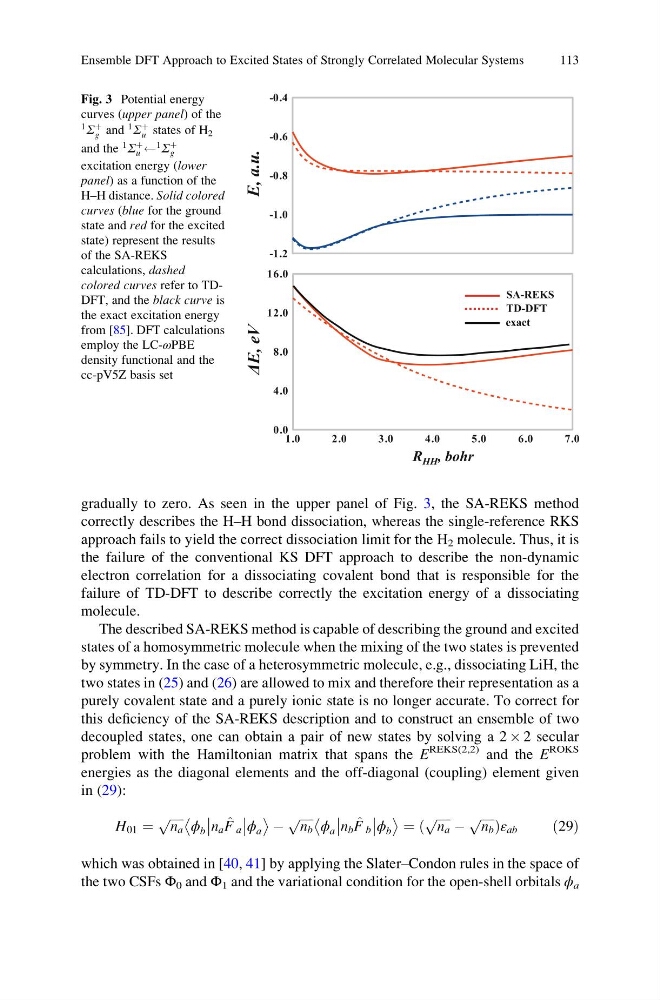
gradually to zero. As seen in the upper panel of Fig. 3, the SA-REKS method
correctly describes the H–H bond dissociation, whereas the single-reference RKS
approach fails to yield the correct dissociation limit for the H 2 molecule. Thus, it is
the failure of the conventional KS DFT approach to describe the non-dynamic
electron correlation for a dissociating covalent bond that is responsible for the
failure of TD-DFT to describe correctly the excitation energy of a dissociating
molecule.
The described SA-REKS method is capable of describing the ground and excited
states of a homosymmetric molecule when the mixing of the two states is prevented
by symmetry. In the case of a heterosymmetric molecule, e.g., dissociating LiH, the
two states in (25) and (26) are allowed to mix and therefore their representation as a
purely covalent state and a purely ionic state is no longer accurate. To correct for
this deficiency of the SA-REKS description and to construct an ensemble of two
decoupled states, one can obtain a pair of new states by solving a 2 Â 2 secular
problem with the Hamiltonian matrix that spans the E
REKS(2,2) and the E
ROKS
energies as the diagonal elements and the off-diagonal (coupling) element given
in (29):
H 01 ¼
ffiffiffiffi ffi
n a
p ϕ b
n a ^
F a
ϕ a
À
ffiffiffiffi ffi
n b
p ϕ a
n b ^
F b
ϕ b
¼
ffiffiffiffi ffi
n a
p À
ffiffiffiffi ffi
n b
p
ð
Þ ε ab
ð29Þ
which was obtained in [40, 41] by applying the Slater–Condon rules in the space of
the two CSFs Φ 0 and Φ 1 and the variational condition for the open-shell orbitals ϕ a
Fig. 3 Potential energy
curves (upper panel) of the
1 Σ
þ
g and
1 Σ
þ
u states of H 2
and the
1 Σ
þ
u
1 Σ
þ
g
excitation energy (lower
panel) as a function of the
H–H distance. Solid colored
curves (blue for the ground
state and red for the excited
state) represent the results
of the SA-REKS
calculations, dashed
colored curves refer to TDDFT, and the black curve is
the exact excitation energy
from [85]. DFT calculations
employ the LC-ωPBE
density functional and the
cc-pV5Z basis set
Ensemble DFT Approach to Excited States of Strongly Correlated Molecular Systems
113
correctly describes the H–H bond dissociation, whereas the single-reference RKS
approach fails to yield the correct dissociation limit for the H 2 molecule. Thus, it is
the failure of the conventional KS DFT approach to describe the non-dynamic
electron correlation for a dissociating covalent bond that is responsible for the
failure of TD-DFT to describe correctly the excitation energy of a dissociating
molecule.
The described SA-REKS method is capable of describing the ground and excited
states of a homosymmetric molecule when the mixing of the two states is prevented
by symmetry. In the case of a heterosymmetric molecule, e.g., dissociating LiH, the
two states in (25) and (26) are allowed to mix and therefore their representation as a
purely covalent state and a purely ionic state is no longer accurate. To correct for
this deficiency of the SA-REKS description and to construct an ensemble of two
decoupled states, one can obtain a pair of new states by solving a 2 Â 2 secular
problem with the Hamiltonian matrix that spans the E
REKS(2,2) and the E
ROKS
energies as the diagonal elements and the off-diagonal (coupling) element given
in (29):
H 01 ¼
ffiffiffiffi ffi
n a
p ϕ b
n a ^
F a
ϕ a
À
ffiffiffiffi ffi
n b
p ϕ a
n b ^
F b
ϕ b
¼
ffiffiffiffi ffi
n a
p À
ffiffiffiffi ffi
n b
p
ð
Þ ε ab
ð29Þ
which was obtained in [40, 41] by applying the Slater–Condon rules in the space of
the two CSFs Φ 0 and Φ 1 and the variational condition for the open-shell orbitals ϕ a
Fig. 3 Potential energy
curves (upper panel) of the
1 Σ
þ
g and
1 Σ
þ
u states of H 2
and the
1 Σ
þ
u
1 Σ
þ
g
excitation energy (lower
panel) as a function of the
H–H distance. Solid colored
curves (blue for the ground
state and red for the excited
state) represent the results
of the SA-REKS
calculations, dashed
colored curves refer to TDDFT, and the black curve is
the exact excitation energy
from [85]. DFT calculations
employ the LC-ωPBE
density functional and the
cc-pV5Z basis set
Ensemble DFT Approach to Excited States of Strongly Correlated Molecular Systems
113