

between the configurations, although the BS-UKS curve deviates stronger from the
target MRCI PES and underestimates the reaction barrier height. The FONs of the
frontier orbitals (only the b 2u FON shown in Fig. 2) obtained by the REKS method
are in a good agreement with the exact ensemble KS values, whereas the BS-UKS
occupations (the natural orbital’s occupation numbers are shown in lieu of FONs)
deviate strongly from the exact ones, suggesting that BS-UKS overestimates the
effect of the non-dynamic correlation. Furthermore, BS-UKS displays an abrupt
onset of the non-dynamic correlation (after ca. R ¼ 2.75 bohr), whereas the REKS
method yields a smooth transition between the PS-VR and E-VR regimes and a
more accurate description of the reaction PES profile.
The comparison vis- a-vis the exact ensemble KS results demonstrates the
validity of the approximations made in the REKS working equations. Besides the
H 2 + H 2 system, the REKS method was applied to study bond-breaking/bondformation reactions in several chemical systems as well as the electronic structure
of biradicals, magnetic coupling in metal complexes and organic charge transfer
crystals. The reader is advised to inspect the original publications [37, 38, 42–53,
56, 57] for more examples of the method performance.
3.2 REKS Method for Excited States: SA-REKS and
SI-SA-REKS
Let us consider a model system with two strongly correlated electrons in two
orbitals, such as the H 2 molecule with the bond stretched beyond the Coulson–
Fischer point [84]. Near the equilibrium bondlength, the electronic structure of H 2
is dominated by a single configuration 1σ g 1σ g
and the doubly excited configuration 1σ u 1σ u
j
ilies high in energy (1σ g is the bonding MO and 1σ u the anti-bonding
MO). When the bond is stretched beyond the Coulson–Fischer point, the energy gap
between the two electronic configurations narrows to a limit that allows for an
efficient mixing of the configurations and the strong non-dynamic electron correlation ensues. In the minimal basis of the two orbitals (the bonding 1σ g MO denoted
to ϕ a and the anti-bonding 1σ u to ϕ b ), the ground-state wavefunction of stretched H 2
can be represented by a two-configurational wavefunction:
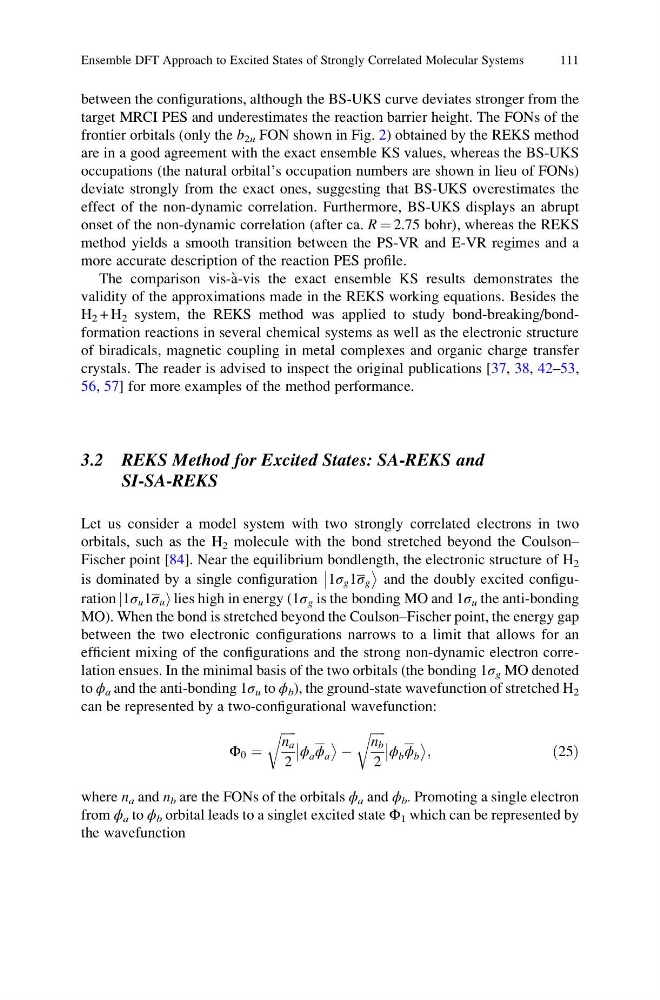
Φ 0 ¼
ffiffiffiffi ffi
n a
2
r
ϕ a ϕ a
À
ffiffiffiffi ffi
n b
2
r
ϕ b ϕ b
;
ð25Þ
where n a and n b are the FONs of the orbitals ϕ a and ϕ b . Promoting a single electron
from ϕ a to ϕ b orbital leads to a singlet excited state Φ 1 which can be represented by
the wavefunction
Ensemble DFT Approach to Excited States of Strongly Correlated Molecular Systems
111
target MRCI PES and underestimates the reaction barrier height. The FONs of the
frontier orbitals (only the b 2u FON shown in Fig. 2) obtained by the REKS method
are in a good agreement with the exact ensemble KS values, whereas the BS-UKS
occupations (the natural orbital’s occupation numbers are shown in lieu of FONs)
deviate strongly from the exact ones, suggesting that BS-UKS overestimates the
effect of the non-dynamic correlation. Furthermore, BS-UKS displays an abrupt
onset of the non-dynamic correlation (after ca. R ¼ 2.75 bohr), whereas the REKS
method yields a smooth transition between the PS-VR and E-VR regimes and a
more accurate description of the reaction PES profile.
The comparison vis- a-vis the exact ensemble KS results demonstrates the
validity of the approximations made in the REKS working equations. Besides the
H 2 + H 2 system, the REKS method was applied to study bond-breaking/bondformation reactions in several chemical systems as well as the electronic structure
of biradicals, magnetic coupling in metal complexes and organic charge transfer
crystals. The reader is advised to inspect the original publications [37, 38, 42–53,
56, 57] for more examples of the method performance.
3.2 REKS Method for Excited States: SA-REKS and
SI-SA-REKS
Let us consider a model system with two strongly correlated electrons in two
orbitals, such as the H 2 molecule with the bond stretched beyond the Coulson–
Fischer point [84]. Near the equilibrium bondlength, the electronic structure of H 2
is dominated by a single configuration 1σ g 1σ g
and the doubly excited configuration 1σ u 1σ u
j
ilies high in energy (1σ g is the bonding MO and 1σ u the anti-bonding
MO). When the bond is stretched beyond the Coulson–Fischer point, the energy gap
between the two electronic configurations narrows to a limit that allows for an
efficient mixing of the configurations and the strong non-dynamic electron correlation ensues. In the minimal basis of the two orbitals (the bonding 1σ g MO denoted
to ϕ a and the anti-bonding 1σ u to ϕ b ), the ground-state wavefunction of stretched H 2
can be represented by a two-configurational wavefunction:
Φ 0 ¼
ffiffiffiffi ffi
n a
2
r
ϕ a ϕ a
À
ffiffiffiffi ffi
n b
2
r
ϕ b ϕ b
;
ð25Þ
where n a and n b are the FONs of the orbitals ϕ a and ϕ b . Promoting a single electron
from ϕ a to ϕ b orbital leads to a singlet excited state Φ 1 which can be represented by
the wavefunction
Ensemble DFT Approach to Excited States of Strongly Correlated Molecular Systems
111